Michael J. Fox

  • Class of 1984 (1982)

    Class of 1984 (1982)

    (In French, On Cable TV, November 2020) Taking the Bad Seed cliché up a few notches, Class of 1984 has a teacher running afoul of a few teenage sociopaths in a high school seemingly jaded to a heightened level of violence. (As the date of production suggests, it’s meant as a near-future satire, but it feels like depressing reality forty years later.) Perry King stars as the meek music teacher, with some assistance from Timothy Van Patten as the irremediable antagonist, Roddy MacDowall as an even meeker teacher and none other than a very, very young Michael J. Fox as a bullied student. The film is very cleanly structured around the lines of a gritty 1970s revenge fantasy, with the teacher getting an increasing amount of aggravation and violence, and then bodies eventually piling up as no one seems willing to acknowledge the evil of the teenage antagonists. As manipulative as it may feel, Class of 1984 is executed with a fair amount of skill—it’s violently over the top, but I’d be lying if I didn’t say that I got a little spark of satisfaction at the very final and predictable death of the infuriating villain. Otherwise, it’s a serviceable 1980s thriller, a cut above most contemporary slashers but not great cinema by any means. At best, you can tie it to the growing anxieties about the Echo teenagers coming of age in the early 1980s and the horrors to come in terms of high school violence. But don’t read too much into it: it’s really an excuse to see violent provocation being answered by even more violent retribution. What else could we expect from exploitation cinema?
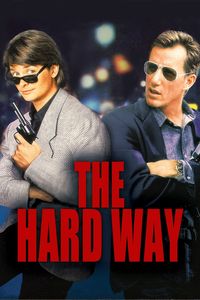
  • The Hard Way (1991)

    The Hard Way (1991)

    (In French, On Cable TV, September 2020) Let’s face it: building a buddy cop movie around a hardened non-nonsense police officer and a frivolous Hollywood actor trying to gather inspiration is an evergreen premise. It’s good to bring in both the gritty policework and the innate humour of an outsider, along with a pinch of Hollywood satire. (It was such a solid premise, in fact, that it’s shared with that other 1991 movie, Into the Sun, about which the less said, the better.) Being able to claim John Badham as a director is a further coup, and having no less than James Woods as the hard-boiled cop and Michael J. Fox as the Hollywood celebrity is just icing on the cake. With Stephen Lang as the serial killer and Annabella Sciorra as the love interest (along with briefer roles for an ensemble as diverse as Delroy Lindo, Luis Guzmán, L. L. Cool J, Christina Ricci and Lewis Black), everything is there for a competent Hollywood film. The Hard Way more or less meets those expectations, with a few issues along the way. Woods and Fox play each other off quite well, even through the rote sequences of early distrust and gradual bonding. The film isn’t so successful as blending the menace of its villain (a bit overdone for a comedy) and feels creepy in its depiction of a cop regularly practising police brutality, but scores a few hits in describing how a Hollywood megastar can have a few problems “going undercover” when everyone knows their name. The metafictional material doesn’t stop there, what with specific problems when the investigation movies inside a movie theatre that happens to be playing the movie in which the actor stars, and a rather elegant envoi that blurs the lines between the film’s reality and the movie it inspired. Much of The Hard Way is rather predictable, but that’s not a bad thing considering the practised skill through which it’s executed. Less interesting are the three or four climaxes that cap the picture—two would have been enough, three is excessive and four gets ridiculous, even though the best and most interesting sequence is kept in reserve for the final climax. The Hard Way isn’t some kind of undiscovered gem or early 1990s classic, but it’s good enough and slick enough to please even despite its flaws.

  • Casualties of War (1989)

    Casualties of War (1989)

    (In French, On Cable TV, August 2019) You can certainly argue that Casualties of War seldom gets as much love as other similar movies. You can even offer a few perfectly reasonable explanations for it: Coming as it did right after Platoon (1986) and Full Metal Jacket (1987), perhaps it couldn’t measure up to those films. Perhaps having Michael J. Fox and Sean Penn in the lead roles made it more about the actors (especially Fox, then and now better known for comedic roles) than the substance. Perhaps Brian de Palma was seen as working too far outside his element. Perhaps the subject matter of war crimes as committed by American troops was harder to take than even an unflinching description of combat hell. No matter the reason, Casualties of War isn’t as likely to be mentioned as a great Vietnam movie. (Although it is receiving a growing critical reassessment.) Now, I’m not going to be a Tarantinoesque contrarian and claim that it’s a hidden gem, but it’s probably worth a look. De Palma keeps thing humming along, Penn makes for a fierce antagonist, Fox doesn’t do too badly as a baby-faced innocent confronted with war atrocities, and the subject matter is indeed more daring than many other takes on Vietnam. It may not be the most entertaining, most evocative, most credible Vietnam film, but it comes in at a sufficiently different angle to be worth a look as a complement, not necessarily as an inferior imitation.

  • The Secret of My Success (1987)

    The Secret of My Success (1987)

    (In French, On TV, July 2019) In between Wall Street, Working Girl, Baby Boom and The Secret of My Success, 1987 (ish) was quite a year for Hollywood taking on the Manhattan corporate career path. This time around, we get Michael J. Fox as a corn-fed Kansas graduate heading to the Big Apple with the conviction of impending success and big bucks. Things soon take a turn for the worse, and he gets to barely eke a living out of a mailroom job. But you can’t keep an ambitious lad down, and before long he’s reading inter-office mail not addressed to him, taking over an empty office and making executive choices for his new company. Of course, I’m skipping over the whole sleeping-with-the-president’s-wife (who happens to be his step-aunt—it’s that kind of movie) thing. Or should I? Because one of The Secret of My Success’s most repellent aspects is how it makes a big deal of accusing its female lead of sleeping around while cheering the male protagonist’s escapades with lengthy sustained replays of Yello’s “Oh Yeah.” This being a comedy, hard work and perseverance take a back seat to Fox’s admittedly considerable boyish charm as he romances the ladies and schmoozes the bankers required for his ultimate success. Caricatures of corrupt business executives end up making the film feel like it’s aimed at kids despite the considerable sexual material. The result isn’t just hard to appreciate as a coherent whole as it zooms between get-rich glibness, sex farce and half-hearted romance: it’s a bit of a repellent mess when taken in as a whole (the protagonist’s lack of ambition beyond being rich also reflects poorly on its 1987 pre-crash nature). Of course, I’m now old enough to think that Helen Slater (then 24) isn’t nearly as attractive as Margaret Whitton (then 38), but I suspect that much of this has to do with each character’s hairstyle. Anyway: the point being that The Secret of My Success is the kind of film that is badly steeped into its time and not really in a charming way—more in a vaguely horrifying fashion that lays stark the moral degeneracy of the time as it blithely does not question its worst aspects. That’s quite a bit to lay down at the feet of what’s supposed to be a quirky breezy comedy but if thirty years’ worth of hindsight show, it’s that The Secret of My Success is far more corrupt than it realized at the time.

  • Doc Hollywood (1991)

    Doc Hollywood (1991)

    (In French, on TV, March 2019) You don’t watch Doc Hollywood for deep insights in the human condition. You don’t watch it for the twists and turns of the plot. You don’t watch it for a ferocious critique of modern society. You watch it because it has prime-era Michael J. Fox as an L.A. doctor marooned in a small Midwestern town, and all of the expected hijinks that will ensue. You watch it because it’s an intensely familiar premise executed according to the best practices of the breezy and fun formula. You watch it because you can see the entire character arc unfolding from the first few minutes, and even because the “rebirth” symbolism is so on-the-nose. You watch it to catch early glimpses of Woody Harrelson and Bridget Fonda. You watch it because Fox can’t be anything but sympathetic, and because Julie Warner is very nice as the love interest. You watch it because some have compared the film to Cars, but it’s more fun comparing it to U-Turn. You watch it because it’s comforting in its predictability both at the micro and macro level (who would have thought that a film set in a small city would feature a town fair sequence?!)  You watch it to decode the hypocrisy in having Los Angeles-based filmmakers try their hand at a film praising small-town living. But, perhaps more than anything else, you watch Doc Hollywood because it’s what Hollywood prescribes best—a small, unassuming, entirely expected comedy that delivers what it’s meant to do and leaves the heavy lifting to others.

  • Teen Wolf (1985)

    Teen Wolf (1985)

    (On Cable TV, February 2019) I don’t think anyone ever expected much from Teen Wolf, whether during its production, initial release or long afterlife since then. But sometimes you just need a spark to make it work, and Michael J. Fox was clearly the ingredient needed in this sometimes silly but rarely dull teen horror comedy take on werewolf movies. Fortunately, the script is not bad: clearly written with some awareness of the genre, the film zig-zags a few familiar tropes and has at least three mild surprises (the father knows; the secret comes out; the crush doesn’t want him) contradicting where we think the story is going, and earning a few laughs along the way at some blatant revelations. The way it fully engages with its premise is almost refreshing even now, and I suspect that much of the film is simply about seeing a werewolf playing high-school basketball. The “Teen” of the title is equally important as Teen Wolf seems very comfortable in the halls of an American High School. There are quite a few teenage anxieties hidden in its premise (what if your alter ego was more popular than the real you?) even despite a plot that’s more straightforward than it appears. But then again Teen Wolf is far better in the fun and games of its premise than it is at the narrative heavy lifting: even if it gets bogged into the mechanics of its climactic basketball game, it’s lighthearted most of the time, and unafraid to be silly even when it doesn’t have to be.

  • The Frighteners (1996)

    The Frighteners (1996)

    (Second Viewing, In French, On Cable TV, October 2017) When I say I’ve been a Peter Jackson fan from way before The Lord of the Rings trilogy, I specifically refer to watching The Frighteners in the late nineties, loaned on VHS from a friend who had been very impressed by the result. Twenty years later, the film has aged a bit (the early-digital special effects look particularly dated, although they’re still used very effectively) but it remains a solid horror/comedy with a sometimes-daring mythology, effective character moments and a dynamic performance by writer/director Jackson. The film does take chances in its treatment of the afterlife, and especially in the way it goes for comedy in the middle of death. But the tonal blend works most of the time, and lead actor Michael J. Fox is well-suited to the protagonist’s role. (Meanwhile, Trini Alvarado is so likable that it’s a wonder that her filmography since then isn’t longer.)  Shot in New Zealand but made to look American, The Frighteners remains a bit of an under-appreciated gem today: not unknown, but not often mentioned. It’s worth a look for those who have never seen it, and a re-watch for those who haven’t seen it in years.