Michael Keaton

  • Birdman or (The Unexpected Virtue of Ignorance) (2014)

    Birdman or (The Unexpected Virtue of Ignorance) (2014)

    (Video on Demand, March 2015)  Once in a while, it’s good to sip a pure dose of concentrated moviemaking skill.  Something like Birdman, expertly directed, featuring top-ranked actors at their best, delving into weighty themes and doing it with a strong sense of style.  A comic drama about a washed-up actor in the moments leading up to his Broadway debut as a writer/producer/performer, Birdman gets inspiration from the world of theater to deliver a film presented as one uninterrupted sequence, the camera gliding from one character to another, skipping forward in time and even presenting fantastical visions alongside its realism.  It’s a giddiness-inducing piece of cinema, from the perfectly-cast Michael Keaton (playing a former superhero actor) to an equally-capable foil played by Edward Norton (making the most of a reputation as an abrasive method actor), with an unsettling drum-based score, carefully staged performances, a bit of magical realism, barbed pokes at Hollywood trends and enough laughs to make us forget that this may be a very sad story.  It’s invigorating, hilarious, poignant, impressive and accessible at once.  The inconclusiveness of the conclusion isn’t as annoying as it could have been, largely because the film delivers so many pleasures along the way.  Easily one of the most striking films of 2014, Birdman earned its various Oscar accolades: writer/director Alejandro González Iñárritu certainly knows what he’s doing, and can do it in ample style.
  • Robocop (2014)

    Robocop (2014)

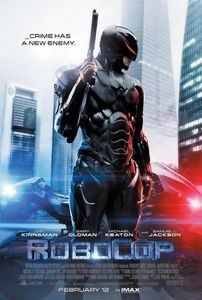
    (On Cable TV, February 2015) I haven’t seen the original 1987 Robocop in at least two decades and wasn’t a big fan even then (I’ve never been fond of grotesque ultra-violence), so this remake doesn’t offend me on any level other than a basic exasperation at Hollywood’s insistence in pilfering existing concepts rather than try to come up with something new.  It turns out that while this remake doesn’t quite make a case for existing, it does tackle a few ambitious themes, is competently directed and doesn’t feel like an outrage.  The basic premise remains the same, as a severely-wounded policeman is remade as a cyborg and has to face dangerous criminals at a time where corruption is institutionalized.  This Robocop clearly exists in an environment where dubious moral judgements are made by corporate executives, where automated force projection is seen as desirable and where the lines between man and machine is becoming blurred on its own.  As a result, the film touches upon issues of political manipulation and free will that weren’t strictly necessary for an action film of this kind.  (It also features a hair-raising scene of pure body horror that goes beyond the limits of its PG-13 rating)  Left untouched is the idea that police work isn’t necessarily all about well-informed deadly firepower, but I suppose that something has to be left for the inevitable sequel.  Joel Kinnaman isn’t much of a presence in the titular role, but Michael Keaton is interesting as an affably evil CEO, while Gary Oldman offers a bit of humanity as a low-key scientist trying to balance curiosity with ethics.  Jay Baruchel and Samuel L. Jackson also have smaller roles that capitalize on their core persona while stretching them a little bit.  Still, the star here should be director Jose Padilha, suffering under Hollywood constraints to deliver a dynamic direction while touching upon quite a bit of thematic content.  If the film has a flaw, it’s that the villains are a bit dull, and the ending somehow fails to cohere and bring everything together: it feels more like a few things thrown together for the sake of resolution and a bit of robot-on-robot combat.  All told, though, it’s a serviceable remake, a bit better than it most likely could have been in other hands.  Make no mistake, though: People are still going to remember the original far more readily than this remake.

  • Need for Speed (2014)

    Need for Speed (2014)

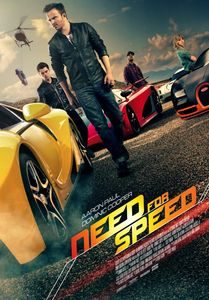
    (On Cable TV, February 2015)  I’m not much of a car guy, but I will watch all car movies.  This being said, I’m left nonplussed by Need for Speed, and the way it doesn’t do much with everything it has at its disposal.  You can see some effort put in the film’s props, from exotic cars to practical stunts to bits and pieces of interest thrown in the mix.  And yet, once you take the entire film in, it just becomes an entirely average action film with few distinguishing features.  The film self-congratulates itself on being a car guy’s movie, but fails to draw in anyone who can’t be impressed by the rare cars on display.  Aaron Paul is almost entirely bland as the protagonist, but Michael Keaton is surprisingly hilarious as an off-the-wall millionaire sponsoring an illegal prestige race and having a blast from within his command centre.  The structure of the film is a bit of a mess with an overlong prologue that should have been handled in flashbacks; it doesn’t help that the film struggles with dull characters and a plot with numerous leaps of logic.  There is, simply put, very little fun in Need for Speed, and that (despite attempts to resist comparing) is really what makes it so inferior to the Fast and Furious series.  Somehow, it feels even worse to see so much effort squandered on-screen in the service on nothing much more than a forgettable attempt at a B-movie.  

  • Mr. Mom (1983)

    Mr. Mom (1983)

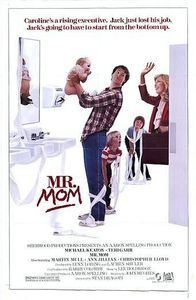
    (On Cable TV, October 2012) As Mr. Mom nearly celebrates its thirtieth anniversary, it’s best to consider it as a film of its time, when it was easier to get laughs from the inversion of stereotypical gender roles.  A father staying home to take care of the kids while his wife works a professional job?  Hi-la-rious, with a large helping of male anxiety as side-dish.  Social conventions have evolved a bit since then, thankfully, but that doesn’t mean the film hasn’t aged well.  Sure, many of the pop-culture gags (or musical cues) are now nigh-incomprehensible to younger audiences, the pacing feels slow at times but John Hugues’ script exists in a nice reality worth visiting.  Compared to more recent parenthood comedies, Mr. Mom doesn’t indulge in grossness or offensiveness: it’s pleasant enough, and has enough material for stars Michael Keaton and Teri Garr to shine through.  There are a smattering of clever lines (“220, 221 –whatever it takes”) and a few good moments: The comedy hits its stride mid-way through as Keaton’s character reaches an accommodation with his parenthood duties, first badly and then more maturely.  The soap-opera-inspired sequence is hilarious, even though it’s a bit of a departure from the tone of the rest of the film.  While the film’s predictability and gentleness may not amount to nothing more than an entertaining time-waster, Mr. Mom still works at what it tries to do, and offers a window back to early-eighties attitudes.

  • The Other Guys (2010)

    The Other Guys (2010)

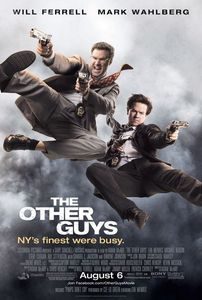
    (In theaters, August 2010) I don’t usually enjoy Will Ferrell’s brand of semi-retarded adolescent-grown-old comedy, so my expectations going into The Other Guys were as low as they could be.  That explains my surprise at this generally successful buddy-movie cop comedy.  Of course, everything will look great after the disaster that was Cop Out earlier in 2010; still, The Other Guys has a lot of fun cataloguing, tweaking and subverting an entire list of action movie clichés.  It starts with a treat of a cameo, as Dwayne Johnson and Samuel L. Jackson play bigger-than-life parodies of the action-movie cops we’re used to see on-screen.  Then it’s back to “the other guys” who fill the paperwork and do the actual investigation that goes on behind the usual action sequences: Will Ferrell as a nebbish cop with a wild past and normally-staid Mark Wahlberg as a competent policeman held back by a mistake.  The film comes with half a dozen of respectable action sequences, and a steady stream of hilarious moments.  Of course, it doesn’t always work: The danger is subverting conventions that exist given their storytelling power is that the subversion often robs the film of its story. At times, The Other Guys is too scattered and less satisfying than it should have been.  Another problem is that the material is so broad that it’s often uncontrolled: a number of scenes run too long and feel too dramatic in the middle of so much silliness.  (The credits, for instance, wouldn’t feel out of place in a Michael Moore film.) Those tonal problems can be annoying:  While the film generally takes place in a recognizable reality, it also occasionally slips up and spends a few moments in a far more fantastical Simpsonesque universe, and the shifts between both tones only reminds us of realism’s dullness.  But the advantages of such a scatter-shot approach are that sooner or later, another good moment will come along to make everyone forget about the latest dull sequence.  A number of eccentric characters all get their moment in the spotlight (few more so than Michael Keaton’s father-figure captain or Eva Mendes as a supposedly-plain wife), much as a few standout sequences really pop, such as a bullet-time sequence of wild debauchery tableaux, continued abuse of the protagonist’s poor Prius and a purely indulgent slow-motion boardroom shootout.  The Other Guys isn’t focused and runs out of laughs toward the end, but bits of it are clever and its overall impact is surprisingly charming.

  • Post Grad (2009)

    Post Grad (2009)

    (In theatres, August 2009): How appropriate that a film about a confused young woman should be so conflicted about its own intentions.  A limp mix of drama, comedy and romance, Post Grad struggles with an unremarkable protagonist, an episodic structure, dull scenes and intermittent comic wit.  Alexis Bledel never engages as an apparently-perfect protagonist who still can’t get a job: her lacks of distinctive skills make for a bland lead that never earns any sympathy.  (It gets worse once we realize that this supposedly-smart woman with editorial ambitions never once considers moving to where the action is –New York- even when Columbia beckons another character.)  The script isn’t much better, mind you: Oscillating between wild comedy and family drama, Post Grad never seems to know what to do next: the dramatic threads are all underdeveloped, events happen without character intervention, and the whole thing soon feels like a slog.  The highlights are few and minor: Michael Keaton is a refreshing presence as a doofus dad, and the film makes a surprising amount of comic mileage out of a flattened cat.  One can only imagine the screenwriting process that led to such a scattered result: Was it a wild comedy toned down to a more general tone, or a hum-drum drama punched up with a few zanier moments?  We may never know, especially since it’s hard to imagine someone re-watching Post Grad to hear a director’s commentary.

  • Batman (1989)

    Batman (1989)

    (Second viewing, on DVD, June 2009): With the critical and commercial success of Christopher Nolan’s Batman Begins and The Dark Knight, it’s becoming easier to forget about Tim Burton’s reinvention of the character, before it slid once again in franchise-killing high camp during the Joel Schumacher years. And that’s a shame, because despite some increasingly dated aspects, Batman still keeps an operatic grandeur that resonates even today. The story is thin and eighties-fashion still peeks through the self-conscious blend of historical references, but the entire film remains intriguing. Health Ledger may have taken over the Joker’s look, but Jack Nicholson’s take on the character remains magnetic. Only an underwhelming finale falters visibly: While everyone remembers the Batman/Joker showdown in the streets of Gotham, fewer will recall the following sequence taking place in a cathedral. Two decades after the film’s release, the special edition DVD can afford to be candid about the film’s rushed production, last-minute producer-driven script changes and casting choices. Alas, director Burton’s commentary track could have benefited from judicious editing: His “you know?”s start grating early on and never fade away.

    (Third viewing, On Cable TV, June 2016) I hadn’t watched Batman in more than ten years, but another look was more than warranted given rapid evolution of superhero movies since then. Tim Burton’s Batman turns out to be a significant step in the evolution of Batman’s movie portrayal from sixties silliness to Nolan’s grimmer portrayal. It’s certainly trying to be more serious, but it can’t completely manage it. It doesn’t help that Burton’s vision for his characters (and particularly the joker) is so colourful and exuberant: it’s tough to keep a straight face at what Jack Nicholson pulls off in his completely unrestrained performance. Otherwise, it’s fascinating to see in here the seeds of the modern superhero blockbuster, albeit with pre-digital effects, restrained cinematography and somewhat more silliness. (Not included in the movie, but far more important, are the media tie-in and marketing effort surrounding the film, which I remember more than the movie itself) Michael Keaton is better than anyone may remember as Bruce Wayne/Batman, while Kim Basinger is spectacular as Vicki Vale. The ending is a bit dull (the Joker shooting down the batwing is memorable, but the subsequent cathedral sequence isn’t), but there are enough good scenes along the way to make it worthwhile. It’s probably impossible to overstate Batman’s impact on the modern blockbuster industry, but there’s actually a worthwhile film underneath the hype.