Michael Parks

  • From Dusk Till Dawn 3: The Hangman’s Daughter (1999)

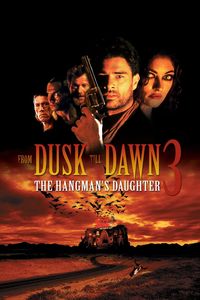
    From Dusk Till Dawn 3: The Hangman’s Daughter (1999)

    (On Cable TV, October 2020) Filmed nearly concurrently with From Dusk Till Dawn 2: Texas Blood Money, From Dusk Till Dawn 3: The Hangman’s Daughter takes an opposite route in going back in time to deliver a prequel. Far closer in structure to the first film than the second, this prequel goes back to the late 1800s to feature none other than writer Ambrose Bierce heading to meet Pancho Villa and encountering a few other characters along the way, converging over the familiar dive bar that forms the nexus of the series. It all culminates into a nicely historical version of that concluding shot, except that we’re expecting it this time around. The point of the film is the concluding half-hour’s worth of gore effects as the characters battle vampires in the Aztec ruins underneath the bar, but there’s some additional ambition in featuring a historical character like Bierce and adapting his cynicism to the setting of the story—Michael Parks nicely drawls though Bierce’s convoluted speech patterns and sardonic outlook, and The Hangman’s Daughter wouldn’t be nearly as interesting without him. (Robert Rodríguez contributed to the story.) The film does have a few other highlights: Danny Trejo makes his usual cameo, Temuera Morrison is reliably good in a small role as the Hangman, and Ara Celi does look nice as the titular daughter. The film is clearly aimed at audiences looking for more of that grindhouse exploitation feel. Others may criticize how the cinematography is yellow-tinged, the story meanders in its first hour, and some moments could have been streamlined. But if you’re looking for a slightly more ambitious take on the same find of western/vampire hybrid of the original, The Hangman’s Daughter isn’t too bad.
  • Bus Riley’s Back in Town (1965)

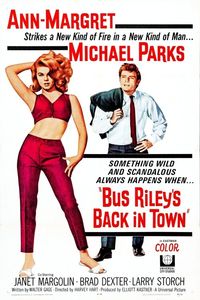
    Bus Riley’s Back in Town (1965)

    (On Cable TV, September 2020) Even if 1967 is generally regarded as the year that movies changed forever (finally moving past the Hays Code and embracing a more naturalistic style), you can see a steady evolution of American movies throughout the 1960s, from black-and-white to colour, and slowly tackling modern issues in increasingly frank fashion. While Bus Riley’s Back in Town is not an exceptional movie in any regard, you can use it as evidence of how things were changing. Here we have a young man (Michael Parks) coming back to his hometown after three years in the Navy, trying to reconnect but feeling more alienated than ever. As a small-town domestic drama, the stakes are low but the plot is character-driven, what with him being seduced by an ex-girlfriend (Ann-Margret, playing a bad girl) now married and bored, his unwillingness to settle for a good but boring job as a mechanic, and his lack of acknowledgement that things keep changing. I was drawn into the film by Ann-Margret’s name, but her mid-1960s screen persona is here used for clearly dramatic effect, as she incarnates the temptation and regression that the main character must move past. Bus Riley’s Back in Town is not spectacular, but it’s considerably more intriguing than I expected, and as a slice of small-town America in the mid-1960s, it’s far more credible than many wilder and better-known movies.

  • Tusk (2014)

    Tusk (2014)

    (On Cable TV, June 2015) The good thing about today’s movie universe is that it has never been easier for just about any determined filmmaker to grab decent-quality filmmaking equipment and shoot their own movies.  This also works for experienced filmmakers, who can indulge their creative urges with smaller projects for specific audiences.  Sadly, this is also making it harder to stop projects that maybe shouldn’t have been completed.  So it is that Kevin Smith can riff off a ridiculous premise in a podcast and, months later, complete a project based on that rant, about a hapless podcaster being tortured into becoming a walrus for a madman’s own purposes.  The wonders of modern filmmaking!  Of course, the problem for end-result Tusk is that even though it tries hard to be a comedy/horror hybrid, it’s neither funny nor scary.  Just gross and pitiful, with a big side-order of boring.  Justin Long is neither good nor bad as the protagonist: while Long-the-actor is naturally likable, his character is obnoxious enough to shut down any nascent sympathy for his fate.  Tusk is self-aware enough to have joke casting (such as having Johnny Depp in a supporting role without crediting him, or featuring Depp’s and Smith’s daughters in small roles), but as with most of the film’s characteristics, the final result is slight enough as to make everything seem pointless.  If Tusk had been a better film, I would have a few nice things to say about the dialogue, the fractured chronology, some directorial choices or Michael Parks’ performance.  But it’s pointless, grotesque and interminable even at 90 minutes.  Even the Canadian content left me less than enthusiastic (the badly-translated French doesn’t help).  I’m not opposed to dumb midnight-movies, but Tusk is not a good example of the form.  And if Kevin Smith’s career is headed in the direction of increasingly-hermetic fan-service goofs, then I’m happy to let him go there and never look again; after all there are plenty of other filmmakers doing far more interesting things with the means at their disposal.

  • Red State (2011)

    Red State (2011)

    (On Cable TV, May 2014) With every new Kevin Smith movie, it becomes harder and harder to remember why I liked his first few movies. It may have been the sheer novelty of the sharp irreverent dialogue (at a time where this wasn’t as commonplace) coupled with the conspicuously lousy directing. But Red State is so far from the example set by his earlier better movies that Smith’s name as a director is now more cause for a double-take than anything else. A dull and unpleasant departure in C-grade thriller-land, Red State doesn’t quite know what to do with itself, and becomes less and less pleasant the longer it goes on. What looks at first like a cautionary tale about the dangers of Internet hook-ups quickly turns into an interminable sermon about right-wing conservatism, followed by yet another siege film in which the government agents play the trigger-happy just-as-bad guys. This Westboro-meets-Waco setup is pointless enough, but what makes it even less interesting is the sadism through which the characters are mowed down, the violent one-note caricature of the cult and the pointless resolution cloaked in anti-government clichés. Some actors manage to do good work: Michael Angarano could have been the protagonist of the film had it been better-conceived, John Goodman almost manages to acquit himself honorably and for all of the interminable duration of his monologues, Michael Parks is curiously compelling at the bloodthirsty cult leader. Smith’s direction has gotten better over the years but not that much better, and Red State‘s naturalistic atmosphere feels uglier than anything else, not exceeding the standards set by most Direct-to-Video thrillers. You can see the gleeful iconoclasm behind some of the film’s initial intentions, but the execution is simply too dull to be effective, and the film spares no time turning its audience against itself. As unpleasant as it is, rumors about an alternate rapturous ending as originally scripted would have made the film even worse, so I suppose we have that to be thankful about. Still, there is no excuse for the lengthy sermon scene or the trigger-happy violence. Where has Smith’s gift for witty dialogue, sympathetic characters or comic set-pieces gone? He keeps threatening retirement, and after Red State it’s easy to look forward to him keeping his promises.