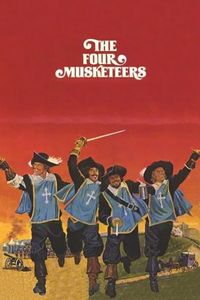
(On Cable TV, February 2021) There are informal series of remakes out there that become generational touch points of sorts. Well-known stories are reinterpreted every few years with a new crop of actors, giving us a glimpse at how each era makes its movies. The generational updates to dramas such as Little Women and A Star is Born certainly count, but Alexandre Dumas’ Les Trois Mousquetaires is in a category of its own. As an adventure with strong dramatic content, the Musketeers story can be adapted to a variety of contexts, either as out-and-out action spectacles, as costume dramas, or as classic swashbuckling adventures. Actors as different as Douglas Fairbanks, Gene Kelly and Luke Evans have played in well-known versions of The Three Musketeers, and the 1974 version fits right in the middle of 1970s Hollywood. To be fair, this is the second half of a story begun with 1973’s The Three Musketeers, so the comparisons are not exact — this film covers the second half of the Dumas novel that often gets short thrift in other adaptations. (Something not apparent to viewers is how both movies were originally conceived as one and led to movie contract history — with producers splitting the film in two during production, and getting in such incredible judicial problems regarding the cast and crew contracts that the film led to the imposition of the SAG’s “Salkind Clause” to prevent such shenanigans from happening again.) Watching The Four Musketeers isn’t as much about the story as it is about how they made mid-budget adventure spectacles in the 1970s — with an all-star cast of actors such as Michael York, Oliver Reed, Richard Chamberlain, Charlton Heston, Faye Dunaway, Christopher Lee and Raquel Welch (!!!), a director like Richard Lester (who was still a few years away from superstardom as Superman director) and expansive European on-location shooting. Alas, movies from the 1970s also share the putrid cinematography of the time, with flat colours, dull images and perfunctory sets. I’m not interested in whether the entire shoot was done under overcast weather — I’m interested in the results, and they are as gray and featureless as the story should be vivacious and fun. Some biting dialogue and voice-overs make the film almost as interesting as the Dumas original, but the impression left by this film is one of heaviness and gracelessness: the action sequences pale in comparison to other adaptions of the story, and even the star-power can’t quite elevate the material. I may, however, be interested in watching the film again as part of a double feature with the original. While it’s fun to watch a musketeer film that pays attention to the often-neglected second half of the novel, I probably would have had more fun in watching the introduction first. Still, I did like to see that cast with that story, and in this regard The Four Musketeers does achieve its goal of being one more entry in a century-old conversation between Hollywood and Dumas’ novel.