Michelle Rodriguez

  • Furious 6 aka Fast & Furious 6 (2013)

    Furious 6 aka Fast & Furious 6 (2013)

    (Video on Demand, December 2013) I am unapologetic about my enthusiastic love for this series ever since the first 2001 installment: I’m not much of a car guy, but I love the blend of action, machines, and humor that the series offers.  Fast Five was a notable pivot in that it took the series away from strict street-racing action (no more girl-on-girl kissing!) towards globe-trotting heists and adventure, with considerable broadening of the franchise’s appeal.  Now Furious Six capitalizes on this shifting dynamic, and takes audiences to Europe in the search for bigger and better action scenes.  The highlight is a highway sequence that pits muscle cars against a tank, leading to a climax set on a massive cargo plane rolling down a seemingly endless runway.  With “vehicular warfare” (oh yeah), we are far from the Los Angeles street-racing origins of the series and yet not that far, given how the series has adopted “family” as an overarching theme and eventually manages to bring back everything to the humble neighborhood where it all began.  Fast and Furious 6 successfully juggles a fairly large ensemble cast, while giving a big-enough spotlight to series superstars Vin Diesel and Paul Walker, with able supporting turns by Dwayne Johnson and a spot for newly-resurrected Michelle Rodriguez.  The script is more blunt than subtle (the ham-fisted dialogues really bring nothing new to the film) and the direction could be a bit less tightly focused so to let the action scenes breathe, but for existing fans of the series, this is nothing except another successful entry.  There are even a few jokes thrown in: The street-racing sequence is introduced by Crystal Method’s circa-2001 “Roll it Up”, while Johnson not only gets at least two jokes referencing his wrestling background (mentioning “The Walls of Jericho” and a final tag-team fighting move with Vin Diesel) but also a few Avengers shout-outs in-between “working for Hulk”, “Captain America” and “Samoan Thor”.  By the post-credit end, the film not only straightens out the series timeline to include Tokyo Drift, but introduce a wonderful bit of casting in time for the next installment.  It’s going to be a bit of a wait until the next film…

  • Resident Evil: Retribution (2012)

    Resident Evil: Retribution (2012)

    (On Cable TV, June 2013) As an unlikely casual fan of the Resident Evil series (I liked the first one, hated the second one, tolerated the third before the fourth hooked me again), I’m better-disposed than most in liking a new installment in the series, and Retribution does deserve a bit of love despite some basic problems.  For fans of the series, the best thing about this fifth entry is the way it dares bring back past elements such as Michelle Rodriguez (who, in-between this and Fast Six, seems to be on her “Hey, world, remember me?” tour) and a glimpse at the protagonist’s pre-zombie suburban days.  The film winks at its own mythology, and has the most obvious nods at its video-game origins by explicitly setting the story in discrete “levels”.  Much of the series’ motifs are also in place, from the way the opening sequence quickly riffs off the ending of the previous film, to the final apocalyptic shot meant to set up the next installment.  Milla Jovovich is also up to her usual standards, which is always good news.  There’s a lot to smile about here, and that’s even before getting into director Paul W.S. Anderson’s impeccable visual composition.  At times, Retribution is so beautifully shot as to approach art-house levels of cinematography: Witness the opening “backward” battle, the stark white-hallway fight, the New York sequence or the presentation of the secret base in which everything takes place.  Given this, it’s regrettable that the film isn’t quite as good as it could be: some of the action scenes are meaningless, Rodriguez isn’t used as effectively as she could be, and there’s no escaping a sense of repetition among the chaos and explosions.  Still, the visuals make up for many sins, and so I am really looking forward to the sixth installment.

  • Battle Los Angeles (2011)

    Battle Los Angeles (2011)

    (In theatres, March 2011) Some movies are difficult to appreciate on their own rather than as references to something else, and since Battle Los Angeles is so derivative, it feels natural to keep rubbing it against other movies to see how it compares.  There’s such a glut of alien-invasion films at the moment that seeing marines fighting alien invaders in Los Angeles feels more redundant than interesting: Even in trying to blend the attitude of Independence Day with the aesthetics of Black Hawk Down, Battle Los Angeles basically becomes a hackneyed collection of war movie clichés with alien taking over the role of the unrepentant enemy.  It certainly doesn’t qualify as serious Science Fiction: The film buries itself in nonsense every time it tries explaining what’s going on, from alien coming to Earth for its water to them having military tactics so naïve that they would get them kicked out of West Point freshman year.  From a thematic point of view, it’s tempting to put Battle Los Angeles in a cultural zeitgeist in which Americans are realizing the limits of their imperial reach and transposing this fearful guilt against an enemy as powerful to them as they are to countries that they have invaded, but that subtext is lost in the film’s gung-ho hoo-rah attitude.  The emphasis here is on the combat scenes, the shakycam feeling of being in a firefight and the nobility of its warrior-characters.  Threadbare narrative arcs, largely indistinguishable characters, functional writing and incoherent editing don’t do much to make this film likable.  Other than the end battle and an interesting freeway sequence, most of the action scenes are too grimy and disconnected to sustain interest: Like many contemporary action directors, Jonathan Liebesman needs to know when to calm down and provide sustained long shots.  Meanwhile, Aaron Eckhart is solid as the square-jawed hero, while Michelle Rodriguez does what Rodriguez does best –and there’s nothing wrong with that, even though it reinforces the feeling that we’ve seen all of this before.  On the other hand, especially measured against recent downbeat alien-invasion films such as Monsters and quasi-brethren Skyline, Battle Los Angeles has the considerable merit of ending on a triumphant note, and delivering much of the good old-fashioned heroics that we’d expect from this kind of film.  It doesn’t make the film any good, but it makes it satisfying once the end credits start rolling.

  • Machete (2010)

    Machete (2010)

    (In theaters, September 2010) When a trailer for then-fake film Machete appeared attached to Grindhouse three years ago, the joke worked pretty well.  But would it survive being turned into a feature-length film?  As it turns out, Machete the film is what Machete the fake-film trailer had promised: A fully entertaining mixture of exploitation filmmaking, populist indignation and self-aware cinematic winks.  Bolstered by one of the most amazing cast in recent memory, Machete finally gives a much-deserved featured role to the mesmerising Danny Trejo, with fun parts for such notables as Robert De Niro, Steven Seagal, Lindsey Lohan, Jessica Alba and Michelle Rodriguez.  Everyone looks like they’re having fun, which is in keeping with the film’s mexploitation theme: if you’re going to make a movie that plays to the audience’s bases desires for nudity, action and revenge, why not do it well?  Writer/Director/Editor Robert Rodriguez certainly knows what he’s doing: the editing lingers on the nudity, stays long enough on the action and flashes past the goriest violence so that we can enjoy the film’s dark humour without being repulsed by its excesses.  (Rodriguez may not have been the film’s sole director, but it’s unmistakably his film.)  It’s a terrific piece of grindhouse cinema, but it comes with quite a bit of populist decency.  The Latino diaspora is colourfully represented by food, more food, Catholic symbolism and a distinctive aesthetics: Add to that a striking case for respecting immigrant rights, and Machete becomes a film that speaks loudly about basic human rights while still delivering a hefty dose of disreputable entertainment.  In short, it’s a film that works on a number of levels, not the least of which is a considerable amount of sheer movie-going pleasure.  Knowing Rodriguez’s considerable personal charm and fondness for explaining the movie-making process, I can’t wait until it comes out on video.

  • 2 Fast 2 Furious aka The Fast And The Furious 2 (2003)

    2 Fast 2 Furious aka The Fast And The Furious 2 (2003)

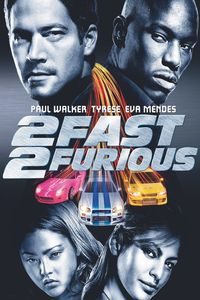
    (In theaters, June 2003) Cars, crime and chicks in sunny Miami; what else could you ask for? Okay, so Vin Diesel is missing and so is a lot of the energy of the original The Fast And The Furious. But it doesn’t matter as much as you think: This time around, the cars look better, and if no one can outfox Michelle Rodriguez from the first film, Eva Mendes and Devon Aoki are totally appropriate eye-candy. Paul Walker doesn’t have to struggle under the shadow of Diesel, and he emerges as a mildly engaging protagonist. (The homo-erotic subtext of his character’s relationship with buddy Tyrone can be a little ridiculous at times, though; how many jealous glances can we tolerate before bursting out laughing?) It’s a shame that about half the car chases don’t really work; dodgy camera moves, overuse of CGI over stunt driving and over-chopped editing don’t help in building a gripping action scene. At least the two highway sequences are nifty. The last stunt is weak and so are many of the plot points before then, but 2 Fast 2 Furious goes straight in the guilty pleasures category; a fine way to spend a lazy evening.

    (Second viewing, On DVD, March 2004) Fast cars, curvy women and sunny Miami: Even the second time around, it’s hard to be angry at this film even as the dialogue is painful, the action scenes aren’t particularly successful and the ending is lame. At least the DVD offers some consolation through a series of interesting making-of documentaries and a few extra car-related goodies. John Singleton’s tepid audio commentary does much to demonstrate the uninspired nature of the film’s production. Competent without being particularly commendable, adequate without being particularly satisfying. This one goes out straight to Eva Mendes fans and car buffs. Not that there’s anything wrong with being either.

    (Third viewing, Streaming, December 2025) Roughly ten installment later, there’s little doubt that 2 Fast 2 Furious is the runt of the Fast and Furious franchise.  Hurriedly put in production to capitalize on the first film’s box-office and missing the mark on several elements that would make the success of the film series, it’s a weak movie that does not deserve any pretension of it holding up.  At best, the success of its many sequels give it a halo effect to help get past its worst moments.  For fans of the series and its characters, this is the film that explains how Taj and Roman met, and how Brian lost his badge.  You can even detect the series’ first foray into ludicrous high technology with the “EMP harpoons” used twice during the plot. It does have a few good action beats: the two racing sequences aren’t bad, and there are two highway sequences with good moments (even if the sequences as a whole aren’t particularly good and filmed in unusually muted fashion). The rest of the film, though, is much blander than one would expect.  The Miami location is only used perfunctorily, while everything that touches Cole Hauser’s villain feels like it comes from an undistinguished straight-to-video police thriller (including a torture sequence that doesn’t fit with the series’ tone at all.)  Most of all, though, is that the film barely seems to touch upon either car culture, big stunts, increasingly solid web of interpersonal relationships or effortless entertainment that would come to define the series.  No wonder the later installments wouldn’t crib too many things from this one. (While I do regret not seeing Devon Aoki in other installments of the series, I gather that acting was more of a temporary thing for her, and she’s happy away from the screen.) There are many reasons why 2 Fast 2 Furious was fated to under-perform (hurried production, Vin Diesel’s hubris-driven decision not to return to the series, director John Singleton’s lack of affinity for the material, etc.) but the result is such a drag that it probably ends up being the most-skipped film in the Fast and Furious box-set.

  • The Fast And The Furious (2001)

    The Fast And The Furious (2001)

    (In theaters, June 2001) Yes! After a diet of pretentious pseudo-profound cinema and ultra-hyped moronic flicks aimed at retarded teens, it’s such a relief to find a honest B-movie that fully acknowledge what it is. If you like cars, you’ll go bonkers over The Fast And The Furious, one of the most enjoyable popcorn film seen so far in 2001. The plot structure is stolen almost beat-for-beat from Point Break, which should allow you to relax and concentrate on the driving scenes. There aren’t quite enough of those, but what’s there on the screen is so much better than recent car-flick predecessors like Gone In Sixty Seconds and Driven that director Rob Cohen can now justifiably park in the space formerly reserved for Dominic Sena and Renny Harlin. The film’s not without problems, but at least they’re so basic that they’re almost added features. The protagonist is supposed to be played by Paul Walker, but don’t worry; bland blond-boy gets each and every one of his scenes stolen by ascending superstar Vin Diesel, whose screen presence is of a rare distinction. Feminists will howl over the retrograde place of women in the film, but even wannabee-sensitive-guys like me will be indulgent and revel in Jordana Brewster and Michelle Rodriguez—not to mention the other obligatory car-babes kissing each other. Despite the disappointing lack of racing in the first half, there is a pair of great action sequences by the end, the best involving a botched robbery attempt on a rig with an armed driver. That scene hurts, okay? I still would have loved a better ending, but otherwise, don’t hesitate and rush to The Fast And The Furious if you’re looking for a good, fun B-movie.

    (Second viewing, On DVD, March 2002) There isn’t much to that film, if you look closely; three or four action scenes, conventional plotting, a few hot young actors and that’s it. But once again in B-movie-land, it all depends on the execution. Here, the young actors are really hot (from Walker to Diesel to Brewster to Rodriguez), the direction is unobtrusive enough and the film is infused with a love of speed that manages to make all quibbles insignificant. The ending is still problematic, with all its unresolved plot-lines, but the film holds up very well to another viewing. The DVD includes an amusing director’s commentary, deleted scenes (some good, some less. Unfortunately, the director once refers to an alternate ending that’s not included), a rather good making-of, three rather bad music videos and a bunch of other stuff.

    (Third viewing, Streaming, December 2025) Decades later, the publication of Barry Hertz’s history of the Fast and Furious franchise suddenly had me hankering for a re-watch of the series’ first instalment. As many have since said, The Fast and the Furious really holds up.  At its core, it remains a solid genre thriller, streamlined to focus on the essentials.  The story moves fast except when it slows down for just-enough background for the characters, the Los Angeles setting or the car culture that’s central to the film’s comfort.  The few action sequences are handled with a professional’s touch, with just enough non-mimetic material (such as some brief CGI, or the sped-up transitions from day to nighttime highlighting the different realms of the film) to highlight the metal-on-metal tactility of the stunts.  It’s easily watchable without too many dull or dumb moments.  And the soundtrack is terrific — although that may just be me recognizing the tracks I was listening at the time. But it’s the the halo effect of its many sequels’ blockbuster success that helps lift it up even further: Paul Walker is quite good here, and Vin Diesel is remarkable. Even comparing this relatively grounded first installment to its increasingly bombastic follow-ups isn’t that big of a jump: You can see where the most successful bits of the sequels come from, and where some of the characters are introduced.  The sequels also manage to tie up the loose ends of the abrupt ending, and develop some half-baked ideas.  But even taken on its own, The Fast and the Furious is a slick, fast, well-made action movie — well worth a look even a quarter-mile, er, a quarter-century later.