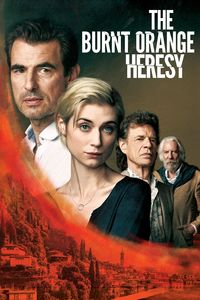
The Burnt Orange Heresy (2019)
(On Cable TV, May 2021) As someone who’s constantly fascinated by the modern art world, it was easy to slip into The Burnt Orange Heresy’s opening scenes, as the worst kind of art critic (the lying kind) begins an affair with a whip-smart woman who is pretty good at naked bedroom repartee. He’s played by Claes Bang, whose good looks and turn as an art curator in The Square clearly prepared him for the role; she’s played by Elizabeth Debicki, who gets steadily more interesting with every film. But what begins as a chilly romance soon becomes something else and then something else again, as they are invited to the estate of a multimillionaire that also acts as the residence of a reclusive artist. That pair is played by the unlikely duo of Mick Jagger and Donald Sutherland, bringing additional interest to the result. A second act delving into more art-world intricacies follows, helped along with Sutherland’s easy likability. But then The Burnt Orange Heresy finally cashes in on its vague forebodingness by turning into a thriller in which many characters die in not-very-believable ways. It’s ironic that I, an at-times over-strident genre fiction fan, would bemoan the film’s turn into murder — after all, it’s adapted from a novel and it’s not as if we’re led at any point to assume that this is going to be a frothy romantic comedy. Still, the murdery section of the film isn’t nearly as interesting as what comes before it, and it’s by that metric that I allow myself to be disappointed by the third act. It doesn’t make The Burnt Orange Heresy any less interesting, but it does give it a scattered, inconsistent impression that lingers on long after the credits roll.
