Mickey Rooney

  • Hide-Out (1934)

    (On Cable TV, December 2021) As much as I’d like to say something interesting or enlightening about Hide-Out, it’s the kind of film that’s good enough to escape snarky comments about its shortcomings but not good enough to get ringing praise. The plot isn’t that complex, as a wounded womanizing mobster ends up on a farm and spends his recovery time falling for the farmer’s daughter. There’s clearly a lot of comedy to be mined in how our urbane protagonist has to adapt to the farm — and some obvious romantic material with the daughter as well. It works more often than not — director W. S. Van Dyke clearly knows what he’s doing even with a middle-of-the-road script, and the acting benefits from the professionalism of Robert Montgomery and Maureen O’Sullivan — as well as an early role for Mickey Rooney. Hide-Out is entertaining even if not particularly memorable — and it ends on a sweet high note, ensuring a nice finish for the audience.

  • Drive a Crooked Road (1954)

    (On Cable TV, September 2021) If a film like Drive a Crooked Road can feel so familiar, it’s probably because it shares its plot with many other films. The story of a young man with a talent for racing being recruited into a criminal gang to act as getaway driver for a heist is not unique, and it’s perhaps best executed in the 1964 remake of The Killers. What this earlier version of the idea has in its favour is the sight of Mickey Rooney in the awkward phase of his career when he was trying to reinvent himself in older-harsher roles than the teenage and young-adult heartthrob characters that initially made him famous. He’s generally but not entirely convincing as a tougher, rougher young man getting mixed up in heavier trade even as he dreams of racing cars professionally. As a noir, though, Drive a Crooked Road is very watchable: The script, from future comedy director Blake Edwards (who turns out to have a very respectable film-noir early resumé), steadily ratchets up the tension and the loneliness of the protagonist, and seeing Dianne Foster playing the femme fatale only makes it better. Taut, efficient and just long enough at 83 minutes, Drive a Crooked Road is not a noir classic, but it’s a decent one.

  • Girl Crazy (1943)

    (On Cable TV, August 2021) As much as we profess to dislike film formulas, they exist because they work. Once you’ve found something that works, why bother changing it? Of course, staleness is the constant danger, and there can be a time where the most entertaining thing about a film series is the way it keeps reworking core concepts in ever-wilder situations. Girl Crazy is the ninth and last film to co-star Judy Garland and Mickey Rooney, and the amazing thing about it is how, despite taking its actors to an isolated western ranch campus in twentysomething roles, it still manages to cram in the “let’s put on a show to save the orphanage!” plot of most of their earlier small-town backyard movies. It’s quite impressive in a way… and it comes later enough in the film that we’ve had a fill of new stuff to tide us over. As is often the case, this is a film of moments and musical pieces rather than a sustained narrative — adapted from a Broadway musical, it does have a few snappy numbers and the presence of Tommy Dorsey’s orchestra — “Treat me Rough,” “Fascinating Rhythm” and “I Got Rhythm” are notable standouts, with that last number being a typical Berkeley Busby spectacle before he was replaced as a director by more mild-mannered Norman Taurog. Style and setting of the film bring to mind an appropriate double-billing with Too Many Girls. Girl Crazy is not that good of a musical, but it’s watchable and arguably more interesting than many of the Garland/Rooney films in which the backyard premise was repeated too often without variation even as they were growing older.

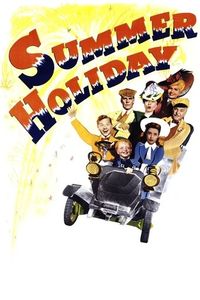
  • Summer Holiday (1948)

    Summer Holiday (1948)

    (On Cable TV, July 2021) By the late 1940s, producer Arthur Freed has cemented his reputation as MGM’s foremost musicals producer — the leader of prestige projects for the studio, often working in colour at a time where it was uncommon. You can see some of the cockiness that comes with that status in segments of Summer Holiday, which doesn’t always neatly segregate between spoken and sung moments in the action, and clearly has the means with which to execute its ambitions. Sadly, those ambitions are pedestrian — the film covers a summer in the life of a high-school graduate, but seems intent on presenting an archetypical and rather boring vision of the American heartland. Anything interesting has to be filed off along the way — for instance, our protagonist (MGM golden boy Mickey Rooney) begins the film with an endearing cynical outlook on life that extends to questioning American values and promoting Marxism. See, that’s an interesting character. Obviously, though, this kind of thing can’t stand: before the end of Summer Holiday, he’s reformed into a capitalistic American patriot intent on marrying “the right kind of girl” (don’t worry, he already knows her) after a boozy flirtation with the wild side portrayed as a nightmare. But so was the dint of the land at the time — MGM couldn’t possibly get its teenage hero spouting off anti-establishment rhetoric and make it to the end of the film. This sour note is not exactly counterbalanced by anything else in the film — the surprisingly dull colour cinematography doesn’t help, the blurring of musical numbers with straight dialogue holds back the film from traditional musical numbers and there isn’t much worth remembering from the result. I’ve been watching much of Freed’s filmography lately, and Summer Holiday is certainly lower-tier material — it hasn’t aged all that well and feels too ordinary to be interesting.

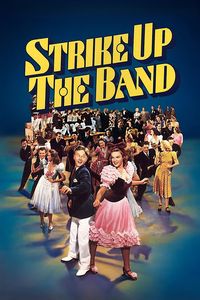
  • Strike up the Band (1940)

    Strike up the Band (1940)

    (On Cable TV, April 2021) Fifth in a series of ten movies that paired Judy Garland with Mickey Rooney, Strike Up the Band uses the couple’s most frequent formula: a series of contrivances leading them to put on a show in order to save something or someone or other. Clearly patterned on Babes in Arms (same stars, same premise) but with a slightly bigger panache to wow the audiences, the film is clearly meant to be familiar to the audiences at the time. Early-1940s Garland and Rooney had plenty of youthful sparkle and the camaraderie that came from working together so often. The plot itself is bland, but some of the numbers are still well worth seeing: with Busby Berkeley at the helm, it’s no surprise if the lavish, complicated dance number “Do the La Conga” is the film’s highlight, with plenty of dancers moving to a catchy rhythm. (There’s also a fun number with instrument-playing fruits — and it’s announced by the opening credits.)  It’s an early production of the Arthur Freed unit that would go on to make many of MGM’s most celebrated musicals, so there’s clearly the spark (if not quite the polish) of later well-known productions. For film buffs, Strike Up the Band is a bridge between Garland/Rooney’s “Andy Hardy” teen movies and the musical super-productions she would later star in. It’s amiable enough to be worth a watch — and some of the numbers are memorable.

  • Words and Music (1948)

    Words and Music (1948)

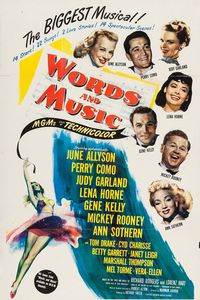
    (On Cable TV, April 2021) Hollywood based many musicals on the life of Broadway composers—you wouldn’t believe how many. On one level, the attraction is easy to understand: it’s a made-to-order way to insert musical numbers as part of the show, the rights to the music come in as a bundle, and audiences of the time presumably had fond memories of the tunes and their context. A modern equivalent would be the musical jukebox-musical biopic, which is alive and doing very well. On the other hand, Hollywood often mismanaged the material: The lives of the composers were often scrubbed of any detail that wouldn’t be acceptable by the Production Code (and considering the higher-than-average proportion of homosexuals as Broadway creatives, there’s an entire aspect of early Twentieth-century pop culture that simply isn’t covered in its Hollywood dramatizations). Nowadays, “Rodgers and Hammerstein” is a legendary duo of composers, but in 1948 the audience knew the duo as a still-fresh replacement for “Rodgers and Hart,” and Hart’s story is the one we see in Words and Music. Played by then former boy matinee idol Mickey Rooney, Hart’s character is not faithfully represented at all: Alcoholism and depression? Yes. Homosexuality? Again, no. (Which led to some hilarious reviews telling viewers that the film wasn’t accurate, but the reviews themselves were unable to specify why.)  Generally speaking, Words and Music is not all that interesting in its first half, as both the successes and the tragedy ramp up quite a bit in the second half once the duo makes their way to Hollywood and Hart’s self-destructive actions reach a tragic ending. From a musical fan’s perspective, the film (from the fabled Freed unit) is far more interesting at the edges than in the core of its story, because that’s where we find short appearances by MGM players such as Gene Kelly (dancing with Vera-Ellen in—yes—a gangster ballet), Judy Garland, Cyd Charisse and, far more strikingly, Lena Horne — Her first number “Where or When” is a sedate reminder about her talents as a signer, but then she starts tearing into “The Lady is a Tramp” and we know it’s the film’s single best number. Meanwhile, the central story of Hart and Rodgers unfolds along predictable lines all the way to the tragic ending. Rooney is not bad as Hart, with the movie making good use of his small stature in portraying a man complexed by his own short height. Words and Music is not near the top of MGM’s best musicals, and its appeal can be found in either appreciating the contributions of the bit players, or seeing this as the cleaned-up prequel to the far better-remembered Rodgers and Hammestein partnership. Either way, it’s a movie that is perhaps best defined by factors other than its main premise, which is a bit odd but not uncharacteristic of other second-tier MGM musicals at the time.
  • Broadway to Hollywood (1933)

    Broadway to Hollywood (1933)

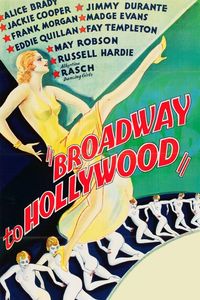
    (On Cable TV, March 2021) One of the defining aspects of the first decade of Hollywood musicals (which could only start after the invention of sound cinema) is how closely they were synonymous with Broadway. In reaching for readymade inspiration, the musicals reached out and grabbed talent, shows, attitudes and best practices from New York’s stage culture. You can see these fingerprints everywhere in 1930s musicals, from shows being adapted to the big screen, to performers jumping from stage to screen, to avowed subject matter revolving around Broadway—and not merely the ever-popular story of “putting on a show.”  Broadway to Hollywood isn’t much of a film, but more interesting when set against this broad 1930s movement. Tracking the story of three generations of theatrical performers as the family trade moves (all together now) from Broadway to Hollywood, it’s a drama more than a musical. Much of the initial narrative has to do with vaudeville losing its lustre and then being truly hammered by early cinema. The last act finds itself in the mansions of Hollywood, with the elderly protagonists having harsh words for what Hollywood has done to their grandsons. Much of the narrative is executed in melodramatic mode—albeit occasionally very satisfying melodrama, as proven by a climactic shove down an armchair—but the most intriguing aspect of the film is in showing, from a very close historical perspective, how American mass entertainment evolved over a lifetime, setting the stage for a cultural landscape far more familiar to us. Broadway to Hollywood has an equally interesting production history — largely shot in 1929 and 1930 in three separate musical streams, shelved when early-early musicals crashed at the box office, reshot and polished off as melodrama in 1933 when a more mature form of musicals once again became hits… the topic becomes the film. There are a few marquee names in here, with most of the contemporary attention going to an incredibly young Mickey Rooney (12!), a puzzling one-scene wonder from Jimmy Durante and a solid turn from Jackie Cooper — although if you want to talk performances, Frank Morgan and Alice Brady are the glue that holds a sometime-disjointed film together as they play the older performers. Broadway to Hollywood is not a completely successful film, but it is fascinating and it does offer a glimpse at a period where the American cultural landscape changed very quickly.

  • Men of Boys Town (1941)

    Men of Boys Town (1941)

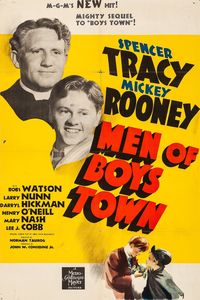
    (On Cable TV, March 2020) Hollywood’s infatuation with sequels is pretty much a century-old tradition by this point, and so are the most common factors why sequels disappoint. An artifact of relevance: Men of Boys Town, sequel to 1938’s Boys Town, once again finds Spencer Tracy finely playing the wise helpful priest heading an educational establishment for troubled boys. Meanwhile, Mickey Rooney is once again the youthful sort-of-delinquent getting in trouble (but not too much trouble). Both could play those roles in their sleep, but that’s not important if the point of the film is repeating a formula. In this aspect, then, Men of Boys Town is a success—it delivers more of the same in the way viewers of the first film would expect. It’s shameless about emotional manipulation, dead dog and all—but the entire film careens from one big emotional register to another, whether it’s comedy in the form of a slow-motion fight sequence, or much darker suggestions of abuse when delinquents are sent to a reform school, quite unlike Boys Town. Of course, the film’s flaws will be magnified if you had no interest in Boys Town in the first place—repetition, manipulation and actors not challenging themselves being the most visible of them. Still, Men of Boys Town is traditional Hollywood filmmaking at its most exemplary, for better or for worse.

  • Boys Town (1938)

    Boys Town (1938)

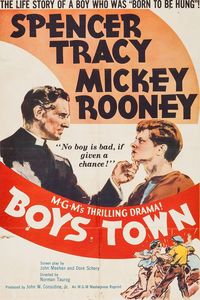
    (On Cable TV, January 2020) There’s an immediately recognizable rhythm to Boys Town that works even eighty years later, so closely does it adhere to some conventions of Hollywood feel-good movies. It starts with our heroic priest protagonist (in an understated performance by Spencer Tracy) visiting a death-row inmate and resolving to do what he can to save boys from criminal destinies. Moments later, he’s establishing a reform establishment for troubled boys in the hopes of putting them on a straighter path. (It’s based on a true story.) As regular as clockwork, this is all a setup for the redemption of a particularly troubled soul played by… Mickey Rooney. That’s right. All-American ruddy-cheeked teenage heartthrob Rooney playing a bad boy, going against the establishment and vowing that nothing and no one will even tame him. You can imagine how the rest of the film goes, and that’s actually part of its charm—the utter comfort of watching a film eighty years later and still being able to know with confidence where it’s going. Boys Town was an Academy Awards favourite back in 1938 and the formula it adopts is still being used these days. Still, the fun of the film is in the details and the performances. Even if you don’t buy Rooney as a hoodlum, Boys Town (helmed by then-veteran director Norman Taurog) is a movie that clearly understands what it’s doing, and executes it with good details. The Christianity of the lead character is present without being overbearing; the bad-boy antics of its teenage co-lead are easily acceptable by the audience and the film rides this kind of middle-of-the-road sensibility all the way to a feel-good conclusion. Is it inspiring but predictable, predictable but inspiring or simply both?

  • The Black Stallion (1979)

    The Black Stallion (1979)

    (In French, On TV, May 2019) As someone who’s indifferent or immune to horse stories, I don’t have much to say about The Black Stallion, except perhaps that I’m glad it exists for those who do love horses and horse stories. The plot, summarized as “a boy and his horse,” spends a lot of time detailing how they meet in dramatic circumstances involving a shipwreck, then speeds up to describe the events leading to a big race. But much of the film is not as much about narrative than it is about visual presentation, atmosphere and simply enjoying the growing bond between the human protagonist and the horse. Mickey Rooney shows up in a late-career supporting role, while director Carroll Ballard keeps a tight rein over the film’s visual aspect. The Black Stallion is a specific kind of film for a not-so-specific audience—and you can see the parallels here with other stories such as Black Beauty and War Horse.

  • The Human Comedy (1943)

    The Human Comedy (1943)

    (On Cable TV, April 2019) As much as I don’t like saying it, there is something frankly awe-inspiring in the propaganda efforts led by Hollywood during World War II. Scarcely any single branch of the US military wasn’t covered by some sort of heroic film, and Hollywood took care to address the home-front as well, boosting morale and preparing the population for the sacrifices of war. The Human Comedy is an exemplary take on inward-directed propaganda, taking a look at a small California town as it experiences the war from afar … except for the young men who have left and may never come back. “Teenaged” Mickey Rooney stars in this paean to salt-of-the-Earth America as a telegraph messenger whose job becomes to relay news of deaths to unprepared families. There’s some sports, romance, drama and comedy to make this film more than just a propaganda effort. It does eventually become a meditative slice-of-life narrative of quasi-anthropological interest—and narrated by a dead character. I found it strangely reminiscent to that other existential small-town drama Our Town. This being said, it remains a propaganda film, and the overall message that “sacrifices must be made for the good of the nation” is hard to ignore throughout. The wartime material hasn’t aged as gracefully as what surrounds it: the poignant episodes involving the ensemble cast, the last few antagonists, the generous outlook on life. Rooney is quite good on a purely dramatic acting level (as opposed to other films where he plays the matinee idol) and that helps a lot in further grounding The Human Comedy as something more than a wartime message.

  • Captains Courageous (1937)

    Captains Courageous (1937)

    (On Cable TV, April 2019) It’s amazing to see what earlier era considered perfectly acceptable entertainment for kids. 1937’s Captain Courageous, for instance, adapted an 1897 Rudyard Kipling novel and refashioned it as a coming-of-age story for a spoiled rich boy swept overboard and rescued by fishermen, who teach him much about fishing and life. Considering that it’s a story that includes the gruesome death of a main character by sagittal bisection, well, I’m not going to begrudge the current crop of kids’ films. Still, the result can be surprisingly enjoyable. Freddie Bartholomew turns in a good performance as the boy, with an endearing turn by curly-haired Spencer Tracy, and supporting roles for both Lionel Barrymore and Mickey Rooney. Tracy has the best role here, as a loquacious Portuguese fisherman who helps the initially detestable boy protagonist become a better person. One thing that holds up surprisingly well is the depiction of fishermen working the Grand Banks of Newfoundland—the footage of real fishermen at sea (in sailboats!) is a terrific time capsule, and the integration of water-tank footage with rear-projection special effects is often better than you’d expect. Despite a drawn-out ending, Captain Courageous does wrap up in a satisfying fashion, capping off a film that still works well today, albeit to an older audience.

  • A Midsummer Night’s Dream (1935)

    A Midsummer Night’s Dream (1935)

    (On Cable TV, February 2019) I’m done apologizing for the way I can’t process Shakespearian dialogue. Fortunately, there’s enough in the 1930s version of A Midsummer Night’s Dream to get us into a surprisingly detailed early example of a fantasy film. As my attention wandered from the dialogue and plot, I was left to admire nearly everything else: The great sets and costumes, as well as the vivid imagination on display. Remove Shakespeare’s name from the credits, and there’s still enough here to make this a modest masterpiece of early fantasy filmmaking. Clearly, the filmmakers saw in Shakespeare the license to go wild (comparatively speaking) in terms of fantastic creatures, wondrous realism and other tropes of the genre what would be developed decades later. If tracing the evolution of fantasy moviemaking isn’t your thing, then maybe you’d be interested in a very early role for Mickey Rooney, or seeing Olivia de Havilland and James Cagney once more. Still, I’m more appreciative of the fantasy filmmaking aspect: there weren’t that many big-budget fantasy movies at that time, and this one fills an early slot in the development of the subgenre.

  • Breakfast at Tiffany’s (1961)

    Breakfast at Tiffany’s (1961)

    (On Cable TV, July 2013) The problem with not having seen some classic movies is that after finally watching them, you wonder what took you so long.  Breakfast at Tiffany’s is essential viewing for at least two reasons: First up would be Audrey Hepburn, as beautiful and lively in this film as she has been in 1961.  Photos of her in her “little black dress” may be iconic, but you have to see the film to understand what made her a star.  The second reason to see Breakfast at Tiffany’s would be her character, Holly Golightly: As the incarnation of a newly-created character in American culture (the single young girl, enjoying life in the city), Holly would end up being the template for decades of similar characters all the way to Sex and the City’s lead characters.  The impact of the film is considerable even today, and that’s partly why it can’t be missed even today.  (The showcase party sequence still feels surprisingly modern.) Ironically, the film also deserves to be seen for the ways in which it undermines its own cultural legacy: Golightly may have been made an object of admiration and imitation by latter generations of single women, but the film fairly clearly underlines the desperation of her life, meddling with the mob and borderline-prostitution in order to make ends meet, her bubbly facade barely concealing a child-like mind barely able to cope with her current situation.  A read of Truman Capote original bittersweet novella only serves to highlight the very thin veneer of fun that the film puts over a rather sad situation: it’s hard to watch the film’s happy ending and feel that it won’t last very long.  (It’s also hard to watch the film and not cringe at Mickey Rooney’s crudely stereotypical portrayal of a Japanese character: While that kind of thing may have been acceptable half a century ago, it’s the one single thing that most damages and dates the film.)  For all of these reasons, and probably a few more than I’m forgetting, Breakfast at Tiffany’s remains essential viewing well into the twenty-first century.