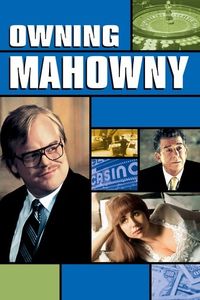
Owning Mahowny (2003)
(On TV, July 2021) I’m not always fond of Canadian Content (CanCon) restrictions on Canadian Cable TV channels requiring them to show a certain percentage of Canadian material if they want to keep their broadcast licenses. It certainly makes for a convenient scapegoat whenever a terrible made-in-Canada movie gets in regular rotation for a while. Of course, the pleasant flip-side of this is that CanCon often helps in keeping good but obscure Canadian movies in play long after they would have otherwise been forgotten. Seeing Owning Mahowny pop up regularly on schedules eighteen years after its release, for instance, is one of those cases where CanCon isn’t so bad. Based on a true piece of Canadiana, it’s the story of a bank vice-president who figures out a way to tap into his company’s funds in order to cover his gambling debts, only to see this “temporary” charade deepen, as he’s unable to cover his losses. Along the way, it clearly becomes a case study in a gambling addiction, as the protagonist goes bigger and bigger (becoming a “whale” for competing casinos) without quite getting any satisfaction out of it. Philip Seymour Hoffman is typically excellent in the lead role, consistently underplaying things in a way that becomes a statement by itself. Minnie Driver doesn’t get much to do as “the girlfriend” (aka the voice of reason), although seeing her in dirty-blonde straight hair with bangs is interesting in itself. John Hurt is delightful as a very amused casino manager trying to learn more about the player with deep pockets showing up in his establishment. Still, this is Hoffman’s show, and he shines brighter than the muddy 1980s-style cinematography attempting a period look. Fortunately, the film is progressively compelling: Hoffman’s character is clearly stuck in a spiral of lies and deception and there’s a perverse pleasure in seeing how far he’ll go in trying to cover up his growing debts. Among Owning Mahowny’s most interesting choices is a sequence that, in any other gambling film, would be about the flash and fun of being treated like a high-roller. Here, however, the entire thing feels like a pain for the protagonist, who would rather go on with the business of playing than being lavished with attention. Some decent screenwriting gives weight to even the minor characters and structural scenes — it makes for an absorbing film even when it doesn’t necessarily start out like one. Owning Mahowny is definitely worth a look if you’re even slightly interested by gambling movies, white-collar crime thrillers or character studies. So: score one more for CanCon victories in further exposing a home-made success.