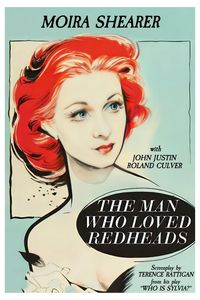
Moira Shearer

  • The Man Who Loved Redheads (1955)

    The Man Who Loved Redheads (1955)

    (On Cable TV, June 2020) It’s hard to resist the appeal of a title like The Man Who Loved Redheads (I feel called out), but there is something quite unusual about the film. It’s about one man’s life-long obsession with a specific woman (a redhead, obviously), so much so that, even as a married man, he keeps having affairs with women who remind him of her. Where it gets interesting is that the four women he woos over the film’s decades are all played by Moira Shearer. What’s more, the film has a very present narrator (one who asks questions to passersbys, and who tells us that there’s nothing to know if he doesn’t know) as well as a sense of wry humour that gets pretty funny at times, even despite the film’s frequent slow patches and immoral centre. Amusingly enough, one of the characters played by former ballerina Shearer is… a ballet dancer, which gives director Harold French an opportunity to stage an out-of-place ballet paying homage to her previous role in the classic The Red Shoes. Despite running the risk of turning into a shaggy dog story, The Man Who Loved Redheads’ ending is interesting from a narrative perspective — as a way to exorcise the protagonist’s obsession but also to show how meaningless it was.

  • The Red Shoes (1948)

    The Red Shoes (1948)

    (On Cable TV, November 2019) What a sumptuous movie. One of the sure-fire highlights of 1940s cinematography, The Red Shoes isn’t just a visual feast from writers-directors Emeric Pressburger and Michael Powell (with MVP Jack Cardiff doing cinematography)—it’s also a rather enjoyable, if melodramatic, meditation on the price of art no matter what kind of art. Creatives of all stripes are liable to get a charge of inspiration from the result, even if they (like me) will look on skeptically at the idea that art is worth dying for. (That’s not true for one simple reason—you can’t create anything more if you’re dead. Full stop.)  But, of course, for most people the film is about ballet, about dancing sequences made even more meaningful by a very sophisticated visual language. Compared to other films of the 1940s (and, indeed, still most twenty-first century films), The Red Shoes is complex and self-assured in the way the visuals work in tandem with the narrative: this is a film worth watching intensely to catch the nuances and interplay between its elements, far more so than other films of that era that do not rely so much on visual material. The complexity carries to other facets of the film, from mixing genres to keeping a poetic ambiguity over some plotting choices. The Red Shoes thus appeals to many audiences for many reasons—the tragic romance, the dancing sequences (which reportedly inspired many young girls to pick up ballet), the impassioned appeal to artistic creation, the ability to diverge from strict realism, the terrific music, the sumptuous filmmaking. Moira Shearer has a one-of-a-kind performance here, and you can argue that despite stories careers, producer Alexander Korda and writers-directors Powell and Pressburger never quite hit the same notes as The Red Shoes does. It’s a cinematic landmark for a reason—and if I don’t quite love it as much as other movies, I can only respect its ambition and its integrity.