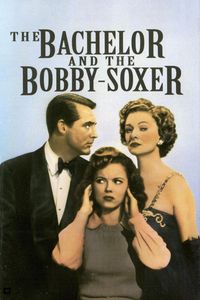
The Bachelor and the Bobby-Soxer (1947)
(On Cable TV, March 2020) As the title suggests, there is one potentially troubling March-June relationship in The Bachelor and the Bobby-Soxer that would make any viewer apprehensive – especially considering that it’s a film from the 1940s. But fear not, enlightened twenty-first-century viewers: Even Classic Hollywood knew that thirtysomething bachelors (even one played by Cary Grant) should not mess around with 17-year-old girls with a crush. Much of the film’s comedy in this film is about the protagonist (Grant) trying to get together with an age-appropriate professional woman (Myrna Loy) while her younger sister (Shirley Temple) interferes. There’s just enough implied naughtiness to make things interesting—the rest is scene-by-scene comedy, as Grant plays both halves of his suave persona unafraid to be humiliated. Cleverly conceived (the script, penned by future potboiler bestseller Sidney Sheldon, won a Best Original Screenplay Academy Award), it’s unobtrusively put together by director Irving Reis and very easy to watch. Grant’s charm does most of the work, but there are also plenty of scattered laughs in the details—my favourite has to be a rapid-fire exchange about “The man with power of whodoo / Who do? / You do!” which sounds like the kind of period nonsense exchange immortalized on screen—and later quoted by David Bowie. While definitely a middle-tier Grant comedy, The Bachelor and the Bobby-Soxer remains a charmer despite a slightly suspicious premise, and a great showcase for its three stars.
(Second Viewing, On Cable TV, January 2021) Cary Grant had the looks and the charm that could make any kind of creepy nonsense seem amusing, and there’s no better proof of that statement than watching The Bachelor and the Bobby-Soxer, a film in which (as it says in the title) he suffers through an unrequited crush from a flighty teenager. Shirley Temple plays the titular bobby-soxer, but it’s Myrna Loy who’s the prize here as the teenager’s older sister, a judge whose tangles with Grant’s character leads to romance. Before that happens, however, there’s got to be plenty of sequences of misunderstandings, comic complications, bone-headed movie psychology, attempts from Grant’s character to divert his teenage admirer to a more appropriate partner, and some physical comedy along the way. To its credit, the film knows that pairing Grant (who was 43) and Temple (who was 19) is a terrible idea—and if that seems perfectly reasonable to you, keep in mind that other similar Hollywood movies, such as the 1954 farce Susan Slept Here, weren’t even able to do that. There are a few good set-pieces and lines of dialogue here: While I’m ambivalent about the outdoors sports scene, the last restaurant sequence is very funny—even if it ends in a way that leads the film to another ten minutes of decreasing interest as the conclusion peters out rather than build to a strong finale. (Hollywood obviously disagreed, because the film won a screenwriting Academy Award.) The call-and-response, “The power of hoodoo.” “Who do?” “You do!” is also quite amusing, and wisely used as closing lines to wrap it up. In between Grant, Temple and Loy, The Bachelor and the Bobby-Soxer is an amiable-enough comedy that manages to steer itself away from some pitfalls that befell other similar films. It’s worth a look, especially for fans of the three lead actors.