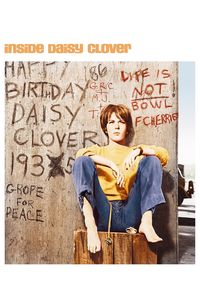
Inside Daisy Clover (1965)
(On Cable TV, March 2020) My interest ebbed and flowed as I sat watching Inside Daisy Clover, a film that seems stuck between the shiny fairytale of 1950s Hollywood and the grim revisionist 1970s. I picked it based on the cast and premise: a drama featuring a young 1930s Hollywood starlet having trouble fitting in, featuring no less than Natalie Woods, Robert Redford and a young(er) Christopher Plummer in a deliciously evil role. Inside Daisy Clover certainly looks good on paper. But it doesn’t start out all that well, what with Woods beginning a film-long struggle with an unflattering hairstyle and the film touching upon an unpleasant blend of teenage alienation and a hard-luck struggle between daughter and mother. The premise starts from pure bubble-gum “poor girl becomes a movie star” to turn into an examination of the hidden darkness behind celebrity, but it somehow doesn’t quite manage to satisfy along the way. Some scenes are quite strong (such as a meta-musical moment in which the increasingly sad song is shot from behind the scenes of a movie shoot), and the ending becomes a bit of explosive dark comedy, but the way from this to that is both too grim and not grim enough to fully satisfy. (Or, if you’d prefer, camp and yet not camp enough.) At some point, I really started wondering how much of Inside Daisy Clover was explicitly meant to evoke Judy Garland (who was still alive at the time). Unusually enough for the mid-1960s, Robert Redford plays a bisexual character—but the film doesn’t get to explore his character as more than an additional burden on the heroine. Hence my opening assertion: the same movie made in the 1950s would have been more buoyant; the same movie in the 1970s would not have pulled its punches. In the meantime, what’s left in Inside Daisy Clover is of mild interest to fans of Hollywood movies about Hollywood, but simply falls apart as its own story.