Nia Long

  • 47 Meters Down: Uncaged (2019)

    (In French, On TV, October 2021) I wasn’t a big fan of the first 47 Meters Down—Despite the rather nice suspense of characters being attacked by sharks while caged underwater, I am growing averse to the “imaginary character” trope and I suppose that the best thing about it is that I kept expecting its sequel 47 Meters Down: Uncaged to feature a fictional character. (In vain, as it turns out.)  No, this sequel would rather focus on more sharks and more claustrophobia, as it sends four teenagers in an underground Mayan temple to fight sharks that don’t need eyes to see their prey. It’s about as straightforward as shark movies come, with a steady diet of victims for the sharks, and thrills that don’t stop until everyone is out of the water. Sophie Nélisse and Corinne Foxx headline the film as the plucky half-sisters fighting it out (if you’re guessing the other characters are expendable, well, you’ve seen enough shark films), although it’s nice to see Nia Long looking gorgeous in a very small role. The Mexican scenery is nice when above the surface, but since much of the film takes place underwater, you can expect more shades of blue than lush greenery. The climax does keep something in reserve even after exiting the underground temple, so don’t go reaching for the remote at the sight of sunlight. While I won’t argue too much with those who maintain that the first film is better, 47 Meters Down: Uncaged at least dispenses with hallucinated characters, and that makes it preferable in my book.

  • Soul Food (1997)

    Soul Food (1997)

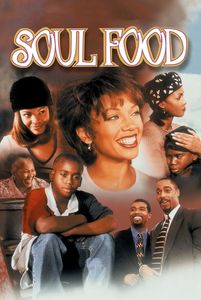
    (On TV, May 2021) The overarching thesis in Soul Food is one I can get behind: No problem in life can’t be solved by food. Dysfunctional family? Food. Relationship problems? Food. Sudden absence of the matriarch? Food. Police arrest? Food. Financial strains? Food. Knife fight? Food. Kitchen fire? Food. Well, Food and a united family, which goes back to food in the film’s mythology. (Or rather: food, family and a stash of money.)  No, Soul Food is not meant to be that profound. But as a depiction of a family threatening to come apart absent the Sunday ritual of bonding over food, it’s well-intentioned, pleasant and heartwarming to watch. There’s a good sense of the relationships between the characters, and the actors (headlined by Vanessa Williams, Vivica Fox and Nia Long) go rather well in inhabiting the roles. Writer-director George Tillman Jr. has a clear idea of where he’s going, and the film finds a happy medium between comedy and drama in the final stretch. Like food itself, Soul Food is familiar, unchallenging and a bit heavy on the grease but sometimes exactly what you need.

  • The Single Moms Club (2014)

    The Single Moms Club (2014)

    (On Cable TV, May 2021) For all of the well-deserved criticism Tyler Perry gets about his work as a writer-director, there’s a lot to be said about his willingness to feature female protagonists, focus on their issues and propose on female-led casts. Some will say that this is a winning commercial strategy for the kinds of films he makes, and while it’s hard to disagree with that, the results still speak for themselves. The Single Moms Club finds him in mostly-dramatic mode, avoiding the pitfalls of the Madea-led comedies to focus on five single mothers brought together by an incident of school vandalism. Forced together, they find some strength in leaguing against their problems. While this could have gone in several directions, those who are familiar with Tyler’s work won’t be particularly surprised or disappointed to find out that the result is more schematic and melodramatic than anything else. The problems confronted by the ensemble cast of protagonists are not particularly novel or wittily presented: Perry is into brute-force melodrama and one can almost see him schematize his characters’ issues based on a list of the top ten complaints by single mothers. The cast is largely but not exclusively black, with the five titular single moms being split in various ethnicities — and with a few class issues as well. Perry’s streak in working with good and interesting actors continues here, with Nia Long, Amy Smart and Terry Crews being part of the cast. (Meanwhile, Perry also has a supporting role as a likable character.)  The Single Moms Club is not great cinema — at best, it’s a serviceable daytime-TV film that, to its credit, believes in people acting kindly and has the decency to end on a positive note. (Although pairing up every single female character with a man undermines the strong-independent-woman thing that the film may have gone for.) For Perry fans, it’s a less flashy example of a routine kind of work for him — albeit one that does show his continued sympathy for women’s issues and his ability to work with actresses. It may not get much respect, but it’s not something to dismiss too quickly.

  • Alfie (2004)

    Alfie (2004)

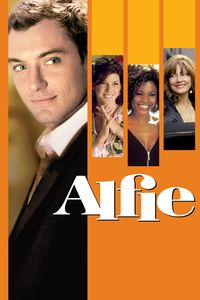
    (In French, On TV, February 2021) I wasn’t all that interested by 2004’s Alfie back when it was in theatres or during its most active video lifecycle, but a recent look at the original 1966 film featuring Michael Caine had me suddenly interested in the later version. Jude Law was among the best choices to measure up to Caine, but this newer take updates and tweaks so many things that it hardly feels like a remake, and more of a companion work. What has not changed is the conceit of having its irremediable cad of a protagonist (suggested to be the son of Caine’s character) regularly address the audience to boast about his philosophy of life: As a British man deliberately expatriated in New York to improve his chances of hooking up, his life is a tightly optimized machinery for meeting, bedding and discarding girls. The first few minutes of the film are all in good fun, but consequences come in the form of a worrying medical diagnostic, the end of a longer-term relationship and, most dramatically, a fling with a friend’s on-and-off girlfriend, resulting in an unwanted pregnancy. Shifting from insouciant cad comedy to a more serious recognition of his flaws, Alfie does follow the original’s dramatic arc, but rearranging and updating the material to make for a decent watch by itself. Law strikes just the right balance in being charmingly arrogant and showing the capacity to reconsider his life after multiple setbacks. He does remain a cad, but at least a marginally forgivable cad. A strong supporting cast has its own merits, from Marisa Tomei to Omar Epps to Nia Long to Sienna Miller and Susan Sarandon. The soundtrack includes many down-tempo pieces sung by Mick Jagger. It’s obvious that 2004’s Alfie can’t have the same epochal resonance as the 1966 Swinging London one — it’s a different time and place, and no one can match 1960s Michael Caine. But the remake is interesting enough to live on its own terms, even for those with recent memories of the original.