Nicholas Ray

  • The Lusty Men (1952)

    The Lusty Men (1952)

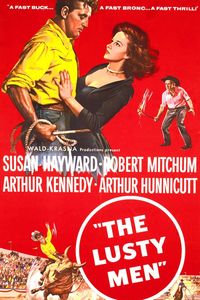
    (On Cable TV, June 2021) Even as countless male leads of classic Hollywood have been forgotten or become undistinguishable from others, Robert Mitchum endures as an icon. His performance in director Nicholas Ray’s The Lusty Men will show you why. Playing a rodeo competitor who decides to retire but ends up partnering with a young man trying to save enough money to buy a house for him and his wife. Matters predictably escalate into full-blown drama, as the life of a rodeo competitor is dangerous, and few of the characters seem able to keep their hands to themselves. (I mean, it’s right there in the title.) Ray directs the film in a more naturalistic fashion than was usual in the 1950s, going for the raw authenticity of its hardscrabble characters. Real rodeo footage is integrated within the film, giving The Lusty Men a patina of authenticity as a modern-day western that now feels like a period piece. Mitchum delivers a good, even great performance here, helped along by the melancholy tone of the script and Ray’s careful directing process. While the result isn’t as flashy as the epic films that Hollywood was producing at the time, The Lusty Men has aged well and remains a high point in both Ray and Mitchum’s careers.

  • King of Kings (1961)

    King of Kings (1961)

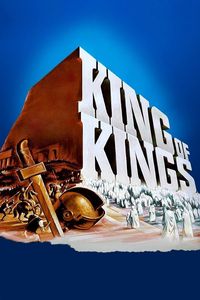
    (In French, On Cable TV, March 2021) I’m not sure there’s anything really interesting to say about King of Kings. One of the last big epics of the wave that began in the 1950s, it tackles perhaps the biggest story in the Western canon—The Passion of the Christ—and gives it the maximalist treatment that blockbuster films went for at the time. It’s melodramatic, unsubtle, garishly dependent on Technicolor and almost exactly what we can imagine from hearing “The Passion of the Christ as filmed in 1960.”  I’m almost sure I watched the film a few times while attending Catholic grade school, and as a result I’m almost disarmed as a reviewer in trying to find anything else to add about the film. It’s an Easter Weekend film staple for a reason — despite relying on acclaimed director Nicholas Ray, it’s one of the most basic takes on its topic, and by the same token one of the most innocuous. I’ll take Jesus Christ Superstar over King of Kings most days of the week, but I can’t deny that it’s one straightforward take on an incredibly familiar story.

  • On Dangerous Ground (1951)

    On Dangerous Ground (1951)

    (On Cable TV, December 2020) Film nor takes a trip to the country for crime and romance in director Nicholas Ray’s On Dangerous Ground. Robert Ryan stars as a burnt out suspect-punching New York City cop who, in the film’s opening segment, gets reprimanded by being sent upstate to cool off and help an ongoing murder investigation. The second portion of the film is a contrast in more ways than one, as the rainy nighttime visuals are replaced by the serene beauty of snowy farmlands and our policeman anti-hero gets to interact with people who aren’t necessarily the scum of the Earth. This is where he meets a beautiful blind woman (the ever-striking Ida Lupino), for whom he falls despite her brother being his prime suspect. It all escalates into a climax that’s both predictable and satisfying within the confines of the film’s sense of right and wrong – romance gradually creeping up on the criminal arc and acting as the true resolution of the film. It’s quite an unusual blend despite its familiarity – noir in the snow and eventually replaced by romantic redemption. But that’s the magic of Ray as a director – make us believe in dubious material, and somehow wrapping it up in a coherent package.

  • They Live by Night (1948)

    They Live by Night (1948)

    (On Cable TV, May 2020) The “lovers on the run” subgenre of romantic tragedy and thrillers has a long history, and while it predates They Live by Night, the impact of that specific film over directors in later decades (including a slew of films in 1970s New Hollywood) remains significant. Farley Granger and Cathy O’Donnell star as, respectively, a young criminal on the run after a prison escape and a robbery, and an isolated young woman who takes care of him after he’s wounded in the robbery. Eventually, they decide to make a run for it, and get married along the way. Typical of criminals on the run during the Production Code era, it does not end well for them—hence the mystique of tragic romance that led to so many imitators, whether in France for La Nouvelle vague or in New Hollywood. But while its legacy is significant, it’s worth noting that They Live by Night is a pretty good film by itself. It holds the distinction of being the first film with a helicopter tracking shot (in fact, it’s almost the first shot in the film) and being acclaimed writer-director Nicholas Ray’s first film. As an early noir, it draws from the novel it was adapted from, as well as French Poetic Realism. It’s easily watchable, although romanticizing the bad-boy criminal remains just as problematic as it ever was. Still, it’s not a bad film, and viewers can have fun tracing the chain of influence from this to À bout de Souffle to Bonnie and Clyde to Natural Born Killers to even newer films about lovers on the run.

  • Party Girl (1958)

    Party Girl (1958)

    (On Cable TV, March 2020) There’s a truly fascinating mix of ingredients in Party Girl: Cyd Charisse with a meaty dramatic role (her last contract role for MGM—indeed, one of the last contract roles in the entire studio system), director Nicholas Ray bringing his usual set of skills to a rather conventional story; Lee J. Cobb as another mobster; and Robert Taylor in a noticeably more dramatic role than usual. Some musical numbers, a few Prohibition-era plot points inspired by real life, expensive colour cinematography, expansive sets, and a plotline that gleefully mixes organized crime, barely-repressed prostitution, crooked lawyers and nightclub showbiz. By all rights, this should be quite a movie—alas, Party Girl merely settles for being just fine. It’s certainly watchable, and Charisse gets one of her last big-budget roles here—but most of the time, it fails to meet expectations as more than a standard mob-nightclub riff. Ray’s direction is competent, but fans of his deeper films may find something missing here. Maybe there’s too much going on; maybe it’s just not made of strong-enough writing. Maybe the actors were just a bit past their prime—no matter why, Party Girl is entertaining without being as memorable as it should be.

    (On Cable TV, June 2021) Frankly, I expected more of a gangster musical comedy featuring Cyd Charisse, director Nicholas Ray and a plot that brings together a fusion of chorus girls dance sequence and mobster drama. But Party Girl does not feel quite like a musical (too few musical sequences), nor quite a noir (there’s a happy ending), not quite a romance (not showing much heat between lead Robert Taylor and the notoriously restrained Charisse) and not quite a comedy (viz the criminal element not played for laughs). It is occasionally well directed and photographed in impressive colour, but somehow the elements don’t quite mix well. There’s probably an issue in Party Girl coming from the late-1950s, at a time of creative exhaustion by the studios (as per the film’s rote musical sequence, aware that the musical was fading away but not quite knowing what to do instead) but also an increasingly unworkable production code that couldn’t allow filmmakers to go where the story needed to go creatively. It’s certainly watchable, but also disappointing in the way it doesn’t fully use the material at its disposal. In many ways, Party Girl is more interesting as a last gasp of the MGM studio system (this was Charisse’s last film under contract and the next-to-last film for Taylor’s contract – they were the last two stars in the MGM firmament) than by itself.