Nicolas Cage

  • Prisoners of the Ghostland (2021)

    Prisoners of the Ghostland (2021)

    (On Cable TV, December 2021) There’s wild and there’s Nicolas Cage wild, but few filmmakers can actually deliver a film that matches Nicolas Cage wild. For better or for worse, that’s not the case for Japanese auteur Sion Sono, who concocts in Prisoners of the Ghostland a cyberpunk western fever dream that manages to be crazier than Cage himself. The worldbuilding is a nonsensical blend of nuclear catastrophe, Japanese iconography, American Wild West conventions and shiny expensive cars. It’s not meant to make sense — it’s meant to look cool and distinctive, and it certainly achieves that objective. The flip side of that is that if you’re looking for narrative substance to go along with Nicolas Cage screaming at Wild West Yazukas, you’re likely to be disappointed. This is a film that becomes increasingly ludicrous while explaining the constrained facets of its pocket universe where everyone knows everyone from ten years ago, and where Western tropes easily outweigh any attempts to make sense. It’s wild, but it’s also curiously forgettable as well: while Cage is in fine form, and Sofia Boutella improves the film like she usually does, the intensity of the images fades to nothing once the credits roll. It feels a bit long and repetitive once the sheen of its first wacky moments has passed. There’s probably an object lesson here — I suspect that we’re going to talk about Cage’s performance in Mandy long after Prisoners of the Ghostland memories fade away, and it’s a demonstration of how wildness should come accompanied by some substance in order to mean anything.
  • The Croods: A New Age (2020)

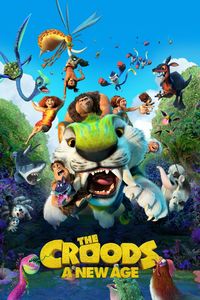
    The Croods: A New Age (2020)

    (On Cable TV, June 2021) I don’t recall being overly impressed by the first film in the Croods series, but sequel The Croods: A New Age does feel like a step-up. Now that the tedious origin story is done, the script seems freer to go in interesting directions, and so this one brings the Croods in contact with more modern counterparts. The result occasionally feels a lot like a modernized version of The Flintstones, what with stone-age inventions meant to highlight comic anachronisms. While A New Age doesn’t quite let go of the sentimentalism of the first film, it manages to integrate it far better with the jokes and the narrative — as a result, there are fewer dull moments and a climax that does bring everything in service of a strong finish. Vocally, the standout duo here is Nicolas Cage going against Peter Dinklage, although Emma Stone and Ryan Reynolds are also distinctive. Still, much of the film’s fun is in the sight gags and energetic animation — with a few recurring gags, such as the antagonists taking every opportunity to learn from the protagonists’ efforts to escape. It’s not exactly a great family movie, but it’s more than good enough to be worth a look, and it’s entertaining throughout without losing itself along the way. While I didn’t exactly ask for A New Age, I’m now not completely against a third one in the series…

  • Vengeance: A Love Story (2017)

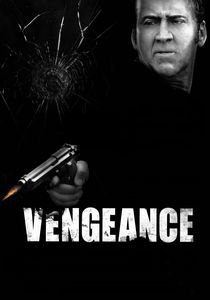
    Vengeance: A Love Story (2017)

    (On Cable TV, May 2021) It’s easy to razz Nicolas Cage for turning to a string of low-budget efforts in his late career — here is an actor of incredible power, unafraid to go big, once lauded as a top box-office draw now churning out half a dozen low-profile movies per year. But here’s the thing: Cage once had serious financial problems and the economics of movies no longer favour performers like him. Given this, he seems reasonably happy being employed full-time, he occasionally still turns in memorable performance (I mean, Mandy, man…) and he usually gives everything he’s got to a movie. He’s got gravitas when needed, he’s credible as a protagonist and he’s, by all accounts, a true professional on set. What’s more, reviewers seem to have turned around on Cage’s career — embracing his newfound status as the king of weird willing to try anything. Vengeance: A Love Story is a bit of an antithesis to the screaming, frothing Cage roles that seem to attract attention. Here he plays a Niagara Falls (USA) policeman who goes on a revenge rampage once the rapists of a local woman walk free from their trial. As could be expected from the plot summary, there’s quite a bit of exploitative manipulation to the way the plot is manipulated to justify vigilante justice. Adapted from a novel by Joyce Carol Oates, the film does have an extra depth that many similar films don’t — characters in the orbit of the villains are developed significantly more than usual, for instance, and there’s usually an extra complication or two added to the straightforward narrative. Still, this merely makes Vengeance: A Love Story a bit cleverer about how it goes about it rather than be outright original. Meanwhile, Cage here doesn’t go for the usual histrionics — there’s clearly something distant in his character, and he keeps it that way. Missed opportunity? Maybe, or not — Cage was once attached to direct the film and it doesn’t take much effort to imagine him accepting the project as an opportunity to depart from his usual persona. As for the film itself, any appreciation will depend on where you’re starting from. Expecting a Cagesploitation wild-out? Disappointing. Expecting your usual trashy B-movie? A bit better than expected. Looking for a sophisticated dramatic thriller? Eh, you may want to recalibrate your expectations. Still, Cage is interesting in his restraint here — and it’s a further example that he’s usually the best part of whatever movie he takes on.

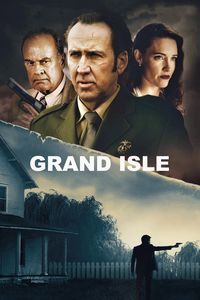
  • Grand Isle (2019)

    Grand Isle (2019)

    (On Cable TV, June 2020) Nicolas Cage is certainly cranking out the films in his older back-tax-paying age, and while Grand Isle isn’t a particularly good Cage film, you can see why he was cast in it. A southern Gothic in which a young man is invited in a vast mansion by a man intent on hiring him to kill his wife, it’s a film with a kernel of potential. Despite the film’s low budget, it’s credibly set in the sweaty humid hurricane-prone atmosphere of Louisiana. The age-old setup has a warring couple making demands on the younger stranger brought among them—in the middle of a hurricane, in an old Victorian house, no less. The nervy sound design, with wind and thunder, is designed to keep up on our toes during it all. In the cast, Cage is Cage (although maybe not as intensely as we’d prefer), while KaDee Strickland shows some potential as a femme fatale and Kelsey Grammer is quite enjoyable as a southern lawyer in the framing story. Alas, those promising elements are eventually blown away, most notably during a scattered third act that keeps going long after the action should have been settled and in doing so breaks the time/space unity that thrillers should keep in mind. (It also introduces a different dramatic arc that is resolved very quickly afterward, and doesn’t do much except allow Cage to be shown with a different hairstyle.) Grand Isle’s production history suggests that the production ran out of money before shooting the last two days of filming, but I have a hard time imagining that even one more week would fix what’s flawed here. The only consolation is that if you didn’t like it, well, there are five other 2019 Nicolas Cage movies to help you feel better.

  • Kiss of Death (1995)

    Kiss of Death (1995)

    (In French, On Cable TV, May 2020) The first thing anyone will notice about Kiss of Death is—holy moly, what a good cast of actors: David Caruso (back when he thought TV stardom led to a cinema career), Samuel L. Jackson (looking young!), Nicolas Cage (as a crime lord!), Helen Hunt, Stanley Tucci (with some hair!), Michael Rapaport, Ving Rhames… I mean, that’s interesting. The second thing one notices after the credits is—wow, this was a completely unremarkable crime thriller. Directed in solid but unspectacular fashion by Barbet Schroeder, it’s an update to the 1947 film noir classic that transposes the story in the 1990s, but doesn’t really do anything all that exceptional with it all. It’s not uninteresting—at the very least, you can say that it’s watchable without trouble. But it’s not anything more: moments where the film is overwrought (thank you, Nicolas Cage) almost give a glimpse into what this Kiss of Death could have been with more verve from everyone. In its current state, though, it’s having a really hard time distinguishing itself from the middle of the pack of 1990s crime thrillers: admittedly a good decade for those, but not an excuse for a film that doesn’t quite reach its objectives.

    (Second Viewing, In French, On Cable TV, July 2021) I know, I know – it makes absolutely no sense that I would see Kiss of Death for a second time in a year when there are far, far better movies that I have either not seen or seen only once. But as seasoned reviewers will tell you: no movies are as hard to review as the indifferent ones. You can be eloquent about the great or good movies; you can be acerbic about the bad or the terrible ones, but those movies firmly in the middle? Good luck even remembering them. So it is that I decided to have a second go at the 1995 version Kiss of Death, largely because I’d just seen the original 1947 one, and there was the remake playing again right now. Alas, I don’t have much to report – the remake is just as featureless and forgettable as the first time. The casting remains interesting, what with David Caruso, Samuel L. Jackson, Nicolas Cage, Helen Hunt, Ving Rhames, and Stanley Tucci (in the awkward balding phase of his career). And while the cast slightly elevates the material (with particular mention to Nicholas Cage, who’s given the unenviable task of measuring up to Richard Widmark’s iconic performance in the original film) it’s really not enough to distinguish what remains a somewhat humdrum mid-1990s thriller. I can understand the desire to strike a mark away from the original noir classic, but in setting out to do its own thing and update the material, this remake forgoes the psychotic vileness of the antagonist, the strong atmospheric cinematography and the impending feeling of doom for the protagonist. (The happy-ish ending is not a surprise like it was in the original, but par for the course of such thrillers.) What we’re left is largely undistinguishable from so many other thrillers of the time, executed with mere competence but no real flair. I’m reasonably confident that I’m going to forget nearly everything about this remake within days, so you may get a third viewing in the next few months.

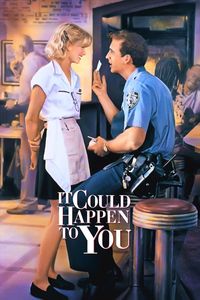
  • It Could Happen to You (1994)

    It Could Happen to You (1994)

    (In French, On TV, March 2020) What’s most striking about It Could Happen to You—besides its famous policeman-gives-millions-dollar-tip-to-waitress premise—is how much it feels like an urban fairytale: the protagonists are tried and rewarded for their inner virtue, with vast amounts of money-making wishes coming true. In this context, even having a narrator (whose origin turns out to be rather mundane) adds another layer of “let me tell you a story” to director Andrew Bergman’s film. Nicolas Cage and Bridget Fonda make for a likable lead couple, with Rosie Perez being as beautiful as ever but playing an unusually evil character for a change. It all comes together rather well, with New York City providing the background to it all. While no cinematic achievement, It Could Happen to You remains a nice and cute romantic comedy and arguably great counterprogramming to meaner fare. One thing, though: If you really want to enjoy the film, try to watch it in the original English rather than the French-Canadian dub, since Cage’s voice is dubbed in a much lower, far less distinctively nasal voice, and I missed it.

  • Mandy (2018)

    Mandy (2018)

    (Google Play Streaming, December 2019) Even if Nicolas Cage has proven his capacity to turn in good dramatic performances, he is a megastar because of his uncanny ability to do justice to grander-than-life characters, chewing scenery like the best of them. There’s no doubt that his tax problems have led him to a spiral of smaller, duller roles in recent years, but occasionally, he gets projects like Mandy in which he can showcase the kind of typical performances that ensure his immortality. But Mandy isn’t your typical movie: Blending a revenge story with a highly stylized cinematography in which not a single frame has not been heavily colour-corrected, it’s a quasi-unique film in today’s landscape. Nodding to the 1980s almost as much as in his previous Beyond the Black Rainbow, writer-director Panos Cosmatos concocts a genre story with quasi-supernatural elements that unleash Cage. The story has something to do with a logger taking revenge on a hippie cult after they murder his wife (Andrea Riseborough as the titular Mandy), but the point is in the purpled-hued phantasmagoric imagery, the fantasy art featured in the film and the nightmarish odyssey that the main character takes to exact his revenge. Battling leather-clad demonic bikers, crafting a battle-axe and befriending a tiger, the protagonist reaches an apex of sort during a chainsaw duel featuring a ludicrous blade measurement contest. It ends, as it should, with him bathed in blood. There’s a cross-genre sensibility found in Mandy that brands it as a cult favourite in the making—time will tell if it has staying power, but this is probably the best Cage performance and his best movie in years.

  • Peggy Sue Got Married (1986)

    Peggy Sue Got Married (1986)

    (In French, On Cable TV, May 2019) There is a surprisingly robust subgenre of romantic time-travel movies out there, and Peggy Sue Got Married qualifies for inclusion even if it arguably hovers on the edge of it-was-all-a-dream justification. Here, no time-travel machine or magic potion: Our protagonist (played adequately by Kathleen Turner) faints at her high school reunion and wakes up in 1960 to relive her senior year. Much of Peggy Sue Got Married is a mixture of now-exasperating (because overdone) boomer nostalgia, with the expected comedy of a woman reliving her life with everything she’s learned over the next twenty-five years. Technology jokes, romantic do-overs and horrifying realizations about 1960 are all included. It feels very familiar (especially so close to the much more dynamic Back to the Future), but director Francis Ford Coppola keeps it together. For modern viewers, one of the best reasons to see Peggy Sue Got Married would be the grab-bag of before-they-were-famous actors, starting with Nicolas Cage but also including Joan Allen, Jim Carrey, Sofia Coppola and Helen Hunt. It works modestly, but it does work.

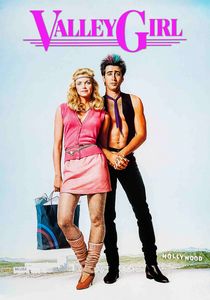
  • Valley Girl (1983)

    Valley Girl (1983)

    (In French, On Cable TV, May 2019) Considering that Valley Girl is a quasi-anthropologic study of life and love between Los Angeles neighbourhoods playing off the eponymous stereotype popularized by Frank Zappa, I clearly made a mistake by watching it in its French-Canadian dub: No amount of repetition of “… genre…” as an accurate translation of “… like…” is as charming as the stereotypical overuse of the word as punctuation in the original Valley dialect. At least the translation is on firmer footing when it comes to presenting a different-sides-of-the-track romance between a hippie Valley girl (Deborah Foreman) and a punk rockfish boy (Nicolas Cage) from Hollywood—the vaguely disreputable Hollywood as seen from another L.A. neighbourhood. Amusingly enough, Cage is here introduced by teenage girls squealing in admiration about his body, screaming, “He’s like a god!” One thing that doesn’t get lost in translation is the time-travelling aspect of going back to 1983 and taking a look at how teenagers (approximately) lived at the time, in between malls and music joints. (And that strange thing called sushi.)  The soundtrack may not be to everyone’s liking, but it is certainly evocative of a time and place. Director Martha Coolidge wasn’t looking to make a document for the ages with this low-budget romance, but that’s roughly what happened—Valley Girl wasn’t just a sizable hit at the time, but it endures as a fond memory. Next time, I’ll watch the original dub.

  • The Humanity Bureau (2017)

    The Humanity Bureau (2017)

    (On Cable TV, December 2018) I’m game to give a chance to nearly all made-in-Canada Science Fiction movies, but my patience has its limits and those were exceeded by The Humanity Bureau, as dull a dystopian film as I can recall recently. Nicolas Cage (clearly still looking to pay his tax bill) stars as a Midwestern government official who assesses people for exile to a colony where (hang on to your hats, here, this is going to get wild) nobody has ever come back. Given that you have already guessed the film’s big twist, there isn’t much more to say … except that this government agent takes pity on a woman and her child and then flee north to Canada where, in the grand tradition of American dystopias, a state of peace, order and good government awaits. (Maple syrup rules force me to point out that this isn’t as much a well-worn trope as a statement of national pride.) This dull plot is executed in bland fashion with brown-black cinematography, predictable plot twists, a darker-than-expected conclusion and bog-standard dystopian clichés. Cage is very ordinary here, looking detached and unaffected by the entire production—there’s nothing of his exuberant acting style left. Exasperating to get through, The Humanity Bureau has little to say and goes at it badly. Considering that there’s a mini-flood of Canadian SF productions out there, it’s not special in any way and would be fated to quick oblivion if it wasn’t for it qualifying as CanCon fit to be played endlessly on Canadian TV channels.

  • Guarding Tess (1994)

    Guarding Tess (1994)

    (In French, On Cable TV, December 2018) There’s a whole slew of apolitical politics-adjacent American movies out there, and Guarding Tess has one of the strangest hooks of them all—Nicolas Cage as a Secret Service agent assigned to an exasperating detail as he’s in charge of protecting a widowed First Lady living in a small town. She (played by Shirley MacLaine) often considers her security detail undistinguishable from her serving staff. You can imagine the rest, including a third-act thriller that runs at odds with the generally comic tone of the film up to that point. Of course the secret agent and former first lady will make up and learn lessons about each other—that’s not the point of the film. What Guarding Tess has in abundance is Cage playing off MacLaine, pokes at the reality of a Secret Service team assigned to what they consider to be a dead-end posting, and the minutia of such an arrangement. There’s a real genre twist thirty minutes before the end of the movie as the former first lady is kidnapped, buried underground and then Nicolas Cage has to shoot a toe off a suspect for him to confess the crime. Somehow this ended up in a comedy, but it feels a bit more natural in the movie than described like this. (After all, what would be the point of a security detail if there wasn’t a threat to their client at some point?) I still liked it, but Guarding Tess is almost the very definition of a movie that you shouldn’t watch if there’s anything more pressing to do.

  • Honeymoon in Vegas (1992)

    Honeymoon in Vegas (1992)

    (In French, On TV, November 2018) Nicholas Cage and Las Vegas make for an interesting coupling ((he’s apparently now a resident of the city), especially given how each one of the movies in which they come together are so different. Leaving Las Vegas is a depressing tragedy, Con Air is a brash action spectacular, and Honeymoon in Vegas is an offbeat romantic comedy featuring no less than a troupe of parachuting Elvises (Elvii?) at the climax. Writer/director Andrew Bergman certainly seems to have fun in setting up the film’s premise, as a couple (Nicolas Cage and Sarah Jessica Parker) travels to Vegas to be married, only to run into an Indecent Proposal-like situation in which a rich man (James Caan) offers to erase the protagonist’s gambling debts in exchange for a weekend with his soon-to-be wife. (Indecent Proposal was released in 1993, although the original novel predates Honeymoon in Vegas.) There’s some plot weirdness about Parker looking like the rich man’s dead wife, but never mind the justifications: Much of the film’s fun is in seeing Cage’s character chasing his wife, only to come back in style by jumping out of an airplane with a bunch of Elvis impersonators. As they say—what goes on in Vegas … warrants a movie. The result is a frothy funny film, not particularly deep at all, but offbeat and likable enough to be worth an unpresuming look. Cage is surprisingly fun as a romantic hero, and the Honeymoon in Vegas itself offers an interesting contrast to his other Vegas movies. Still, it may work best as a chaser for Leaving Las Vegas.

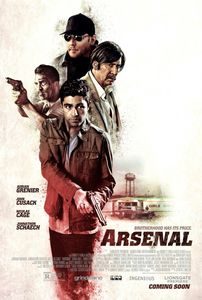
  • Arsenal (2017)

    Arsenal (2017)

    (Video On-Demand, May 2017) on the one hand, hiring a big-name actor for a direct-to-video movie can ensure funding, attention and even quality for a low-budget project. On the other hand, what happens if the big-name actor shows up with his own incompatible idea of what the role is about? So it is that anyone can watch Arsenal, which is in many ways a prototypical low-budget crime movie, and wonder “What is Nicolas Cage doing in here?” Turning up with a seventies moustache and an eighties interpretation of a small-town mobster, Cage chows scenery and seems to exist in an entirely different film. Every scene with him creates more questions than answers, endangering the suspension of disbelief required for immersion. (There’s also a greasy performance here by John Cusack that adds almost nothing to the film, to the point where we’re left wondering what he’s doing there.) It really doesn’t help that the film’s execution seems at odds with its script: director Steven C. Miller relishes exploding sprays of blood far too much to do justice to the quiet nature of the story, and every shootout seems as if it was optimized for 3D. The result sits squarely in the realm of direct-to-video thrillers: rather dull with flourishes by big-name actors.

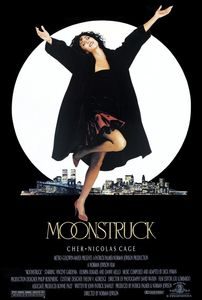
  • Moonstruck (1987)

    Moonstruck (1987)

    (On Cable TV, May 2017) I’ll give you two good reasons for watching this film: Nicolas Cage and Cher. Never mind that it’s a romantic comedy set against the Italian-American Brooklyn community. Or that it’s from acclaimed writer John Patrick Shanley and veteran director Norman Jewison. Or the unpredictable, gentle nature of the plot. The focus here is on Nicolas Cage’s energetic performance, and Cher’s terrific portrait of a woman contemplating middle age with doubts. Cher looks spectacular here, but so does Cage, and Olympia Dukakis has a strong supporting role. I’m not sure there’s a lot of substance in Moonstruck, but there’s a lot of sympathy and gentle humour—the way the film climaxes, with an unusually reasonable discussion around a dinner table, is the most unusual flourish on an improbable film. But it works, and it’s charming enough even a generation later.

  • The Bad Lieutenant: Port of Call – New Orleans (2009)

    The Bad Lieutenant: Port of Call – New Orleans (2009)

    (On DVD, February 2017) At its most basic level, The Bad Lieutenant: Port of Call—New Orleans shouldn’t be much more than a crooked-cop thriller. You know the drill: bad cop uses gun, authority, aggression to get drugs, sex and money. We’ve seen this film before. But there’s a few things that make this Bad Lieutenant stand apart. First up would be using post-Katrina New Orleans as a backdrop, with signs of catastrophe still corrupting the scenery. Second would be giving the film to veteran filmmaker Werner Herzog, and allowing him to run wild with shots of wildlife, oneiric sequences and just whatever passes his fancy. Capable actors in supporting roles also help; Eva Mendes hits strong dramatic notes as the protagonist’s girlfriend, while Jennifer Coolidge gets a striking dramatic turn. Val Kilmer, Brad Dourif, Fairuza Balk and Michael Shannon also all show up in minor roles. But Bad Lieutenant’s main asset remains Nicolas Cage, turning in a scenery-crunching performance as the unhinged titular cop, combining his dramatic chops with the grandiose operatic acting style he’s come famous for. Under Herzog’s direction and working from a decent script, Cage’s madness is harnessed to the needs of the film and seems even more remarkable as a result. (Witness the “His soul’s still dancing” sequence.) This is the kind of Cage performance that fans talk about when they celebrate his standing as an actor. I held off on seeing this film partially given my unfamiliarity about the original Bad Lieutenant, but it turns out that this is more a remake than a sequel, and it certainly stands alone. The Bad Lieutenant: Port of Call—New Orleans is a good example of how an actor with an oversize screen persona and a fearless director can elevate average material.