Nora Ephron

  • Mixed Nuts (1994)

    Mixed Nuts (1994)

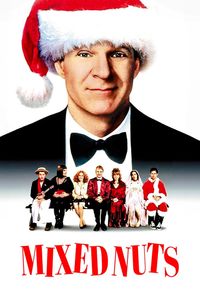
    (In French, On Cable TV, May 2020) I’m somewhat nonplussed by Mixed Nuts. It’s a weird, very Americanized adaptation of the pitch-black French Christmas comedy classic Le père Noël est une ordure (which I haven’t seen in ages), set in snowless Los Angeles on Christmas Eve. Much of the weirdness is due to it being pulled in two different directions—the very dark comedy of the original (which ends with body parts of a serial killer being wrapped up in Christmas packaging and fed to zoo animals) and the innocuous audience-friendly style of writer-director Nora Ephron. I mean—this doesn’t feel like an appropriate match, and it isn’t. What were they thinking? This is the kind of premise (dark comedy hijinks at a suicide prevention hotline on the day before Christmas) that calls for a low-budget anarchic approach, not a glossy Ephron-style comedy. This is nowhere as dark as it should be, and it’s wrongly engineered for guiltless Christmas cheer. The high-budget slick approach also ensures that the film is made to be safe, and that, in turns, means that its approach to two sensitive topics—mental health and transgenderism—now feels half-outdated rather than transgressive. (It’s not as bad as it could have been—Liev Schreiber’s transwoman character is treated with some respect—but it clearly wouldn’t be remade the same way today.) As a result, the comedy feels both forced and neutered, and the laughs usually take the form of mildly amused smiles. But even then, as the film’s title jokes on my behalf, Mixed Nuts is also a grab-bag of other, more interesting bites: The cast is admittedly impressive, with a mixture of names that were familiar at the time (dark-haired Steve Martin as the hotline director, Rita Wilson as the attractive co-worker with a crush, Juliette Lewis, Madeline Khan and Rob Reiner), and other ascending actors used in sometimes small roles (Adam Sandler doing ukulele, a Steven Wright cameo, Parker Posey and Jon Stewart as rollerbladers, Haley Joel Osment and others.) Martin and Wilson, in particular, get nice roles even in the middle of a confused comedy. Still, The biggest takeaway I’m getting from Mixed Nuts is that I need to re-watch Le père Noël est une ordure soon.

  • Bewitched (2005)

    Bewitched (2005)

    (On Cable TV, August 2016) For a television show adaptation that could have coasted on simply reprising the basic elements of the original, there is a whole lot more postmodernism to Bewitched than necessary … and it does help make the movie better than it should have been. Less-annoying-than-usual Will Ferrell stars as an arrogant high-profile comic actor in desperate need of a hit, accepting a lead role on a TV show based on the old Bewitched TV show. So far so good, except that the show also ends up selecting an unknown woman (Nicole Kidman) as the co-lead … unaware that she’s a witch trying to go straight. Numerous hijinks ensue, helped along by the multiple levels of fiction and wizardry. Written and directed by Nora Ephron, Bewitched does have a gentle comic quality heightened by it meta-fictional nature. Ferrell is more or less up to his own standards, but Kidman is effortlessly charming as a good witch, with Michael Caine as her disapproving father. Shirley MacLaine also shows up as a matriarch with secrets, plus Steven Colbert in an actual character role. The film itself isn’t that great, but it’s decently entertaining for what it is, and it would have been far less interesting had it not nudged, even gently, in postmodernism. As far as adapting old TV shows are concerned, I’ve seen worse.

  • Julie & Julia (2009)

    Julie & Julia (2009)

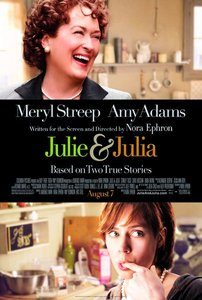
    (In-flight, November 2009) Nora Ephron’s films are generally amiable and unobjectionable, but after a short absence from the big-screen, it’s good to see her move slightly-away from romantic comedies to tackle a film about cooking, blogging and female empowerment.  The twin true stories of Julia Child (who, in the fifties, popularized French cuisine in America) and Julie Powell (who, nearly fifty years later, took on the project to cook her way through Child’s first book in a year and blog about the experience), Julie & Julia is perhaps most enjoyable as the journey of two foodies.  It’s practically impossible to sit through the film and not be shamed into becoming a better cook.  Food remains the film’s love interest even as various romantic subplots are weaved in the narrative.  The film’s biggest problem is that its two true stories don’t necessarily intersect with grace (although there are a few nice transitions) and that the conclusion feels a bit flat: There are no big dramatic finales built into the true events that inspired Julie & Julia, and some of the most intriguing elements of the story (such as Child’s lack of affection for Julie’s blog) are not necessarily explored.  More happily, it’s striking that the best depiction of a blogger so far in mainstream American cinema (what motivates them, the challenges they face, the thrills of being read) has been in a fluffy food romance.  Who would have thought?  Otherwise, there’s little to dislike in Julie & Julia: maybe a sense of material not being fully exploited, but the funny moments, another great performance by Meryl Streep and food-friendly atmosphere usually compensate for those.