Of Human Bondage series

  • Of Human Bondage (1964)

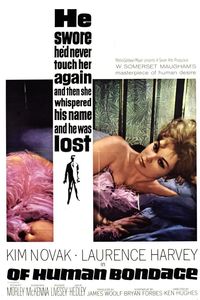
    Of Human Bondage (1964)

    (On Cable TV, February 2020) In retrospect, it wasn’t such an idea to watch all three filmed adaptations (1934, 1946 and 1964) of W. Somerset Maugham’s novel Of Human Bondage back-to-back-to-back. Not so much because they all blend together (they all have their own particularities) but because their story is so trite that a triple dose of it can be overdoing it. This third version is, in almost a tautological way, the most modern of them: the camera moves and the staging are self-consciously cinematic as opposed to the quasi-theatrical way the first two movies were directed. The use of deep shadow, more naturalistic sets and less expensive costumes don’t necessarily work in the film’s favour, especially when measured against the first film. While this Of Human Bondage is a bit more daring, story-wise, than its Hays Era predecessor, it does remain curiously stiff and old-fashioned, something that the black-and-white cinematography doesn’t help even at its most visually three-dimensional. While the film’s technique narrowly gives it a second-place finish in the remake trilogy, the narrowness is against the third-place finish for the 1946 version and not the untouchable 1934 one.
  • Of Human Bondage (1946)

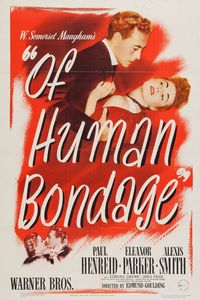
    Of Human Bondage (1946)

    (On Cable TV, February 2020) In retrospect, it wasn’t such an idea to watch all three filmed adaptations (1934, 1946 and 1964) of W. Somerset Maugham’s novel Of Human Bondage back-to-back-to-back. Not so much because they all blend together (they all have their own particularities) but because their story is so trite that a triple dose of it can be overdoing it. This second version is probably the worst of the three—or at least the least interesting. It does crank up the melodrama, but doesn’t quite manage to catch up to the grandeur of the first adaptation—although it’s probably a bit more accessible, taking into account twelve years of improved filmmaking and decreased stiffness from the actors. This being said, it’s also the weakest from a cinematographic standpoint: Even when broadcast on TCM—known to use the highest-quality copies available—, this Of Human Bondage suffers from high-contrast cinematography, with details being absorbed in the overwhelming blackness of the picture. Story-wise, the film also suffers (read: is made boring) from having been made at the nadir of the Hays Code era—it’s remarkably tamer than its pre-Code forebear or post-Code successor. This 1946 version is nowhere as essential as the first film’s star-launching role for Bette Davis nor as relatively modern as the 1964 version…, which is another way of saying that’s probably not worth watching unless you’re really going to be a completist.

  • Of Human Bondage (1934)

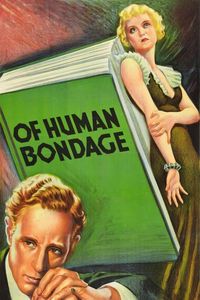
    Of Human Bondage (1934)

    (On Cable TV, February 2020) In retrospect, it wasn’t such an idea to watch all three filmed adaptations (1934, 1946 and 1964) of W. Somerset Maugham’s novel Of Human Bondage back-to-back-to-back. Not so much because they all blend together (they all have their own particularities) but because their story is so trite that a triple dose of it can be overdoing it. This first version is probably the best—or at least the most interesting. Casting makes it worthwhile: With Bette Davis’s star-making role here, the film becomes a showcase for both her (in a shrill, somewhat unpleasant role) and for co-star Leslie Howard—although we know who’s the biggest star here. The film’s most striking moment is simply seeing Davis in full frame, her big eyes staring at the camera and showing where the Kim Carnes song comes from. Other than that, this Of Human Bondage does manage to make good use of its pre-Code status by showing a destructive love affair between two flawed individuals. It does have the qualities of 1930s prestige productions: Despite the restrained camera techniques, rough technical qualities and acting styles, the sets and costumes are lush, and the brightly-lit cinematography does have its own charms. The antagonistic romance between the two leads is interesting, and the literary origins of the story are never too far away. (Although the film, like its later remakes, does occlude a lot of detail from the original novel in the interest of focus and length.) Even today, the film is best remembered for offering Davis a plum role that would define her persona—she was at her best playing devious, often unlikable characters and she gets a good dose of that here. Given that the film is in the public domain, who can even watch it from the film’s Wikipedia page.