Pat O’Brien

  • Boy Meets Girl (1938)

    Boy Meets Girl (1938)

    (On Cable TV, May 2021) I have a fondness for Hollywood movies satirizing Hollywood, but the ones from the 1930s will always have a special place in my heart — Hollywood was still giddy about itself back then, and a bunch of urbane screenwriters were still having fun selling the Dream Factory to the rest of America. Boy Meets Girl (while not strictly meeting the definition of Hollywood-spoofing-Hollywood, being an adaptation of a Broadway play) is one of the better such films of the era, thanks to its witty dialogue, jaded-but-not-cynical approach and having James Cagney in the lead role. Our two protagonists are screenwriters trying to keep their studio job while helping out a pregnant woman, and the film’s stage-bound origins can best be deduced by the number of sequences set in the studio executive’s office. The chaotic humour here is as fast as Cagney’s ability to rattle off dialogue, and the best moments of the film are impromptu improv sessions in which Cagney and his writing partner (Pat O’Brien, gamely keeping up) create new—if repetitive—variations on the old “boy meets girl” story. It’s all in good fun, with a fake over-the-top trailer clearly showing the film’s satirical bend. Marie Wilson is nothing short of adorable as the pregnant young woman that the protagonists are trying to help — and, more importantly, the beacon of sanity that makes the manic energy of the rest of the film mean something. Even acknowledging that I’m an easy audience for this kind of material, Boy Meets Girl is still a lot of fun to watch.
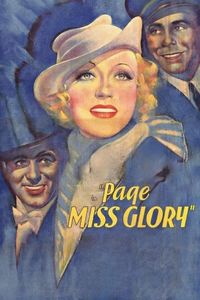
  • Page Miss Glory (1935)

    Page Miss Glory (1935)

    (On Cable TV, February 2021) While I like 1930s comedies a lot more than you’d think, an issue I’m noticing from those films is that they are frequently featureless from an audiovisual perspective compared to later movies. This is not a criticism — more an acknowledgement that technical means being limited at that time, 1930s films work within a narrow range of audiovisual constraints, something that can be further throttled by films that have not been (or cannot be) restored. It’s almost all black and while, or rather shades of gray with very little dynamic range. The audio is usually scratchy, with very little range between the highs and the lows. Soundtracks are usually made of classical music pieces with few variations. The result, unfortunately, means that movies of that era will not catch your eyes and ears as well as later films — if you happen to be distracted, the film will not draw you back in through an arresting colour scheme, flashing lights, loud noises, catchy songs or any of the techniques that decades of filmmaking have perfected. I’m bringing this up regarding Page Miss Glory not only as an example of a widespread issue, but also to explain why, despite a promising plot in which a made-up star has to be played by a real person, the film had a really hard time keeping my attention. There’s no real reason, from a script-centric point of view, why it should be so: the story itself still has some originality, the stars are fine (including Marion Davies, Pat O’Brien and Dick Powell), director Mervyn LeRoy’s work is adequate for the time… but the film itself seems to flitter away at the slightest distraction. I could, I suppose, watch Page Miss Glory again under the strictest constraints to give it my full attention. Or I could just complain about its relative flatness.

  • The Front Page (1931)

    The Front Page (1931)

    (On Cable TV, November 2019) One of the reasons why Hollywood keeps remaking films is that in the best-case scenario, you don’t just have a decent commercial product with built-in brand recognition—you get a new classic that completely replaces the original. In theory, this can happen more easily because the remake can take a look at the original and improve upon its weaknesses. This is certainly not a new thing—Hollywood has been in the remake game since the silent era, and there was a particularly high number of remakes in the 1930 as the studios “upgraded” their silent films to more popular talkies. But I’m blurring lines, here, because if the 1931 version of The Front Page is an adaptation from a Broadway play (one co-written by Ben Hecht, who would become one of Hollywood’s first famous screenwriters), it’s not a remake. On the other hand, it was remade three times, and the first of them—1940’s His Girl Friday—has become an all-time classic eclipsing the 1931 original. (Meanwhile, the 1974 remake of the same name featuring Jack Lemmon and Walter Matthau is a pleasant but not essential diversion, while 1988’s Switching Channel is all but forgotten today.)  Where I’m going with this epoch-spanning consideration of remakes is that considering the existence of His Girl Friday (the best take on the story) and the 1974 version (the most accessible one to modern audiences), only die-hard film historians or curious cinephiles have any reason to go back to the 1931 original. And yet: Had it never been remade, The Front Page would still be remembered as a funny screwball take on the tough-and-tumble world of print journalists at the turn of the 1930s, almost breathtaking in its Pre-Code cynicism. The technical qualities of the film are a bit rough, while Adolphe Menjou and Pat O’Brien are merely fine as the protagonists. It’s not a bad movie! But when put against His Girl Friday, it’s clear that director Lewis Milestone is not working in the same world-class league as Howard Hawks did in his remake, nor are the actors as crackling as they were in the remake. The film will forever work in the shadow of its successor—part of the proof being that the easier way to purchase the film today in its best quality is as an extra in the Criterion Edition of His Girl Friday. Sure, have a look if you’re already familiar with the other films … but see the other ones first if you haven’t.