Paul Mazursky

  • Bob & Carol & Ted & Alice (1969)

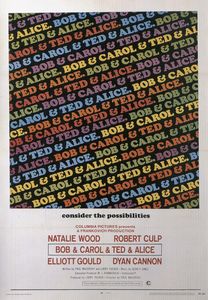
    Bob & Carol & Ted & Alice (1969)

    (On Cable TV, March 2020) Mainstream Hollywood’s take on the sexual revolution of the 1960s gets one of its definitive examples in Bob & Carol & Ted & Alice. Writer-director Paul Mazursky takes on the radical openness of the time with his protagonists seeking enlightenment (or maybe just a sense of cool) through affairs and proposed swinging. But nothing quite goes as planned, which definitely keeps the film more interesting than a simple time capsule. A typical problem with 1960s films is that they often feel like watching your parents trying to goof off—we know it’s not going to hold and, in the meantime, it’s just embarrassing. Bob & Carol & Ted & Alice, in its breathless embrace of free love and infidelity, occasionally runs into this problem. But keep watching because Mazursky eventually arrives at a conclusion that anticipates the post-hedonistic letdown of the 1970s. Or maybe the film is more about messy feelings than the attraction of free sex, and that works just as well. In addition to Mazursky’s welcome ambivalence about the whole thing, the film does benefit from a solid cast—with specific mentions to the ever-beautiful Natalie Wood and a pleasantly goofy Elliott Gould. While permeated by the smell of the 1960s, Bob & Carol & Ted & Alice has aged better than the average drama of the time: it doesn’t go for easy answers, moral characters or irony. It’s still definitely a period piece, but not an unbearable one.

  • Down and out in Beverly Hills (1986)

    Down and out in Beverly Hills (1986)

    (In French, On Cable TV, November 2019) There’s something quite provincial in Hollywood making a movie about class differences in Beverly Hills—I can’t figure out whether Down and out in Beverly Hills is hypocritical or self-flagellating, although with writer-director Paul Mazursky at the helm, it’s closer to a gentle critique than outright satire. The plot gets moving once a bum nearly drowns in a rich family’s house, and they welcome him out of a sense of guilt. But the bum (as is tradition) sees clearer and thinks farther than his new dysfunctional family and before long sorts out all kinds of big and small problems. The plot schematics are obvious, but the film does a little bit better on moment-to-moment viewing thanks to a capable cast. In between Nick Nolte, Bette Midler, Richard Dreyfuss and a young Elizabeth Peña (plus Little Richard as a neighbour), the film does have its charms, and recognizably aims for more than just the laughs. Thematically, I’m bothered by how the film doesn’t seem to have the courage of its convictions—I’m not sure that the dysfunctional family won’t be back to dysfunction within the week. This may be a consequence of Mazursky not quite going for comedy and not quite going for drama—Down and Out in Beverly Hills ends up being a less-than-satisfying hybrid, watchable but not admirable.