Paula Prentiss

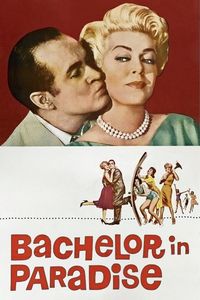
  • Bachelor in Paradise (1961)

    Bachelor in Paradise (1961)

    (On Cable TV, February 2021) If you believe the movies, Americans woke up in the 1960s and starting to notice all sorts of new phenomena around them. What is that sex thing? ask the movies of the time. The truth is somewhat less revelatory — it’s the movies that unshackled themselves from a prudish reflection of American society, and it had to be done in a very gradual way, as so not to shock the masses. A first step along the way were the cute sex comedies of the early 1960s, in which the films barely hinted at naughtiness — which, to be fair, was a step up from the previous decade. It’s in the vein that Bachelor in Paradise features Bob Hope as a salacious best-selling playboy author who infiltrates a suburban community in the hopes of researching a new book. While over there, he’s confronted by the prejudices of neighbourhood gossip queens, especially when he, a single eligible bachelor, finds himself surrounded by lovelorn housewives. As usual for films of the time, Bachelor in Paradise is as interesting for its unspoken presumptions and period detail than for the elements of its narrative. The sequence set inside a grocery store is a fascinating throwback to how people shopped at the time, while the various social taboos being broken are often more revelatory of 1961 American than the filmmakers would care to admit. Bob Hope does make for a funny protagonist — and seeing Lana Turner as his romantic foil doesn’t hurt, even though I find Turner more generic than many other commentators. (I rather would have liked Paula Prentiss in the role, but that would have broken her expected on-screen pairing with Jim Hutton.)  While Bachelor in Paradise remains quaintly sexist, is not built for social commentary and pales in comparison of more groundbreaking films later in the decade, it’s intriguing, cute, charming, and quite a bit of fun to watch even today.
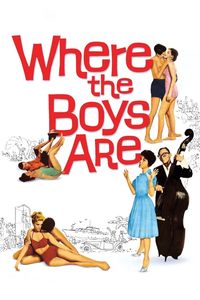
  • Where the Boys Are (1960)

    Where the Boys Are (1960)

    (On Cable TV, February 2021) I’m uncomfortable calling Where the Boys Are a sex comedy, even though it’s most commonly described as such. For one thing, the moniker “sex comedy” as applied to 1960s films means something very different than when applied to its much coarser post-1975 equivalent: Even in movies squarely taking a look at the changing nature of sex in a liberating society, 1960s sex comedies were usually charmingly restrained by today’s standards. The second, most fundamental objection is that Where the Boys Are may start as a sex comedy with boys and girls heading to Fort Lauderdale in order to you-know-what, but the film steadily slides into a dramatic register, with a sobering ending that kicks the joy out of nearly all of the characters thanks to a rape sequence (largely off-screen, but still disturbing) that punctuates an increasingly disillusioned arc. If you think that circa-1960 films were innocent, you may be confusing the execution with the fundamentals: As our characters, both male and female, head to the beach, everyone is acutely aware that boys prey on girls and that nice girls must learn to say no — the girls who escape the worst have developed defences against common come-ons, honed by constant practice. If that’s not a damning, timeless lesson, I’m not sure what is. It does put Where the Boys Are in an uncomfortable spot, though: if you stopped watching at the three-quarter mark, you’d probably recall the film as an amiable, naughty, clever sex comedy examining the burgeoning spring break culture among college students heading south for a week of fun. There’s some truly funny material here, whether it’s physical comedy, girls accumulating more and more floor-sleepers in their hotel room every passing night, some satirical material about “dialectic jazz” and unusually kind police officers. The cast is also pretty good, what with a slim George Hamilton, lovely Paula Prentiss, cute Yvette Mimieux and funny Connie Francis, along with Dolores Hart playing band leader to this clever merry bunch. But then there’s the letdown of the film’s last few minutes that, ironically, saps the comedy but sharply increases the interest of the film for modern viewers—as a shining demonstration that people of the 1950s–1960s, despite the neutered contemporary depictions of their times, knew perfectly well what it was all about and what was going on. It feels like an inevitable tragedy that the films inspired by Where the Boys Are, most notably the Beach party series, were considerably lighter to the point of fluffiness — but they made money and offended no one.

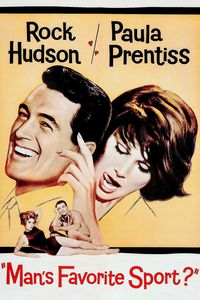
  • Man’s Favorite Sport? (1964)

    Man’s Favorite Sport? (1964)

    (On Cable TV, December 2020) Any movie that claims to be directly inspired by Bringing Up Baby gets a fast-track to my affection, and Man’s Favorite Sport has a much stronger claim than others at that distinction, having been directed by Howard Hawks – who apparently tried to get Cary Grant and Katharine Hepburn to reprise their roles. He obviously wasn’t able to do so, but getting Rock Hudson and Paula Prentiss instead is really not a bad substitute. The story has to do with a fishing expert having never fished (Hudson) and the woman (Prentiss) who discovers his secret on the eve of a major competition. But the plot is really a driver for a neo-screwball comedy featuring Howard’s typical fast pace running roughshod over absurd comic situations. The film can be especially funny to those with some outdoors experience, as much of it is seeing a befuddled Hudson trying his best at becoming an outdoorsman. Prentiss is cute and vivacious enough, while Hudson is perhaps a bit uncomfortable in a zanier comic persona that was asked of him in earlier romantic comedies. (I have a hunch that Hudson was never able to completely surrender his persona to the ridiculousness of the comedy beats.) There’s a sense that the film wasn’t quite able to get the lightning pace of previous Hawks screwball comedies, but it’s not for lack of trying and the result is that Man’s Favourite Sport is merely funny rather than hilarious – which is still a success.

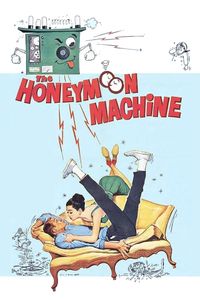
  • The Honeymoon Machine (1961)

    The Honeymoon Machine (1961)

    (On Cable TV, November 2020) We don’t naturally associate Steve MacQueen with comedy, but The Honeymoon Machine does offer him a good showcase for his persona in a more lighthearted context. Here, he plays a hustler-type US Navy sailor who sees an opportunity when his ship, equipped with a super-powerful computer, docks at a fantasy version of Venice complete with a casino and a luxurious hotel suite. Dragging fellow crewmembers into his burgeoning scheme, he rents the suite, gets the cooperation of the computer expert, brings in the necessary equipment to communicate with the ship and finds a way to crack the probabilities of roulette. Things get funnier and more complicated when the admiral’s daughter stumbles into the suite, when the computer operator’s old flame resurfaces, when the admiral launches an investigation into unauthorized ship-to-shore communications and when even the Russians grow concerned about what’s happening with the Americans. Before long, The Honeymoon Machine (adapted from a Broadway play) has several spinning plates all crashing into each other in comic complications. MacQueen is his usual cool and likable self, except playing for farce this time around and being good at it—even if he reportedly walked out on the film’s sneak preview. Meanwhile, Paula Prentiss looks gorgeous in her character’s thick-rimmed glasses, even with the film making a few jokes about it. The Honeymoon Machine is not a good movie, but it’s a fun one—it’s very much in-line with a stage-bound farcical tradition and is well worth rediscovering from Hollywood’s archives. Plus, there’s a MacQueen in a rare comedy role, which isn’t the least of the film’s charms.