Paulette Goddard

  • Second Chorus (1940)

    Second Chorus (1940)

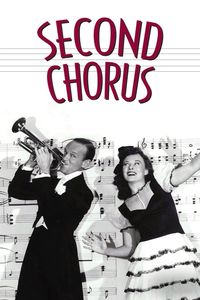
    (On TV, February 2021) The more I dig into Fred Astaire’s filmography, the more I understand why some of his movies aren’t as popular as other ones. While Astaire himself is never less than funny and amazing, the rest of the movies can’t always claim as much. Second Chorus still gets some airplay these days, but one suspects that its status as a public domain film has much to do with the circulation of its low-quality prints. It’s also a film that curiously de-emphasizes Astaire’s skills as a dancer. Instead, the premise has us believing in Astaire (then forty-one) as a twentysomething trumpeter who voluntarily flunks his courses in order to remain with the college band. His friendly competition with another trumpeter kicks into high gear when they meet a young woman and convince her to work for them as a manager, in turn causing no less than bandleader Artie Shaw to recruit her. The rest are comic shenanigans occasionally making good use of Astaire’s skills — most notably in a duet with co-star Paulette Goddard and a climactic number in which tap-dancing is combined with orchestra conducting. More of a band movie than an Astaire movie (especially thanks to Artie Shaw’s contribution), Second Chorus is pleasant to watch but hardly in Astaire’s top half. Goddard herself is far from being the best dancer Astaire’s been paired with (although she does quite well in their sole duet, the one-shot “I Ain’t Hep to That Step but I’ll Dig It”), but she’s among the cutest. Astaire does get a few more good comic scenes — including “Kamarinskaya,” in which he dresses up as a Russian for some step-dancing — but there’s a sense that Second Chorus wastes the considerable talent he brings to it. The result is fine, but just fine: there’s little in the way of pyrotechnics that he brought even to his most average efforts. But that’s what I get for watching Astaire movies in rough descending order of popularity.
  • Pot o’ Gold (1941)

    Pot o’ Gold (1941)

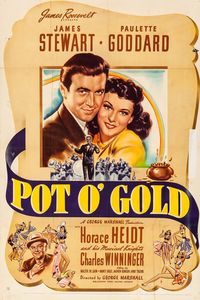
    (On TV, January 2021) James Stewart’s filmography is vast, and not all of his movies are equally good or as well known to modern viewers. By 1941, he was already well known—The Philadelphia Story had earned critical acclaim, and you could see his screen persona coalescing around his specific strengths. These strengths did not necessarily include singing and dancing, making him a curious choice for Pot o’ Gold, a musical comedy teaming him with Paulette Goddard along with feuding families, obscured identities and a radio program distributing cash prizes. There’s singing, dancing, romance and comedy—but the sum of it is less successful than you’d expect. Stewart himself wasn’t a fan of the film, and contemporary reviews were harsh. Nowadays, Pot o’ Gold can be mildly interesting for the incongruous spectacle of Stewart in a musical comedy role, or as another film to feature the beautiful Goddard. Still, it’s not much of a success, and there are plenty of better films to see.

  • Hold back the Dawn (1941)

    Hold back the Dawn (1941)

    (On Cable TV, February 2020) I’m a good sport for anything written by Billy Wilder, but even I remain underwhelmed by Hold Back the Dawn. Wilder’s biography tells us that it was largely inspired by his own life—as an immigrant from Europe, Wilder had to spend some time waiting at the Mexican/American border for his right to enter the country. Of course, Wilder’s stay was uneventful—the story here is quite different. Charles Boyer stars as a European gigolo trying to gain entry to the US and resorting to what he does best—seduction. Taking aim at a visiting American schoolteacher, he inevitably develops feelings for his mark, and much of the film follows the consequences of trying to square everything away. We know from the framing device that he will make his way to Hollywood, but there’s more than him to care about. Olivia de Havilland plays the romantic interest, adding a further bit of star-power to the result—although Paulette Goddard is more interesting as a vengeful flame. Hold back the Dawn is unapologetically a grand Hollywood romantic drama. It seldom holds back in terms of melodrama, and toys with audience expectations in its very dramatic third act. While it does end well (at least for most characters), there are plenty of dramatic complications along the way, and chances for the actors to deliver sob-inducing speeches. I liked it well enough as an example of that kind of film, although I can’t say that I have any particular affection for it over similar examples.