Peter Bogdanovich

  • The Thing Called Love (1993)

    The Thing Called Love (1993)

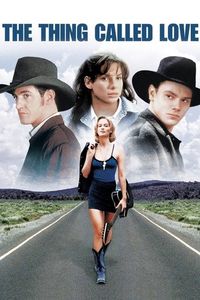
    (On Cable TV, October 2021) I still have many films to go before I’m done with Peter Bogdanovich’s filmography: he’s had an eclectic career, and while his best-known films are almost classics, the rest of his work is practically obscure. I certainly had no idea about The Thing Called Love, although the circumstances of the film’s release (close to the untimely death of its headliner River Phoenix, ensuring a quasi-confidential release out of fears to be seen exploiting the situation) have not helped the film reach posterity. It probably doesn’t help that it also heads for familiar territory in showing the low-intensity struggles of four songwriters working to strike it big in Nashville. Despite a few romantic sparks, the film remains about struggling artists and how they congregate every week for a chance to play at an influential local bar. For many viewers, the draw here won’t be for Bogdanovich’s careful direction but seeing a main cast featuring young River Phoenix, Samantha Mathis, Dermot Mulroney and Sandra Bullock. The soundtrack is not bad (and I say this while having no special affection for the country/western genre), although the romantic subplots feel underwhelming compared to the performing aspects. The script does have a sense of humour, and the result is not much of a chore to sit through. Still, The Thing Called Love will never be considered an essential film—perhaps for fans of the lead actors, perhaps for those invested in songwriting (as opposed to simple vocal performance), perhaps for Bogdanovich fans.

  • Targets (1968)

    Targets (1968)

    (On Cable TV, November 2020) Aside from the content of the film itself, there’s a wistful quality in Targets that comes from seeing the beginning of a career and the end of another—this being Peter Bogdanovich’s first film, and Boris Karloff’s last starring role. The production history of the film has its quirks—it came from Roger Corman being owed two days of work by Karloff, and instructing then-young writer-director Bogdanovich to make a low-budget movie around this constraint. Taking advantage of the social turmoil of the time, Bogdanovich ended up building a clever twin-strand plot featuring an aging horror film actor and a young Vietnam veteran going on a murderous rampage. The intention is obviously to confront old horror and new monsters, and the ending does finally bring everything together. Targets can feel surprisingly modern at times—the idea of a random person just shooting people off the highway still unnerves, and the gritty handheld style of the film does echo far newer films. The result is worth a look, although it can feel like a drag at times—by shooting around Karloff’s schedule, Bogdanovich was inspired by creative constraints but wasn’t quite able to tie everything up in a completely seamless way. Still, Targets makes an interesting argument at the dawn of New Hollywood, and benefits from having an old-school star in the lead role.

  • Bombshell: The Hedy Lamarr Story (2017)

    Bombshell: The Hedy Lamarr Story (2017)

    (On TV, April 2020) The story of how a beautiful movie star invented Wi-Fi is now well-known enough to be part legend and part truth. While Bombshell: The Hedy Lamarr Story helps detail much of what happened, it does err a bit too much on putting the modern foundations of western civilization on Lamarr’s shoulders. Much of the film is about Lamarr becoming a movie star—her early career in Europe, immigration to the United States, success as an actress, and the legendary beauty that opened up many doors, whether they were professional or romantic. Since Bombshell is a hagiography, it doesn’t really mention how Lamarr’s films have not endured—Like Brigitte Bardot, she’s a movie star whose individual films aren’t that good, and unlike Bardot, she doesn’t have a signature film that people can point to and say, “This is what Lamarr was about.” Still, Lamarr was reasonably popular during World War II and if her life had been limited to her filmography, she still would have been an interesting topic for a film. But there’s more, obviously—thanks to contacts in the arms-dealing world (via her then-husband) and a musician friend, she co-patented a technique to hop between frequencies. This concept eventually became a building block for a host of later radio technologies, including the modern Wi-Fi protocol. Since Bombshell is all about Lamarr, it does draw a very thick, short and exaggerated line from Lamarr’s idea to modern-day Wi-Fi routers, ignoring the smorgasbord nature of technological development. The beauty-with-the-brain story is too hard to resist, though, and so is the tragically-victimized-woman narrative. In the third act of the film, we go over Lamarr’s less-than-impressive decline over the next five decades—how she married six times, wasn’t able to successfully transition away from the bombshell movie persona and how she eked a meagre living in difficult circumstances. The film definitely soft-pedals Lamarr’s increasing litigiousness and crankiness in later years, as well as her penchant for petty crimes such as shoplifting—although, amusingly, one of the targets of her lawsuits, Mel Brooks, ends up delivering one of her strongest defences when interviewed for the film. Still, Bombshell is equally dedicated to making a saint out of its oppressed heroine, blaming society-at-large for her use of drugs, her poverty, and her increasing obscurity until she and her achievements were essentially rediscovered during the 1990s. (Makes sense: I first heard about Lamarr in 1996 when her portrait won a CorelDraw contest—something that led to another lawsuit.) At the very least, Bombshell lays out the three main poles of interest in Lamarr’s life in compelling fashion, with several interviewees, including Peter Bogdanovich, Jeanine Basinger, Robert Osborne, her children and Lamarr herself in archival footage. It’s informative, compelling, emotional, somewhat authentic and filled with good archival footage. It’s, in other words, most of what you need to know about her. Where I’ll diverge from the usual good words, however, is in regretting that writer-director Alexandra Dean took the easy hagiographic way to cover the material, going for the cheap yet unarguable “genius woman underestimated because of her good looks” tragedy angle when there’s a lot of material unsaid or unexplored that would make this a more complex tale. But no—Lamarr is at the centre of the universe in Bombshell, so much so that it’s a wonder she’s not portrayed installing home routers.
  • What’s Up, Doc? (1972)

    What’s Up, Doc? (1972)

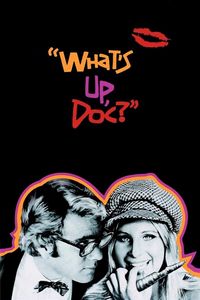
    (On Cable TV, March 2020) There’s an adorable playfulness at work in writer-director Peter Bogdanovich’s What’s Up Doc? that makes it difficult to resist—and doubly difficult if you’re even casually aware of screwball comedies. Barbra Streisand and Ryan O’Neal star: he in a straight-laced role while she plays the anarchic Bugs Bunny figure turning his life into chaos. There are several broad acts to the film, from the first-act hotel farce to a fight sequence, a large-scale chase through San Francisco, an absurdly funny courtroom scene and then the romantic conclusion. It makes What’s Up, Doc? slightly episodic, but the energy and comedy are kept at a high pace throughout. (Then it eviscerates O’Neal’s own turn in Love Story in its final moments, which is always a plus.) While the film explicitly patterns itself on 1930s filmmaking, today’s audiences will see another kind of nostalgia in the film’s generous display of 1970s fashion. It all amounts to something very enjoyable to watch—perhaps not quite completely hilarious from beginning to end, but still a film that’s easy to like. I’m not sure Bogdanovich was ever looser, funnier or more crowd-pleasing than in putting together What’s Up, Doc?

  • Paper Moon (1973)

    Paper Moon (1973)

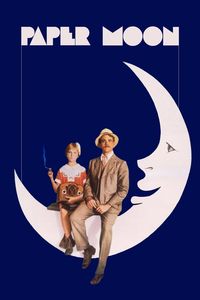
    (On Cable TV, December 2019) Considering writer-director Peter Bogdanovich’s fondness for Hollywood history, it really shouldn’t be a surprise how the opening moments of Paper Moon almost perfectly recreate depression-era filmmaking, down to the black and while flat cinematography and acting styles. Of course, this being an early-1970s film, this façade slowly crumbles as the film goes on, as it features a con artist and his daughter merrily scamming their way through the Midwest. Ryan O’Neill here holds one of his best roles, opposite his own daughter Tatum O’Neil. The tone is a semi-comic one with a big sentimental ending—although you have to be indulgent as our heroes scam widows and sell illegal booze back to their owners. The episodic structure of the film works relatively well as characters enter and exit the story—Madeline Khan is a welcome sight as an avowed gold-digger with no perceptible loyalty. It also builds to an emotional climax, as the film gradually makes its way from tragedy to comedy to drama. The interplay between father and daughter is quite nice, and Tatum may be more impressive than her father (who, should it be noted, rarely made an impression as an actor) in an Oscar-winning role. I’m not so sure that Paper Moon deserves its presence on the various best-of lists that I’ve seen, but then again, I’ve had worse movie-watching experiences.

  • Mask (1985)

    Mask (1985)

    (In French, On TV, July 2019) There’s something almost joyous in the way director Peter Bogdanovich presents Mask, the story of severely disfigured teenager Rocky Dennis, as adapted from a true story. Well, at least through most of the movie—as we follow Rocky while he integrates to a new school, his visible disfigurement takes a back step to his sweet inner nature and the various other issues he’s got to work through, from a drug-addicted mother to the vagaries of romance and friendship. Eric Stoltz masters the lead role under a significant amount of makeup, but Cher is quite amazing as a feisty single mom running with bikers, and Sam Sheppard has a persona-defining performance as a revered motorcyclist. A teenage Laura Dern shows up as a significant secondary character. Much of Mask is considerably lighter than you’d expect, with the protagonist overcoming one obstacle after another through intelligence, humour, and determination. There’s an absorbing rhythm to the film as it sidesteps expected sequences and grows larger than simply being about the protagonist’s appearance. (Decades later, Wonder would have much of the same approach and strengths.)  The ending of the film, alas, isn’t nearly as cheerful. While telegraphed early on (and predictable from the facts on which the movie is based), the conclusion brings the cheerfulness to a halt and adds a lot of gravitas. Nonetheless, Mask is a bit of a surprise—not as exploitative, broader than expected, it remains a fine film now that the mid-1980s patina has added a bit of period charm to the result.

  • Star 80 (1983)

    Star 80 (1983)

    (In French, On Cable TV, June 2019) The early 1980s were an interesting time in Hollywood’s history—a period where there was a battle going on for the soul of Hollywood, lines drawn between the New Hollywood of grimy dark stories, and the purveyors of Pop Entertainment that sought to bring cinema back to its crowd-pleasing origins. We all know how things played out, but even as late as 1983 you could still see movies steeped into 1970s aesthetics and themes. A movie like Star 80, for instance, which details the abusive relationship between a Playboy playmate and her homicidal ex-boyfriend. It’s all based on a true and sad story. (Hugh Hefner and Peter Bogdanovich both show up as characters, with portrayals consistent of what we know of them.)  Given that this is a movie about a centrefold model, expect a fair and persistent amount of nudity—but keep in mind that Star 80 delights in contrasting the eroticism of the lead character with her bloody end, so it’s not exactly wall-to-wall fan service. At times, the film does give the impression of indulging in trash exploitation—the regular cuts from the biographical narrative to the maniacal murderer muttering about his revenge do get a bit ridiculous after a while. Mariel Hemingway is nice and doomed in the female lead role, while Eric Roberts is uncommonly slimy as the prototypical abusive, over-controlling boyfriend from hell. The role is written without any subtlety, and he holds nothing back—giving an intensely unlikable performance that actually quite good from an actor’s perspective but unbearable to the audience. Much of the same can be said about Bob Fosse’s direction: an atypical choice for him, with blunt-edged effectiveness. Pseudo-interviews are interspaced here and there to present the illusion of a documentary and further tie the film to 1970s cinema-vérité style: points given for a collage approach that was relatively new at the time, but still not quite satisfying. The overall effect is, frankly, a bit dull—it doesn’t take a long time to figure out where the thing is going, and the film just keeps going there relentlessly, with little character nuance beyond the angelic victim and the irremediable killer boyfriend. When you look at the way the 1980s turned their back on New Hollywood, you can point in Star 80’s direction as an example of why.

  • The Last Picture Show (1971)

    The Last Picture Show (1971)

    (On Cable TV, December 2017) As I’m dutifully checking off my list of acknowledged film classics, I usually side with the critics in appreciating what generations of reviewers have seen in them. But there are exceptions, and Peter Bogdanovich’s Oscar-nominated The Last Picture Show is one of them. It’s not as if the film is objectively bad—it’s that it manages to be boring despite deaths, drama and sex scenes. It’s that it may be too successful in portraying the dead-end monotony of a dying town and what people do to escape it. The black-and-white cinematography makes it look even more lifeless, and the two-hours running time feels even longer. From a technical perspective, I found much of the film jarring—the cuts between angles are awkward and the editing is just as lifeless as the rest of the film. An impressive number of actors such as Cybil Sheperd, Jeff Bridges, Randy Quaid, Ellen Burstyn and Cloris Leachman all show up in significant roles, but it’s Eileen Brennan who steals scenes as a very tired waitress. I still haven’t decided where the film is a success or not, given how I suspect that the whole point of it is to be as dull as possible in order to put ourselves in the character’s lives. I’m just glad that I made it out of there, and can now check off The Last Picture Show from my list of films to see so that I never have to see it again.

  • She’s Funny That Way (2014)

    She’s Funny That Way (2014)

    (On Cable TV, June 2016) I hadn’t seen a screwball comedy in a long while, and veteran writer/director Peter Bogdanovich’s She’s Funny That Way is unapologetic about how it tries to re-create the confused romantic farces of earlier film eras. Here we have an adulterous theatre director, his wife (an actress), their friend (an actor), an escort changed by their meeting, the worst psychiatrist even, a private detective, a lonely judge … clashing together in weird and ridiculous ways. The film gradually builds it set pieces, goofs along its equally goofy characters, leaves the actors to do their best and lets the chaos take over. What’s unfortunate is that the film keeps its best set pieces (the restaurant clash) for the middle, leading to a curiously lacklustre ending. Still, the film is fun, and the surprising number of recognizable actors showing up in minor roles only adds to the film’s unpredictability. Owen Wilson is fine as the lead director, with Kathryn Hawn, Rhys Ifan and Imogen Poots holding up their end of the plot. Surprisingly enough, queen-of-blandness Jennifer Aniston also turns in a thoroughly despicable performance. She’s Funny That Way’s pacing is zippy, the misunderstandings are numerous, the dialogue relatively interesting and a stuffed squirrel even shows up as a plot point. I’m not sure I can ask for much more.