Peter Boyle

  • The Friends of Eddie Coyle (1973)

    The Friends of Eddie Coyle (1973)

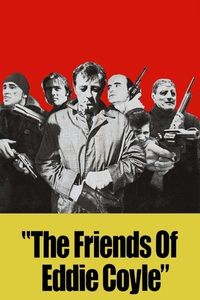
    (On Cable TV, July 2021) The 1970s were not a fun time at the movies, and movies like The Friends of Eddie Coyle certainly drive the point home. The story of an aging small-time gunrunner (Robert Mitchum) trying to navigate a tricky path between criminal friends and police officers who want him to become an informer in the hope of staying out of prison, it’s bleaker-than-bleak, uglier than sin and about as much fun to watch as your least favourite nightmare. Mitchum is quite good here — some call this performance his last great role, and he certainly fits the part of an older criminal with few other prospects, trying to protect his homely wife and daughters against the consequences of doing three-to-five in a state penitentiary. Spilling what he knows about his criminal associates seems like the least awful course of action, but there are consequences for such a thing. Peter Boyle also makes an impression as one of Coyle’s “friends.”  One of the film’s biggest draws as far as I’m concerned is hopping into the time machine to take a look at early-1970s Boston — It’s the big American city that I know best, so it was interesting to see the film tackle some landmarks, whether it’s the brutalist city hall, an already-familiar skyline or spending some time watching the accursed Bruins. (Alas, they play the Chicago Black Hawks rather than the Habs.)  There’s also a nice lime-green muscle car driving through big chunks of the plot. As an oft-mentioned representative of the neo-noir movement, it almost goes without saying that there is no happy ending in store for The Friends of Eddie Coyle, but even those who know what to expect will still be caught off-guard at the brutality of the conclusion. You have to have a solid stomach before delving into 1970s cinema in the first place, but this one goes a few extra steps further.
  • The Dream Team (1989)

    The Dream Team (1989)

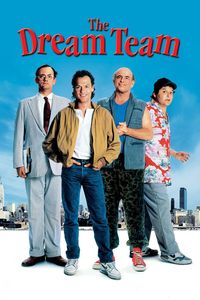
    (In French, On Cable TV, January 2021) Michael Keaton spent much of the 1980s starring in various comic vehicles of varying interest, and it’s interesting to note that one of the least engaging of them, The Dream Team, was released the same year that Batman raised him to a different class of actor. Little superheroism shows up here as the film sets up its dicey premise: what if a psychiatrist took four patients from the asylum to a baseball game in the heart of Manhattan? What if, to make it even more interesting, he was suddenly incapacitated and his charges were left to roam the city? Fortunately, The Dream Team is a comedy rather than anything else, and so the film sets out to show how our characters can act sane in an insane city and do some self-therapy along the way. Mix in a criminal subplot and you’ve got the bare essentials of an unthreatening Hollywood mental illness comedy in which all you need is love and unsupervised time. The biggest problem with The Dream Team is that while it has the bare foundation for a comic film, it doesn’t have much more. There are few laughs, few comic set-pieces, and quite a bit of excessive sentiment that often gives the impression of trivializing the issues it touches. Keaton is fun to watch—especially given that the film makes sure that his issues are not too severe—and the film does benefit from such comedy notables as Christopher Lloyd and Peter Boyle. But the potential of the film remains largely unrealized.

  • Johnny Dangerously (1984)

    Johnny Dangerously (1984)

    (On TV, December 2020) I’m not going to pretend that Johnny Dangerously is a great comedy. But I will say that it seems to have been unfairly forgotten over the decades. There are reasons for this, of course: This is Michael Keaton playing a mobster during his silliest era, and his run of 1980s comedies doesn’t get enough appreciation. Then this is a 1930s gangster film parody, and most people don’t remember those as clearly as they did even in the 1980s. (Although you could almost see Johnny Dangerously as a predictive parody of 1991’s Billy Bathgate.) It’s also quite uneven in matters of jokes – some witty bits are juxtaposed with broad dumb stuff, and the effect isn’t as much a film going for all kinds and levels of humour (something I usually respect and encourage) but a film that can’t quite find its own specific comic sensibility. This being said, there is some really funny stuff here, and some of the players (notably Peter Boyle, Joe Piscopo, Griffin Dunne and a younger Danny DeVito) carry their part really well. Keaton himself is charm and hilarity, while director Amy Heckerling can deliver a joke but often has trouble keeping some tonal unity over the entire thing. Johnny Dangerously may aspire to high-pace spoof comedy, but doesn’t quite stick the landing. Now, the best thing I could do to you would be to lower your expectations so that by the time you finally see the film, you would think that it’s better than you thought it would be. So here goes: Uneven but sporadically funny, Johnny Dangerously will do if you think you’ve seen the big comedies of the 1980s and are now making your way through the rest. It has a few funny surprises for you.

  • Young Frankenstein (1974)

    Young Frankenstein (1974)

    (On DVD, November 2001) Alas, years of ever-heightened comic pacing have not been kind to this satire of the first two Frankenstein films. (Which you should see in order to get a few scenes, most notably the blind man sequence.) The jokes come too slow, and sometime feel too forced. Fortunately, the actors pretty much earn our sympathy early on, and help considerably in enjoying the picture. (Particular wows go to Teri Garr, whose luscious Inga steals the show. “Vould you like a roll in ze hay? It’s fun! Roll! Roll!”) Mel Brooks fans will love it: the overall pacing is a lot like Blazing Saddles. The DVD features quite a few deleted scenes (justifiably cut for pacing, but they explain a lot. The “intellectual discussion” should have been kept in the film.) and a good making-of documentary that benefits from a comfortably-distant perspective.

    (Second Viewing, On Cable TV, March 2020) There are plenty of reasons why Mel Brooks’ Young Frankenstein is a great comedy that appreciates with time (I certainly like it a lot more now than in 2001), but my favourite one is that every top-billed actor in the movie goes all-out. Everyone has a memorable quirk to play, everyone has a few great scenes, and everyone gets to highlight something that makes them special — whether it’s Peter Boyle’s bulk, Marty Feldman’s bulging eyes, Cloris Leachman’s scenery chomping or Teri Garr and Madeline Khan’s gift for sexy comedy. And then there’s Gene Wilder (who co-write the script) – playing a neurotic character with carefully-studied cracks allowing a glimpse into the madness underneath. Better yet is that this terrific troupe of comic actors is finely controlled: unlike other Brooks films, Brooks-the-director finely keeps a handle on how to execute Brooks-the-co-writer’s script, and even keeps Brooks-the-actor from showing up. This gives to the film a deliberate nature that often feels missing from other Brooks film that never quite know when enough is enough – this one gets its laughs in, but doesn’t belabour the point. The laughs in Young Frankenstein are not always simple – a mixture of double-entendres, ironic riffs on overblown overacting, eye-rollingly dumb gags and a sophisticated pastiche of an earlier filmmaking era. The production means of the film are surprisingly good, which adds to the high comedy of the whole. Young Frankenstein is an incredibly slick production, and it’s hard to imagine it could be funnier.