Peter Falk

  • A Woman Under the Influence (1974)

    (Criterion Streaming, August 2021) I don’t particularly like A Woman Under the Influence, but I have to recognize that writer-director John Cassavetes has achieved something remarkable with the film, something as of yet not quite duplicated. It’s essentially a slice-of-life narrative of a housewife with a mental illness, but it defies any attempt to make the narrative (or the illness) fit in easy Hollywood conventions. Our protagonist, in a rather brave performance from Gena Rowlands, has a lot of problems, and they’re not the cute Hollywoodized version of a mental illness. It escapes easy categorization, and it’s not neatly resolved or even managed by the end of the film. Her husband, in another bravura performance by Peter Falk, is not the saint to her sinner — he’s ill-tempered, ill-suited to take over the kids when she is sent away, ill-prepared to deal with what’s going on with her. In other words, A Woman Under the Influence avoids most attempts to transform it into something that can be neatly squared away after the credits roll. There’s a painful realism to it, and while that still makes it a remarkable movie nearly fifty years later, it’s also the kind of film that gets practically zero repeat value: it ends on such a note that few will get the impression of a conclusion. Clearly a product of the New Hollywood, it’s practically impossible to imagine something this being backed by a major studio today — sure, I’d see independent films tackling something close to it… and then be ignored by nearly everyone.
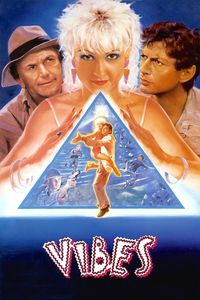
  • Vibes (1988)

    Vibes (1988)

    (On Cable TV, March 2021) I’m not sure if the cast or the loopy premise is what makes Vibes worth a look despite not being that much of a good movie. It does start in a very weird, very dated way, as volunteers are matter-of-fact tested for psychic powers and the evidence is portrayed as incontrovertible. This, apparently, isn’t a big deal in the universe of the film, but rather a setup for a romantic comedy in which a psychometrist (a young and gangly Jeff Goldblum) meets cute with a trance-medium (Cindy Lauper!) that gets otherworldly information from an unheard spirit guide. Both of them are then hired under false pretence to find a treasure high up Ecuador’s mountains by a mysterious man (Peter Falk). It all leads to a mixture of romance and paranormal adventure, enlivened by a deliberately awkward performance from Goldblum and a bubbly take from Lauper. The casting surprises continue into the supporting role, what with Julian Sands popping up as an antagonist, an early turn by Elizabeth Peña in arresting lingerie, and Steve Buscemi in a brief role as a no-good boyfriend. Unfortunately, even the off-kilter opening and the intriguing cast can’t quite manage to make Vibes a success — at best, it’s an entirely forgettable film that struggles with the ideas and actors at its disposal. At worst, it feels like a cynical product, taking some woo-woo themes and awkwardly grafting it onto a formula blend of familiar genres and narratives. Still, the verdict is in, and the cast remains the best reason to seek out the film: Goldblum is definitely worth a look, and so is Lauper in one of her few acting roles.

  • Pocketful of Miracles (1961)

    Pocketful of Miracles (1961)

    (On Cable TV, December 2020) I’ll go easy on remakes if the director of the original is the one remaking it, and here we have Pocketful of Miracles, Frank Capra’s remake of his own 1933 romantic comedy Lady for a Day. The story of a mob boss transforming a street vendor into a society madam for the purpose of impressing her marrying daughter remains the same, but some aspects of the film have been upgraded – the colour cinematography is easier to take in for modern audiences, and the camera has a greater degree of freedom here than in the early 1930s. The acting talent here is also quite a bit better: It’s hard to argue against Bette Davis as the Pollyannaed street vendor, and the cast (which also had Glenn Ford and then-girlfriend Hope Lange) includes an early appearance by Peter Falk and a screen debut for Ann-Margret as the vendor’s daughter. Still, it’s not hard to prefer the original version: Capra’s early enthusiasm is not reflected in the more workmanlike execution of the remake (which would end up being his last film) and the story, even as a conscious 1930s period piece, seems to fit more closely in Depression-era America than the early-1960s. This remake is also far too long for its own good at a staggering 137 minutes. Still, if that’s going to be Capra’s swan song, then it’s not a bad one: Pocketful of Miracles still manages to exhibit the writer-director’s faith in the ordinary Americans and his compassionate touch.

  • … All the Marbles (1981)

    … All the Marbles (1981)

    (On Cable TV, December 2020) Peter Falk with forever be Colombo, but his film career is filled with hits, from his dead-on Bogart impersonation in Murder by Death to a very odd turn in City of Angels to, well, a rather decent turn in female wrestling drama movie…all the Marbles. Here we are, clearly in the early 1980s, following a female tag-team wrestling team and their manager (Falk) as they tour the decaying pockets of the United States interested in female wrestling, going from one terrible hotel room to a low-rent venue, always looking for bigger and better engagements. It’s a miserable living and an equally miserable movie at first, as the lead trio keeps squabbling, running into trouble and losing faith in their ability to succeed. Things eventually change for the better in the film’s later half, as the protagonists move west for greater and greater success. It all culminates at a Reno face-off with their biggest opponents, an event during which Falk’s character demonstrates his talent for working the crowd. As an underdog sports comedy, it features the expected comeback and the marginally happier finale than the film’s opening moments. Falk is quite good here, with his gravelly voice reflecting a man who knows he’s spiralling down but always clinging to the hope of a break. While the film is not always pleasant to watch, it does build to something better. I’m reminded of the adage “three good scenes and a great finale” – you really can’t go wrong with a big final victory.

  • Murder by Death (1976)

    Murder by Death (1976)

    (CTV Streaming, July 2020) I recall seeing bits and pieces of Murder by Death as a kid, so I was more than curious to re-watch the film, only remembering that it was about parodies of fictional detectives being set up to solve the perfect murder. Going in the film otherwise almost entirely unaware, I was amazed at the cast of the film: Peter Sellers, Alec Guiness, Peter Falk, David Niven, Maggie Smith and none other than a very young James Cromwell! Then I was bowled over once over again, as I recognized the archetypes they were playing—Falk imitating Humphrey Bogart’s Sam Spade, Niven as a pitch-perfect incarnation of William Powell’s Nick Charles, and so on. I could have done without the casual racism of Sellers’ Charlie Chan, but it does get us the rather wonderful spectacle of having him going toe-to-toe with his inspiration Alec Guiness in a scene or two. None other than Truman Capote shows up as the main antagonist of the film, setting up a perfect murder that none of the world-class detectives will be able to solve. As Murder by Death is working from a Neil Simon script, you can expect a steadily amusing script and dialogue—although the film doesn’t quite get as hilarious as it could have been. The structure of the story seems lopsided as well, with a very long time spent on introductions and setting up the premise, then zipping to a conclusion. It doesn’t get any better once we realize (after an android or two) that the film is absolutely not meant to make conventional narrative sense. There are six successive plot climaxes in a row getting more and more absurd, the joke being turned on the viewers expecting this comedy to make any kind of narrative sense. Murder by Death becomes a letdown after such a promising start, but the result is still worth a look if only for the cast and the playfulness of the script as it charges forward, determined to upend most expectations.

  • Der Himmel über Berlin [Wings of Desire] (1987)

    Der Himmel über Berlin [Wings of Desire] (1987)

    (In French, On TV, October 2019) There are so many reasons why I should not even like Wings of Desire. The deliberate use of monochrome, the stream-of-consciousness dialogue (is it dialogue if it’s eavesdropping on people’s thoughts?), the languid pacing, the improv-style acting, the pretentious philosophical claptrap, the very familiar dramatic arc … and so on. On paper and initially on-screen, Wings of Desire is an almost prototypical art-house film meant for a very specific audience. But gradually, almost begrudgingly, I ended up warming to the results. There’s a subtle grace to the way writer-director Wim Wenders uses a downplayed portrayal of angels to explore a full-spectrum take on humanity, portraying their black-and-white coolness against the colour perceived by the human characters. Peter Falk shows up playing a version of himself (even referencing “Columbo”) that turns out to be a fallen angel. Otto Sander also plays an angel with a mixture of detachment and empathy. But the acting focus here falls on Bruno Ganz convincingly portraying an angel yearning for human feelings, falling in love with a trapeze artist played by the captivating Solveig Dommartin. Clever understated touches (overcoats, libraries, children of course perceiving angels) add to the overall effect, while pre-reunification Berlin, cut by its wall, is shown in stark detail. Even the use of black-and-white has a plot purpose—and I surprisingly found the last colour portion of the film blurrier and less impressive than its initial black-and-white presentation. The film peaks somewhere near its third quarter, both in imaginative detail and in execution—the ending feels satisfying but pat, possibly from having influenced many other takes on similar material. While I don’t love Wings of Desire, I do end up liking it more than I thought, which hints at its more universal appeal than could be anticipated.

  • The Great Race (1965)

    The Great Race (1965)

    (On Cable TV, September 2018) I sometimes do other things while watching movies, but as The Great Race went on, I had to put those other things away and restart the film. There is an astonishing density of gags to its first few minutes (from the title sequence, even) that require undivided attention. While the first act of the film does set up expectations that the second half fails to meet, it does make The Great Race far more interesting than expected. Clearly made with a generous budget, this is a comedy that relies a lot on practical gags, built on a comic foundation that harkens back to silent-movie stereotypes. Making no excuses for its white-versus-black characters, the film features Tony Curtis as an impossibly virtuous hero, facing the comically dastardly antagonist played with gusto by Jack Lemmon in one of his most madcap comic performance. Meanwhile, Natalie Wood has never looked better as the romantic interest (seeing her parade in thigh-high black stockings unarguably works in the film’s favour) and both Peter Falk and Keenan Wynn are able seconds. The film’s visual gags are strong, and so is writer/director Blake Edwards’s willingness to go all-out of his comic set pieces: The legendary pie fight is amusing, but I prefer the Saloon brawl for its sense of mayhem. There is a compelling energy to the film’s first hour, as pleasantly stereotyped characters are introduced, numerous visual gags impress and the film’s sense of fun is firmly established. Alas, that rhythm lags a bit in the last hour, with an extended parody of The Prisoner of Zenda that falls flat more than it succeeds (although it does contain that pie fight sequence). Still, it’s a fun film and the practical nature of the vehicular gags makes for a change of pace from other comedies. I liked it quite a bit more than I expected.