Peter Sellers

  • The Smallest Show on Earth (1957)

    The Smallest Show on Earth (1957)

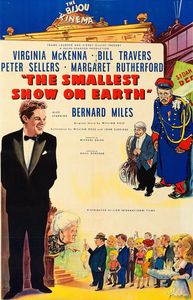
    (On TV, June 2021) There are plenty of movies about moviemaking, but far fewer movies about moviegoing. This makes The Smallest Show on Earth distinctive even today, as it details the adventures of a young British couple who inherit a decrepit movie theatre located between two train tracks and despair to get any profit out of the property. The local movie mogul (owner of the city’s other theatres) is only interested in offering them a pittance for bulldozing the lot and putting up a parking lot, while the theatre’s three elderly employees fear for their continued employment. (Peter Sellers plays one of those three employees, but he’s near-unrecognizable in heavy makeup, and doesn’t break away from a mercifully toned-down character.)  More of an affectionate look at moviegoing more than an outright laughing marathon (although the antics of the rowdy audience get a few chuckles), The Smallest Show on Earth is not a big movie, but it’s warm, sympathetic, features likable leads and wraps up in a typically wry (and not entirely law-abiding) British comedy fashion. I liked it quite a bit, even if I’ve accepted that single-screen movie theatres are fading away. In fact, I may like it because they’re fading away.

  • The Bobo (1967)

    The Bobo (1967)

    (On Cable TV, October 2020) Any film starring Peter Sellers starts at a disadvantage with me, and The Bobo further compounds the issues by not being a very good film. A comedy about a singing matador seducing a near-professional gold-digger, it takes place in Barcelona and, if nothing else, does feature some nice 1960s eurochic period detail. Alas, it also features Sellers at his most irritating, playing up a character with plenty of quirks and, eventually, blue-dyed skin. Opposite him is then-wife Britt Ekland, looking pretty good but stuck in a not-very-good film. The Bobo tries a few things, but getting a laugh isn’t one of those. The result is overlong and tedious—no amount of period atmosphere eventually overcomes the film’s lack of reason for existing. There are times when I question whether I’m being overly harsh on Sellers due to having read his biography. Then comes along The Bobo to reassure me that I’m not.

  • Waltz of the Toreadors (1962)

    Waltz of the Toreadors (1962)

    (On Cable TV, October 2020) There are movies for which the only payoff is realizing, in the end, what could have been. Such is the case with Waltz of the Toreador, which stars Peter Sellers for his character work, but seems more interested in a blend of not-quite-slapstick, not-quite-serious tone. I tried staying interested in the film and failed more often than not, only seeing toward the end what could have been. The core seems solid enough, what with a retired military officer reflecting on his life and us seeing the results of choices made in flashbacks. But there are many ways in which such a movie can end in a disappointment, whether it’s in adapting source material that may not be suitably for the big screen (in this case, a theatrical play), squabbling between producers and directors as to what exactly is to be delivered, an actor’s ego getting in the way (a real possibility in the Sellers’ case) or simply the movie moving out of touch with time—Waltz of the Toreador may have been a commercial success back then, but it’s been mostly forgotten today even for Sellers completists. The result is a mess, neither going for the typical Sellers comedy nor achieving something along the lines of the not-dissimilar The Life and Death of Colonel Blimp. No matter the reason, Waltz of the Toreadors falls flat, and it’s more trying than you’d expect to make it all the way to the end, even if the end does tie it back together.

  • There’s a Girl in My Soup (1970)

    There’s a Girl in My Soup (1970)

    (On Cable TV, August 2020) It’s tough to resist a film titled There’s a Girl in My Soup, although seeing Peter Sellers play the aging playboy is certainly enough to cool any enthusiasm. I’ve had a hard time liking Sellers’ work even since reading his biography, and having him in a somewhat repellent role can be a tough sell. At least there’s Goldie Hawn (in one of her earliest screen appearances) to keep his character in check. As would befit a film from the early New Hollywood era, There’s a Girl in My Soup doesn’t end well – although it’s not exactly a downer either. Along the way, we get two capable actors batting good dialogue back and forth (as you can reasonably expect from a theatrical source), perhaps the highlight being a lengthy dialogue sequence as he takes her back to his place and she deconstructs his seduction techniques. The third act of the film doesn’t have anywhere as rich to go, and There’s a Girl in My Soup deflates as it makes its way to its inevitable ending. Still, Sellers does manage to create a complete character by the end of it, keeping his personality shifts to a minimum along the way. Fittingly enough for him, the ending is a perverse celebration of narcissism as a solution to heartbreak.

  • Murder by Death (1976)

    Murder by Death (1976)

    (CTV Streaming, July 2020) I recall seeing bits and pieces of Murder by Death as a kid, so I was more than curious to re-watch the film, only remembering that it was about parodies of fictional detectives being set up to solve the perfect murder. Going in the film otherwise almost entirely unaware, I was amazed at the cast of the film: Peter Sellers, Alec Guiness, Peter Falk, David Niven, Maggie Smith and none other than a very young James Cromwell! Then I was bowled over once over again, as I recognized the archetypes they were playing—Falk imitating Humphrey Bogart’s Sam Spade, Niven as a pitch-perfect incarnation of William Powell’s Nick Charles, and so on. I could have done without the casual racism of Sellers’ Charlie Chan, but it does get us the rather wonderful spectacle of having him going toe-to-toe with his inspiration Alec Guiness in a scene or two. None other than Truman Capote shows up as the main antagonist of the film, setting up a perfect murder that none of the world-class detectives will be able to solve. As Murder by Death is working from a Neil Simon script, you can expect a steadily amusing script and dialogue—although the film doesn’t quite get as hilarious as it could have been. The structure of the story seems lopsided as well, with a very long time spent on introductions and setting up the premise, then zipping to a conclusion. It doesn’t get any better once we realize (after an android or two) that the film is absolutely not meant to make conventional narrative sense. There are six successive plot climaxes in a row getting more and more absurd, the joke being turned on the viewers expecting this comedy to make any kind of narrative sense. Murder by Death becomes a letdown after such a promising start, but the result is still worth a look if only for the cast and the playfulness of the script as it charges forward, determined to upend most expectations.

  • Tom Thumb (1958)

    Tom Thumb (1958)

    (On Cable TV, May 2020) Producer George Pal was the SFX wizard of his time, always picking projects that pushed back the state-of-the-art in matters of cinematic spectacle. As the first project he directed, Tom Thumb isn’t that big of an anomaly in his career—we remember the Science Fiction films Destination Moon, War of the Worlds and The Time Machine, of course, but he also produced (sometimes directed) some more family-friendly fantasy films like this one. An attempt to combine effect-heavy blockbuster filmmaking with the very different demands of a musical comedy, Tom Thumb may not have stood the test of time as well as Pal’s other films, but it’s still worth a look. Various techniques, such as oversized object trick photography and stop-motion animation, all help sell the illusion of the VFX side, while catchy songs do the rest on the musical side. The demands of special effects clearly constrained the final result, since the film clocks in on the much-shorter side for musicals at only 98 minutes. Ascendant stars Terry-Thomas and Peter Sellers have supporting antagonist roles in here, while Russ Tamblyn seems in his element as the hero. While the seams on the special effects are now obvious, that’s part of the fun as well. Thankfully, this Tom Thumb doesn’t stick too close to the fairytale: the entire thing is bouncy, lighthearted and a joy to watch, which is not the case with all adaptations of that source material.

    (On Cable TV, March 2021) A wild blend of musical comedy and special effects, Tom Thumb takes considerable liberties with the original story to deliver a rounded old-school Hollywood experience, albeit with a heavier dose of spectacle than most films. Helmed by event-filmmaking legend George Pal, it starts with the proposition that special effects are the point of the film, and then go on to deliver a (thin) story and (ambitious) musical numbers, one of them even incorporating extensive stop-motion animation. Having a feature film with a tiny character means quite a bit of trickery and while much of that has already been done better in the years since, there’s still a charm and an earnestness to the results here that’s hard to dismiss. Good song backed by a spirited performance from Russ Tamblyn (with some supporting work from British comedy legends Terry-Thomas and Peter Sellers) help sell the entire package. Comparisons with some of Disney’s family pleasers aren’t misplaced, even though Tom Thumb is often more interesting is bits and pieces rather than as an entire film.

  • The Pink Panther Strikes Again (1976)

    The Pink Panther Strikes Again (1976)

    (On Cable TV, May 2020) Hey, there’s no accounting for taste, and that’s how I can say both that I don’t care all that much about the Peter Sellers-focused Pink Panther series and that I like The Pink Panther Strikes Again better than the others. There’s no good reason for this. I’m not even watching them in order, nor in any rapid succession. But there’s something I like in this instalment’s shift to a slightly different, more grandiose scope. As the film begins, Inspecteur Clouseau once again angers his nemesis Dreyfus, and—having driven him completely insane—leads Dreyfus to get a scientist to create a world-threatening weapon. Thus, being closer to James Bond parody (complete with warring self-defeating assassins) than anything else in the series so far, The Pink Panther Strikes Again feels a bit fresher. Director Blake Edwards’ penchant for big comic physical set-pieces is indulged, and there’s enough space in-between those bits for Sellers to overindulge in weird accents and mugging for the camera. Meanwhile, Lesley-Anne Down doesn’t have enough to do. It’s not that good, but not that bad either, and it’s relatively watchable even if some of the series conventions (such as Clouseau getting a new girl every movie) are definitely annoying. Eh—I’ve seen worse than The Pink Panther Strikes Again, especially in other Pink Panther instalments.

  • I Love You, Alice B. Toklas! (1968)

    I Love You, Alice B. Toklas! (1968)

    (On Cable TV, January 2020) One of the advantages of watching movies, taking notes, but coming back to edit those notes into a coherent review months (even years!) later is that in that way you get a perspective that just wouldn’t apply for a review written immediately after. So it is that I can tell you with confidence, four years after the fact, that the title song of I Love You, Alice B. Toklas! is a formidable earworm — I can still hum the chorus despite not having heard it since watching the film. I didn’t say it’s a good song—just a memorable one, and that stands for the film as well. It’s representative of an era, obviously — Peter Sellers (ugh) plays a straight-laced lawyer who ends up discovering the hippie subculture through a free-spirited girl, and that’s how we get a near-documentary take on how America perceived hippies in the late 1960s. It’s sort-of-interesting from an anthropological point of view, but again that doesn’t make it good. While I don’t like Sellers all that much, he’s more tolerable than usual here as the disaffected young man who leaves his staid life behind to explore what the counterculture has to offer. Tellingly, the film has him eventually reject the hippie lifestyle, but not necessarily going back to his own personal conservatism. The comic setpiece of the film is an early variation on the now-cliché “unsuspecting people eat drug-laced brownies” trope — I’m not sure it’s the earliest such scene, but it’s played in such a straight way that it feels like it. But my problem with I Love You, Alice B. Toklas! is that, well, it’s that it’s an annoying film. It doesn’t quite glorify hippies (one of the protagonist’s third-act epiphanies is that the free-spirited girl is quite shallow) but it does look at them from a gawking point of view, and the character arc feels very conventional. It probably aged a bit better than it could have had the script been worse, but it has aged, and it has aged worse than other movies at the time that were either more serious or wilder about their approach to the counterculture. But the most annoying thing may be the earworm title song, which pops up far more often than you’d think, driving itself into your brain and becoming more inane every time. It’s annoying, and it transfers its annoyance to the film itself. In the end, I Love You, Alice B. Toklas! is best recommended to Sellers completists (those poor souls) and anyone curious about contemporary depictions of the hippie movement.

    (Second Viewing, On Cable TV, November 2020) I may have liked Peters Sellers at some point, but that was quickly damaged by his exasperating son-screen showboating, and then extinguished by the two biographies I have read/seen about him. Nearly every movie of his I see now carries the baggage of knowing far too much about him and the rampaging egomaniac that he was. For I Love You, Alice B. Toklas!, it doesn’t help that the film has aged poorly and ends on a conclusion fit to frustrate anyone. Sellers here plays a straight-laced Los Angeles lawyer who, inevitably enough, comes to be seduced by the wild, drug-taking, free-loving hippie subculture. Considering the date of the film, that should not be a big surprise—soon he dumps his fiancée at the altar, lets his hair grow long, opens his house to all sorts of groovy people and awaits the epiphany that he’s gone too far. But while the film presents thesis and antithesis, it skips out on the synthesis as it (as a product of its time), opines that the truth is somewhere else and ends at that point, irresponsibly letting his fiancée at the altar for a second time (where, one hopes, she’ll catch her final clue). Sellers once again indulges far too much on the creepy aging lothario angle, although he does keep the funny voices in check for once. While the look at 1960s counterculture can be intriguing, there really isn’t much in the film that feels particularly insightful or new—although comedy historians may note an early example of the “brownies eaten by unsuspecting straight-laced people” trope. It feels equally suffocating both in showing the mainstream and the counterculture, which I suppose is the point but at least could have outlined something else rather than quitting midway through. Plus, well, I don’t like Sellers in either short or long hair, leaving little else to say about the film. The title tune is admittedly catchy, although it remains to be seen whether it’s really catchy or simply drilled into our heads through endless repetition.
  • Carol for another Christmas (1964)

    Carol for another Christmas (1964)

    (On Cable TV, January 2020) Calling Carol for another Christmas preachy is not being insulting: it’s being descriptive, and—considering its intentions—even complimentary. It comes to us modern viewers through a fascinating process: Originally produced for television as a Christmastime special, it was the first of a series of TV movies produced by the United Nations to promote the organization’s ideals. As such, it reuses the premise of Charles Dicken’s A Christmas Carol in order to teach its protagonist a lesson. But instead of having Scrooge learn about human kindness in his life, here we have a foreign affairs isolationist learning about the values of dialogue and diplomacy. The ghost of Christmas Past ferries the bodies of dead soldiers and reminds the protagonist to his past visit to Hiroshima. The Ghost of Christmas Present comments on the developed world’s ability to gorge itself while ignoring the hungry and the needy staring at them. Finally, the Ghost of Christmas Future takes us to a post-apocalyptic American town where a demented demagogue (played with relish by Peter Sellers) recites the lead character’s philosophy and remonstrates its idiocy ad absurdum. This last segment gets surprisingly dark (in keeping with the rest of the film, really), and the epilogue isn’t much of a comfort. The preachiness extends to characters spouting statistics and indulging in heated logical combat, as per a rather clever script from Rod Serling. With Joseph L. Mankiewicz at the helm, the film is far better-directed than you’d expect from a 1960s TV movie, further adding to its appeal. Reviews at the time of Carol for another Christmas’ broadcast were sharply divided, with even those who agreed with the message being annoyed at its didactic nature. Then the film disappeared from public view for nearly five decades, until TCM dredged it back up in 2012 for its Christmas special and infrequent broadcasts since then. From a modern perspective, the didactic insistence and preachiness have transmuted into something far more interesting—a time capsule from the cold war that still rings true today, bolstering its message to a degree that 1964 audiences couldn’t guess at. It’s also a fascinating repurposing of the Dickens classic for a purpose that can be re-watched any month of the year, and a collection in intriguing performances from some known actors. (Eva Marie Saint shows up as a WAVE in a short but effective role.) I found it particularly fascinating as part of a look at Peter Sellers’ work, especially with Britt Eckland in a small role. It’s also notable that the film is preachy without being sappy, a partial inversion of the usual takes on the Dickens classic. No matter how you size it, Carol for Another Christmas is a fascinating piece from the archives, and it’s worth a look once, even if it probably won’t make your list of Christmas classics.

  • The Mouse That Roared (1959)

    The Mouse That Roared (1959)

    (On TV, September 2019) I have very fond memories of reading the comic novel on which The Mouse That Roared is based—a romp in which a small impoverished European country, having learned the wrong lessons from the Marshall Plan, deliberately sets out to lose a war against the United States in order to be richly rewarded by a reconstruction plan. But the plan fails when the country unexpectedly wins the war, inadvertently capturing a doomsday device. The film does deviate a bit from its source, most notably by casting Peter Sellers in multiple roles, including that of the country’s reigning queen. It’s all quite amusing in a clipped British-humour way, although the opening minutes of the film feel remarkably modern given the density of the editing, the deadpan jokes and the way it quickly gets the exposition business out of the way. Things do slow down after that, once we’re past the grand concepts and into the character humour—it never gets as funny as in the opening moments, but it does wrap things up nicely. The Mouse That Roared in not a great film, but it’s one that does still have its share of pleasures even today—albeit perhaps more as an affectionate look at Cold War issues.

  • The Return of the Pink Panther (1975)

    The Return of the Pink Panther (1975)

    (In French, On TV, June 2019) This is the first Peter Sellers film I’ve seen since diving deep into Sellers’s biography, and it’s fair to say that the disappointment at uncovering the actor’s worst traits definitely has echoes in the way that I’m reacting to the film. But not that much, as The Return of the Pink Panther is Sellers at his most rote and formulaic: Donning costumes, affecting different mannerisms (alas, the French dub means that I didn’t get the voices, even if that “alas” is qualified by how much I don’t particularly care for the accents). My appreciation for the Pink Panther sequels isn’t high to begin with: I didn’t like the Pink Panther sequel I watched a few months ago, and I still don’t here. Despite my lack of enthusiasm for The Return of the Pink Panther, it’s not a complete waste—some of the plotting is amusing, some of the costumes work and for all of its repetitiveness, some of the slow-motion scenery destruction is worth a chuckle or two. Christopher Plummer does have presence as the master-thief villain, as does Catherine Schell as another one Clouseau’s inexplicable string of love interests. Sellers himself is willing to do anything for a laugh, but it is a bit too much and the same considering the superficial variations in disguise. At this time in the series, this was the fourth Clouseau film and the third to star Sellers—you can argue that the series hadn’t yet degenerated in further self-copying. But even at this relatively high level of quality, The Return of the Pink Panther can feel as annoying as it is entertaining.

  • The Life and Death of Peter Sellers (2004)

    The Life and Death of Peter Sellers (2004)

    (In French, On Cable TV, May 2019) Few biographies have as much naked contempt for their subject matter as this unexpectedly fascinating biography of famed comedian Peter Sellers. After all, The Life and Death of Peter Sellers exposes Sellers as an unstable, gluttonous, credulous, and self-hollowed figure, cruel to children and lovers, unable to depend on a solid inner core and all-too-willing to escape through his characters. I suspect that my admiration for this film has as much to do with its willingness to break down the structure of typical biographies than my growing knowledge of Sellers’s work (It’s a lot of fun to see the film recreate and nod at movies of the period, even some Sellers-adjacent ones in the Kubrick repertoire—the 2001: A Space Odyssey reference is blatant, but there’s a not-so-subtle one to The Shining as well). Structurally daring, The Life and Death of Peter Sellers reinforces its thesis about Sellers taking on roles as a substitute for his inner life by having Sellers occasionally portray people around him, delivering monologues that either reflects these people’s opinions of Sellers, or Seller’s best guess at what they thought of him—it’s not rare for the film to step in and out of sound stages, further breaking the thin line between fiction and moviemaking. The all-star cast helps a lot in enjoying the result: Geoffrey Rush is surprisingly good as Sellers, the resemblance between the two getting better and better as the film goes on. Other notable actors popping into the frame include Emily Watson and Charlie Theron as two of his four wives, John Lithgow as Blake Edwards and no less than Stanley Tucci as Stanley Kubrick. The tone and look of the film shift regularly to illustrate Sellers’s state of mind, his circumstances or simply the movies he played in—as an expressionist take, The Life and Death of Peter Sellers is frequently surprising, delightful and rewarding the more you know about Sellers. It did cement my unease with Sellers’s work (you’d be surprised at how many Sellers movies I don’t particularly like—click on the Peter Sellers tag to know more) but it informed my half-grasped notions about his life. Now I’ll have to read a biography to know more. [June 2019: And I did! As it turns out, the real story is even stranger, even worse for Sellers and just as disdainful for its biographer.]

  • The Party (1968)

    The Party (1968)

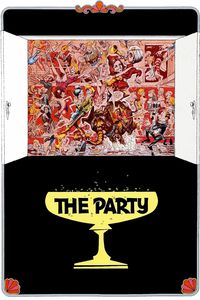
    (On Cable TV, April 2019) Is it possible that the more I see of Peter Sellers, the more I find him annoying? The Party does him no favour, with director Blake Edwards letting him go wild with improvisation, and showboat in brownface with an Indian accent. The plot is paper-thin, and really an excuse to let Sellers run set-pieces into the ground through repetition and predictable execution. His character, a bumbling Indian actor, is designed to be as irritating as possible and it’s not an accident if the film improves the further away it moves from him. He is, of course, immensely destructive, with a climax of bubbling proportions. If you’re getting the feeling that I didn’t like The Party all that much, you’d be half-right—I couldn’t stand Sellers most of the time, but even I have to admit that there’s something magnificent in the film’s fantastic set, its ability to avoid relying on dialogue, and the sheer anarchy of the last twenty minutes. Still, The Party should have been a far more disciplined film, a less stereotypical one, and it would have been better with someone else in the lead role.

  • Revenge of the Pink Panther (1978)

    Revenge of the Pink Panther (1978)

    (In French, On TV, February 2019) OK, world, I admit it. Revenge of the Pink Panther has pushed me over the edge, and it forces my hand. I have to come clean, even if you’ve seen it coming from the hints I’ve left all over the place. Are you ready? Here goes: I’m not that much of a Peter Sellers/Inspecteur Clouseau fan. I have accumulated enough data points by now to realize that I like the original The Pink Panther best because Clouseau is a support player to Niven/Cardinale/Capucine. By this sixth entry in the series, Sellers/Clouseau has become an all-engulfing, all-self-indulgent ego monster around which the entire series revolved. The plot revolves around him (it’s all about attempts to kill him, something that director Blake Edwards must have had on his mind at the time), the direction puts him centre stage and the editing can’t bear to cut away from his antics. The silly story hits many familiar plot points in the series, and can’t stand still by going from England to France to Hong Kong. While the budget is obviously bigger than previous instalments and there are a few comic moments along the way, the constant bumbling, perplexing fixation on costuming, graceless stumbling upon the truth, have become more grating than amusing—and that applies equally to the criminal and the romantic plot. Revenge of the Pink Panther was the last of the six “main” Pink Panther movies, and it clearly shows the reasons why it was quickly running out of steam by that point. Or maybe even at any point past the first movie.

  • A Shot in the Dark (1964)

    A Shot in the Dark (1964)

    (In French, On TV, February 2019) The original The Pink Panther was not designed to spawn a series of movies featuring Inspecteur Clouseau, who was clearly a supporting player in a much broader farce. But Peter Sellers brought such a manic energy to the role that producers were quick to ditch the panther and keep the inspector. With A Shot in the Dark, you can see the progression of the series’ premise in featuring Clouseau at its centre, not even attempting to recapture the spirit of the original. It’s not yet perfect—the comedy is unusually dark for the series, with a high body count of innocents dying from being at the wrong place while villains were aiming for Clouseau. But there are still a few funny moments in the result—most notably toward the conclusion, as “the usual suspects” are brought together and nothing goes as planned. Sellers himself is quite good in pratfalls, but his bumbling does become tiresome when it’s the focus of the film, and A Shot in the Dark’s annoying repetitions of the same gags does mean that the film gets redundant after a while. Ironically enough, the French dub of the film is less annoying than the original English version … because it removes Clouseau’s ridiculous accent, and makes Sellers about half as annoying as a result.