Peter Stormare

  • The Killing Room (2009)

    The Killing Room (2009)

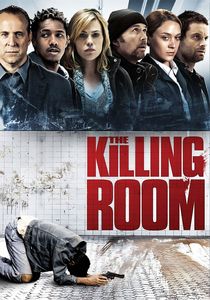
    (In French, On Cable TV, March 2021) It’s amazing how much a little perspective can put things in their place. Twelve years later, we’re barely starting to process the awfulness of the Bush administration and how America had to overcome the post-traumatic stress disorder of 9/11 (and then Afghanistan, and then Irak). Looking back at the socially conscious entertainment from this period at a slight distance can be revelatory — the paranoia against the government at the time was at an all-time high, and since then, the latest Republican president has done much to destroy any notion of an all-powerful, all-capable administration capable of doing anything more complex than not tripping over itself. This brings us to The Killing Room insofar as this is a psychological thriller that could only have been born in the post-Bush era. It starts with mystery, as strangers are assembled in a room and then quickly faced with a life-and-death situation as a doctor explains to them the parameters of the test they’re about to undergo… and then shoots one of them in the head. The rest is the kind of locked-room paranoid thriller that we’ve seen everywhere from Cube, Exam, The Belko Experiment and other examples of killer-psychological test horror movies. It’s mildly intriguing up until the time when it becomes ludicrous — specifically, by the time the film builds a preposterous narrative saying that these tests are being conducted en masse to find dedicated killers for the government. There are so many wrong things in that statement that it’s hard to know where to begin (and the film does itself no favours by referencing the MK-ULTRA program) — this is a clear case where the film should have avoided clearing up the mystery justifying what it really wanted to do: crank up a low-budget thriller exorcising that era’s paranoia. Narrative nonsense aside, the film is not badly executed: thanks to director Jonathan Liebesman (who did far higher-budget films afterwards) and a cast that somehow brings together players as familiar as Chloé Sevigny, Timothy Hutton, Clea DuVall and Peter Stormare, the film assumes its clinical griminess and delivers what it intends. A shame about the escalating stupidity of the justification, but so it goes. Nowadays, of course, the film is more interesting as a reflection of where America was at psychologically at the end of Bush’s second mandate — not in great shape, and terrified of what an ultra-competent government could do to them.

  • Kill ’Em All (2017)

    Kill ’Em All (2017)

    (In French, On TV, September 2020) There is something halfway interesting in Kill’em All’s structure: As a nurse is interrogated by the FBI regarding a mass shootout at her hospital, we see, in flashback, the way the day unfolded. As a way to add interest to a bog-standard revenge story starring Jean-Claude van Damme, it’s not a bad idea. Alas, this promising opening quickly gets bogged down in other more serious issues. The lack of directorial prowess from Pjetër Malota is regrettable, but really unexpected from the film’s low-budget pedigree: as long as people are getting beaten up or shot, it’s not the staging or the cinematography that’s going to wow us. What’s far more damaging is that, as Kill ’em All advances, it feels to grow more serious than it should be. There’s a time for sombre reflections on the cycle of violence to emerge from the Balkan states’ wars, but there’s also tonal consistency issues—and while Kill ’em All tries to be a pulse-pounding action movie, it also stomps on the brakes as it moodily explains its revenge-fuelled backstory in a way that’s really no fun at all. But it gets worse, and you can actually sense it coming—By spending so much time on the nurse protagonist, the film clearly telegraphs that there’s more to her than meets the eye, and much of the film’s last twenty minutes are spent preparing, announcing, making, then reinforcing a perfectly obvious plot point that is clearly supposed to be a twist. It really doesn’t work—in fact, it makes the film much worse considering how much of its last minutes are spent going over perfectly obvious material. (Suzzzaaaaane with a Zed!) Once all is done, we’re not left happy, and the film’s lesser flaws are magnified. There’s bad casting, for instance: While it’s cool to see Maria Conchita Alonso again and Autumn Reeser is very cute in hospital scrubs and brunette bangs, Peter Stormare is all wrong in greasy hair and thick beard as a back-office CIA analyst. Worse yet is Jean-Claude van Damme, about twenty years too old to even fit in the chronology of his character—a casting mistake made even worse by the way his character reacts like an old man rather than what a younger character should have been able to accomplish. Those may have been forgivable with a stronger, more sustained script—but the multiple points of failure in Kill ’em All multiply to make the film feel even worse than it is.