Peter Ustinov

  • The Comedians (1967)

    The Comedians (1967)

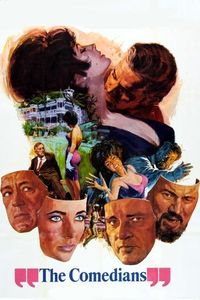
    (On Cable TV, August 2021) To answer an obvious question: No, The Comedians is not a comedy. It’s really at the other end of the scale, since it’s a brutally convincing portrayal of Haiti under the murderous Duvalier regime, with its unrestrained tonton macoutes enabling a reign of terror over the island. Like many French Canadians, I have an above-average awareness and affection for Haiti, and wasn’t expecting a 1960s American film to be so effective into portraying a regime of terror that endured well into the 1980s, overlapping with my childhood memories of then-current events. Much of the darkness of the film clearly comes from Graham Greene’s original novel, writing squarely in his usual “white man goes to a poorer country; terrible things happen” mode. This time, the white man is portrayed by Richard Burton, with then-wife Elizabeth Taylor playing his married mistress. The plot is a downbeat mixture of British operatives, American businessmen, Haitian oppressors, diplomatic personnel and homegrown resistance. It really, truly, definitely does not end well. Still, there’s quite a bit to like here: Burton plays world-weariness like few others and he shares a few good sequences with Taylor. Alec Guinness brings some dark comedy to the cast, with Peter Ustinov also contributing some flair to a supporting role. Some black American actors of the time, such as James Earl Jones and Cicely Tyson, also get supporting parts due to the setting of the film. Downbeat tone aside, The Comedians suffers most in its pacing — at a punishing 160 minutes, it’s too scattered, too leisurely and too inconsistent as well to be truly effective. Probably too faithfully to its source (Green adapted his own novel without concision), its lack of concision does its topic matter no favours. I still found it interesting, largely for Burton and the portrayal of Haiti (even if filmed in now-Benin), but I can think of several ways in which the result could have been better.
  • Topkapi (1964)

    Topkapi (1964)

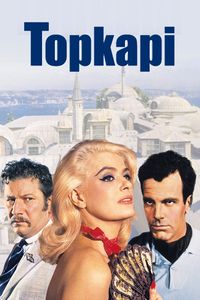
    (On Cable TV, June 2021) In my own developing history of Hollywood movies, I’ve earmarked the 1960s as the decade where Europe came to the rescue of American filmmaking: you can clearly feel the stagnation of post-studio-era Hollywood in the decade’s first years, and the energy of filmmaking being concentrated in censorship-busting Europe. Much of those lessons crossed the Atlantic during the decade and culminated in a 1967 crop of movies that changed everything. In this admittedly incomplete historical summary, Topkapi finds its place as one of the films that regurgitated the American heist film into something slightly grander, slightly more colourful (literally, in this case) and with a different sense of style. It certainly makes sense that Jules Dassin would be the director to do the transition — a successful Classic Hollywood director during the film noir age, Dassin was essentially exiled from the United States due to the McCarthy blacklist and re-established himself in Europe. By 1955, he was making the classic Rififi and already adapting the American style to the French palette. Topkapi feels like an extension of this work, going even farther even as other American movies such as Ocean’s Eleven were starting to digest his lessons from the earlier Rififi. An exotic and lighthearted heist film shot in glorious colour in Istanbul, Topkapi goes through the now-familiar motions of its subgenre: Assembling the specialized members of the crew (often by unfortunate happenstance), having them describe the heist, suffering from an execution that flies off in all directions, and wrapping things up in a bittersweet but amusing conclusion. There’s intra-group conflict, an alluring prize (a jewel-encrusted dagger), elaborate plans and freakish deviations getting bigger — in short, everything you’d want from that kind of film from a narrative perspective. It does help that Dassin knows what he’s doing behind a camera, and that he managed to bring together an impressive number of actors — with a lot of attention paid to Peter Ustinov’s bumbling hustler inadvertently brought into the plot (a role that earned him an Oscar), and Maximilian Schell as a master criminal having to deal with smaller fry. You can see bits and pieces of heist film DNA being put together here, most visibly the acrobatic tricks that would later be amplified in the first Mission: Impossible film. For twenty-first century viewers, the impact of all of this is curiously mixed: While impressive by mid-1960s standards, Topkapi suffers from being so successful and being imitated ever since. It’s fun to see where much of this started, or as part of an essential double feature with Rififi, but many viewers may shrug and ask about the hubbub if they compare it with its imitators. Still, it is a cinematic piece of history, and it’s still quite entertaining.

  • Death on the Nile (1978)

    Death on the Nile (1978)

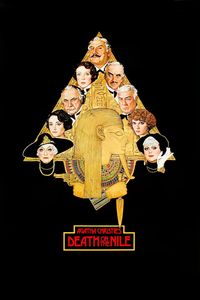
    (In French, On Cable TV, August 2020) While I’m anticipating watching the 2020 version of Agatha Christie’s Hercule Poirot adventure Death on the Nile, I thought I’d have a look at the 1978 version first. As the first of the Poirot films starring Peter Ustinov as the Belgian detective, this film has layers of old-school charm. It’s obviously dominated by 1970s filmmaking techniques and stars; the image is mushy, the staging a bit stiff, and a wonderful star-studded cast includes Bette Davis, Mia Farrow, George Kennedy, Angela Lansbury (not in detective mode), David Niven and Maggie Smith—whew! The other layer is the 1937 setting of both the narrative and Christie’s novel: we are comfortably sitting with the upper-class characters as they board an old-school paddle steamer and float down the Nile, with murder in an enclosed location as their main shipboard entertainment. While not on the boat, the film indulges into some great location shooting in Egypt. The narrative is incredibly comfortable, running down the tropes of detective fiction all the way to a round-up of “the usual suspects” in time for the finale. Murder mysteries usually age pretty well, especially in a period setting and Death on the Nile is no exception. It’s not quite as compelling as its prequel Murder on the Orient Express, but it’s still a solid hit of murder mystery pleasures.

  • Hot Millions (1968)

    Hot Millions (1968)

    (On Cable TV, September 2019) I started watching Hot Millions for the dumbest of reasons — The film’s log-line mentioned something about computers, and as an IT professional I’ve developed something of an interest in the depiction of computers in movies. Of course, this is a bit of a bait-and-switch: Hot Millions isn’t about computers as much as it’s a comic caper about an embezzler updating his methods to take on the computer age as represented by the machine at his new workplace. Peter Ustinov is progressively likable as the criminal mastermind, but part of the spotlight also goes to a surprisingly young (and redheaded) Maggie Smith as a love interest who turns out to be a mastermind in her own right. Come for the computer, stay for the laughs—while amiable for most of its duration, Hot Millions does reach its comic streak late in the film with a surprise revelation that makes everything funnier. Otherwise, it’s a decent but not overwhelming film, cute enough to be likable even today, but not one that we’d call a classic for any reason. Still, that’s good enough.

  • The Sundowners (1960)

    The Sundowners (1960)

    (On Cable TV, February 2019) There is a weightiness to The Sundowners that makes it both respectable and a burden to watch. The story of a nomadic family trying to make ends meet in outback Australia, it’s a character study (adapted from a novel) of a man unwilling to settle down, something that his wife finds increasingly untenable. Robert Mitchum stars in a very manly role, with Deborah Kerr as his long-suffering wife—despite the mostly happy marriage banter between the two, much of the film’s central conflict is about whether or not they’ll be able to reach an accommodation, and the ending is far less definite than many would have wanted. But the real reason to watch the film may have less to do with plotting and more with the impressive colour cinematography—unusually enough for 1960, much of the film was shot on location in deep Australia, featuring plenty of koalas, kangaroos, sheep and sheep-shearing. Peter Ustinov makes an impression as a refined older man somehow found in the outback. It’s a solid drama that was eventually nominated for five Academy Awards (including Best Picture), but don’t expect much in terms of resolution.

  • Quo Vadis (1951)

    Quo Vadis (1951)

    (On Cable TV, April 2018) I have dim memories of watching Quo Vadis as a kid (especially the last shot of the film) but watching it now is more an exercise in historical Hollywood than an enjoyable viewing in itself. Historically, Quo Vadis was the first big success of an era in film history where Hollywood headed to Rome in order to film epic movies on a smaller budget. You can see the result on-screen with a lavish production with countless costumes, credible historical re-creations and an ambitious Bible-related subject matter palatable to international audiences. Quo Vadis is a deep dive in Roman history in the decades when Rome fought the newly popular Christianity. It’s not particularly historically accurate, but it does revel in the imaginary imagery of the era, combining swords and sandals and political/religious conflict alongside a big dash of family melodrama. It’s tedious and impressive at once, especially when you try to keep up with the very large cast and equally long running time. It does help that the film features actors such as Robert Taylor and Peter Ustinov, alongside captivating actresses such as Deborah Kerr and Marina Berti. A long list of notables had small roles among the cast and crew, but the film’s biggest impact was financial, both in terms of revenues (it reportedly saved MGM from bankruptcy) and legacy (it paved the way for very similar epics). It’s not quite as good as many of the films it would spawn, though: the highlights are few and far between, while the film’s connection to the bible is tenuous at best. It does make for an impatient viewing experience—well-known but not particularly enjoyable, Quo Vadis is a bit of an imposed viewing … unless you like that kind of thing, of course.