Preston Sturges

  • The Miracle of Morgan’s Creek (1943)

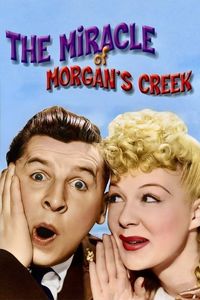
    The Miracle of Morgan’s Creek (1943)

    (On Cable TV, July 2021) Writer-director Preston Sturges famously made his mark in the early 1940s with an impressive string of comedies that fired on all cylinders, and The Miracle of Morgan’s Creek is clearly part of that run, even if it’s not quite up to the standard set by at least three of Sturges’ previous films. I suspect that some of that lessened impact has to do with social mores — the idea of having a young woman pregnant from an unknown father and desperately trying to save her reputation by marrying the nearest hapless clerk was reportedly a scandal back then, but not quite as hard-hitting today. (And probably not as comic either.)  Betty Hutton stars as the party-loving girl who drinks too much and wakes up both married and pregnant (albeit without a clue as to her husband’s identity), but for once the brassy Hutton gets upstaged by Eddie Bracken, whose tics-ridden performance as an exceptionally nervous young man walks a fine line between sympathy and exasperation. The script here is a thing of beauty (even if it was reportedly re-written on the fly to accommodate apoplectic censors) — flashbacks, satire, character-driven comedy with absurd flights of fancy affecting even the highest personalities of the time: Hitler gets outraged at “the miracle,” Mussolini resigns and, most hilariously of all, Canada protests (in a clear echo of the Dionne quintuplets). Managed at a pace that still impresses, The Miracle of Morgan’s Creek isn’t quite as madcap as Palm Beach Story, as cutting as The Lady Eve or as philosophical as Sullivan’s Travels, but it still packs a punch today and should play well even with jaded audiences.
  • Remember the Night (1940)

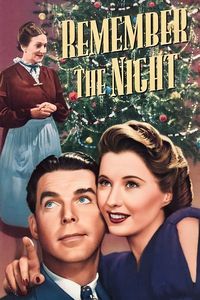
    Remember the Night (1940)

    (On Cable TV, December 2020) It’s hard to go wrong with Preston Sturges, Barbara Stanwyck and Fred MacMurray, even if Remember the Night is a portent of better things to come for all of them. An incredible contrivance is at the heart of the story – a District Attorney taking an accused shoplifter with him on a long car trip to spend Christmas with his parents. It’s a splendid excuse for a romantic comedy, though – with Stanwyck as the corrupt temptress and MacMurray as the letter-perfect officer of the law, working at tempering their differences and gradually falling in love along the way. (Their climactic kiss takes place in front of Niagara Falls, on the Canadian side.) This was the last film exclusively penned by Sturges before he took up directing (Mitchell Leisen directed this one), and it’s filled with great moments, good dialogue, clever plotting and well-sketched characters. Remember the Night manages the impressive trick of being both archetypical enough to summarize quickly, and has a stuffed plot to make the moment-to-moment watching of the film engaging enough. It’s both a Christmas film and something that can be watched any other month of the year: when it’s funny, it’s very funny, and when it’s romantic, it’s very romantic. And yet, all three major players here would go on to bigger and better successes, sometimes even with each other – Stanwyck and Sturges in The Lady Eve, Stanwyck and MacMurray in Double Indemnity, and, of course, Sturges by himself with an extraordinary series of films over the following few years.

  • The Palm Beach Story (1942)

    The Palm Beach Story (1942)

    (On Cable TV, February 2020) It’s not often that a classic Hollywood movie has me blinking in confusion, rewinding and starting again to make sure that I hadn’t missed anything, but then again very few Hollywood movies have as fast-paced an opening as writer-director Preston Sturges’ The Palm Beach Story, which crams a film’s worth of romantic comedy hijinks into a three-minute-long summary (if that), then proceeds to tell the sequel to that non-existing first film. (Pay attention, though, because there are a lot of clues in that opening flash to foreshadow the otherwise confounding last minute of the film.) Not that things get any sedate after that, considering that our happily married couple at the end of that film summary find themselves out of cash to develop an invention. In the finest screwball tradition, they have a flash of inspiration—why not divorce, let her find a rich husband, and allow that new guy to finance the development of the invention? If you think that’s insane, you haven’t met the other characters of the tale—including a shooting-obsessed hunting club eager to transform a train car into a shooting gallery. Part of Sturges’ miraculous first years, The Palm Beach Story is very, very funny from beginning to end. It’s filled with characters acting in ways we’d consider crazy, good lines of dialogue and plenty of screwball sequences—and it doesn’t skimp on a very romantic and satisfying ending. This is all enlivened by a charming throwback view of the 1930s as seen from the upper-class, from nighttime trains to fancy yachts and elaborate aristocratic entanglements. Claudette Colbert is utterly adorable in the lead role here, with Joel McRae providing good support as a nominally less-crazy husband. I know a lot of viewers have their favourites in Sturges’ filmography—either The Lady Eve or Sullivan’s Travels or maybe even The Big McGuinty. I’ll have to re-watch all of them to make up my mind, but for now I’m putting up The Palm Beach Story as my favourite by a nose—perhaps, unlike the better-known others, because it came out of nowhere and hooked me so quickly.

  • The Lady Eve (1941)

    The Lady Eve (1941)

    (On Cable TV, February 2020) I’m slowly starting to understand what film enthusiasts mean when they point at writer-director Preston Sturges’ extraordinary 1938–1944 run. The Lady Eve remains a spectacular film by any standards, and yet it’s only one of the four Sturges movies from the period often mentioned as an all-time comedy classic. In some ways, the premise feels familiar: the grafter taking aim at a wealthy target for purely monetary objectives, only to fall in love along the way. But there are twists and turns here that complement a well-executed delivery. It certainly helps that Henry Fonda is very likable as a hapless romantic lead, a bookish scientist who falls for Barbara Stanwyck’s scheming seducer. If Stanwyck has been sexier or funnier in any other movie, please tell me, because this is a classic performance—her opening sequence, as she provides colour commentary on seduction attempts on her target, says it all. The duo has a pair of very funny seduction sequences—first an unbroken shot of Henry with his head on her lap, and then later on a barn conversation interrupted by a curious horse. The film’s conventional first half leads to an unexpected turn midway through, and then even more comic sequences later on. Deftly mixing top-notch dialogue (you can quote that movie all day long) with physical comedy and absurd situations, The Lady Eve is indeed a screwball comedy classic, and a very good showcase for Fonda, Stanwyck and Sturges. This is what we mean when we say that they don’t make them like this anymore.

  • Sullivan’s Travels (1941)

    Sullivan’s Travels (1941)

    (On Cable TV, August 2019) An integral part of writer-director Preston Sturge’s incredible early-1940s steak, Sullivan’s Travels remains quite a watch even today. It helps that it’s firing on all cylinders, from casting (Joel McCrea and Veronica Lake) to writing/directing (featuring Sturges’ early-career manic energy) to its subject matter (a movie star sinking to a work prison camp) to its full-throated defence of comedy as a noble pursuit. It would be quite a heady film even without Sturges’ sure touch on the dialogue and directing, but with them it becomes an incredible film. There’s even an unusually respectful treatment of black characters at a time when those were usually marginalized or stereotyped, and that clear demonstration of Sturge’s humanism explains why his films are still delightful today. Lake delivers a good performance, McCrea a great one and the film is fit to stand alongside The Lady Eve and The Palm Beach Story as the very best of what Sturges did in rapid succession.