Raquel Welch

  • The Wild Party (1975)

    (On Cable TV, September 2022) There are many reasons why The Wild Party should be an interesting film, but most of them fail to show up on-screen. The subject matter alone is intriguing for film buffs –a party given by a silent film star in order to boost his profile in a world increasingly dominated by sound films. The era being firmly set in 1929, this lavish early Merchant-Ivory production has a sumptuous historical atmosphere and sometimes pokes at Hollywood history: for instance, in using Fatty Arbuckle as the model for its protagonist. The film goes from hope to disillusionment to violence, and no less than Raquel Welch is showcased in the female lead role for obvious purposes. And yet, watching the film, very little of this is used, even less capitalized upon. The lavish atmosphere of the late-1920s jazz era, as filtered through the dirty ugly downbeat 1970s, doesn’t support a compelling narrative. Whatever plot remains in the film is confused between several tones, from comedy to tragedy, Welch is boring (rumour has it she was a terror on the film set and fired nearly everyone, which may explain why the film swerves between tones) and titular wild party feels incredibly sedate. Those looking for a serious take on the end of the silent era will be better served by another viewing of Singin’ in the Rain and those thirsting for a bit of Welch will be better served by almost any other film she appeared in. The Wild Party may be a tempting curio, but it’s far less than what you’d imagine from reading about the premise, cast and crew.
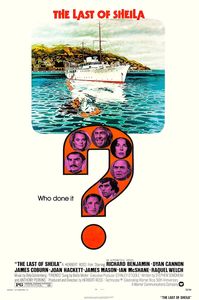
  • The Last of Sheila (1973)

    The Last of Sheila (1973)

    (On Cable TV, January 2021) There’s something primal and timeless about a good murder mystery—the universal stakes of death being on the line, and the playful nature of the convoluted plotting that usually accompanies such films. The Last of Sheila has, to put it bluntly, not necessarily aged well: The muddy cinematography is clearly from the early 1970s, as are the sometimes-hideous fashions and the contemporary details that pepper the film. Here, a Hollywood mogul calls six “friends” for a Mediterranean holiday aboard his yacht. But what they discover early on is that the puzzle-obsessed mogul has fun and games in mind for them: Six days, six stops, six enigmas to resolve. But what they eventually discover is that the mogul has a much darker scheme in mind—a year earlier, his wife was killed in a hit-and-run, and the guilty driver is among them. Then it gets more complicated—all the way to an ending where the survivors all find killers and guilty consciences. The cast is interesting, what with James Coburn having far too much fun as the mogul, and guests played by a motley crew, including an old James Mason, a young Ian McShane, and Raquel Welch in the middle of her peak popularity. The script, from unlikely scribes Anthony Perkins and Stephen Sondheim (who used to host murder mystery parties), is suitably twisty, witty and clever—I’m not too sure that the third act is as spectacular as it should be given its more intimate setting, but it satisfies well enough. Despite being visibly stuck in the early 1970s, The Last of Sheila is highly watchable—even more so for fans of the actors involved, but accessible to all, especially once the fun and games start.