Ray Milland

  • Panic in Year Zero! (1962)

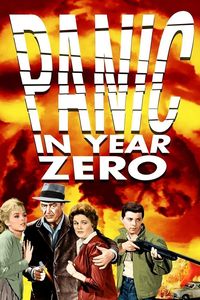
    Panic in Year Zero! (1962)

    (On TV, April 2021) If you want to understand in which kind of context the October Crisis happened in 1962, you may want to have a look at Panic in Year Zero!, a surprisingly effective Cold War nightmare in which an ordinary Los Angeles family out for a camping trip reacts to a nuclear attack on the United States, including the vaporization of Los Angeles. Better-prepared than most with a fully-loaded camping car, they still have to face many challenges before making it to relative safety. You may by misled by credits listing American International Pictures and Frankie Avalon — after all, their biggest hits of the 1960s were the frothy colour “Beach Party” comedies. But that came later—Panic in Year Zero! is a sober, dystopian take on something that seemed almost inevitable by the early 1962—massive nuclear exchanges between the United States and the Soviet Union. Millions of deaths and a complete breakdown of social order were the starting point of such survival films, and this one is no exception. Crisply directed by Ray Milland, who also stars as the patriarch making tough choices for his family, the film is a lower-budgeted but surprisingly credible exploration of the now-familiar scenario of a family having to survive a societal breakdown. Avalon plays the son of the family with a mixture of innocence and growing maturity, making a good contrast with his later fun screen persona. It’s largely an episodic film, with various incidents meant to show how mean and/or helpful various people can be in crisis. I suspect that the sheer number of post-apocalyptic films since 1962 has probably dulled the impact of Panic in Year Zero!, but it did get there early, and its mild-mannered take on a wide-scale crisis is an interesting period take that endures as a reflection of how it was seen at the time. The film makes for compulsively interesting viewing — a real surprise if ever you see it pop up.
  • The Major and the Minor (1942)

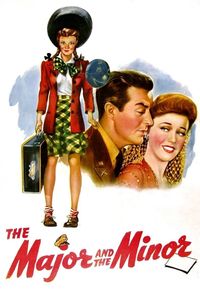
    The Major and the Minor (1942)

    (On Cable TV, August 2020) I’m on a long road to see most of writer-director Billy Wilder’s movies, so it was inevitable that I’d eventually make my way to his English-language debut feature sooner rather than later. After all, The Major and the Minor is a perfectly entertaining romantic comedy, featuring none other than Ginger Rogers and Ray Milland. The fun gets started when the twentysomething protagonist, out of cash for a ticket home, dresses up as a little girl and doesn’t convince the ticket takers. Chased through the train, she finds refuge in the cabin of an officer and, from there, follows him to the military academy where romance blooms. While this was the first American film directed by Wilder, it was far from his first script, and his comfort in writing good, zesty yet comfortable material shines through: Despite a premise that doesn’t really hold up (there’s a limit to how much two tresses can make Rogers pass as a twelve-year-old), the dialogue is great and even the familiar engine of romantic comedies feels rejuvenated. The Major and the Minor is quite funny, and it does wait its own sweet time to deliver the romance promised throughout the picture—the mark of a great filmmaker.

  • The Lost Weekend (1945)

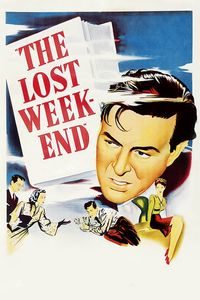
    The Lost Weekend (1945)

    (On TV, June 2018) You really wouldn’t expect a film about alcoholism to be so … entertaining. And yet here we are with The Lost Weekend, a film about an alcoholic protagonist being offered a weekend out of town to work on his issues … which he refuses in order to go on a three-day bender that leads him to rock-bottom. Surprisingly non-didactic, the script nonetheless carefully maps out the behaviour and coping mechanisms of a functioning alcoholic, before dropping him down as low as he can go: abandonment, debts, imprisonment, hallucinations, suicidal thoughts and perhaps self-redemption at the end. And yet the film remains fascinating and engaging throughout, a paean to director Billy Wilder’s ability, amply demonstrated here and elsewhere, in balancing extremely different tones into a cohesive whole. Ray Milland is convincing in the lead role, although Doris Dowling is captivating in a relatively minor barfly role. The filmmaking techniques here are used wisely, but it’s the message of the film that’s interesting: Alcoholism isn’t always shown in a proper light (often used as a comic device), and this film does manage to find a way to talk about it that still stands the test of time. Hilariously enough, The Lost Weekend was directly inspired by director Wilder’s experience working with noted alcoholic Raymond Chandler during Double Indemnity. I’m not the best audience for the film (I don’t even drink, so it’s not as if I can relate to alcoholism), but I found the film far more interesting than expected, and I find it an entirely acceptable Oscar-winner.

  • Dial M for Murder (1954)

    Dial M for Murder (1954)

    (On DVD, January 2018) Even the most average Hitchcock films are better than most other thrillers, so when I refer to Dial M for Murder as slightly-above-average, the lofty standards of the director mean that the film is really good. There’s a pleasant eeriness at the very beginning of the film, as elements are thrown together on-screen (such as a blackmail letter) in a way that seems more hurried than logical—it’s only later that we learn the ghastly truth having led to the situation. The rest is about an attempted murder, a criminal scheme, a woman in distress and an intricate plot for a detective to untangle. The mid-point plot twist makes Dial M for Murder jump tracks into far more interesting territory than simply a woman being stalked by a murderer. The plotting is impeccable, the character work is fine, much of the story is thrillingly set in one location, and the climax is unusually effective even by contemporary standards. There’s a comfortable classic feel to the story as set in post-war London. Grace Kelly is quite good in the lead role, with able supporting turns by Ray Milland, Robert Cummings and John Williams (who’s not John Cleese). Hitchcock’s direction is so slick that despite the film having been shot in 3D, little of it seems forced or out-of-place. I now have a little bit more respect for the 1998 remake A Perfect Murder, which takes the same premise but runs with it in different yet satisfying fashion. Still, have a look at the original Dial M for Murder—it’s a thrill and a pleasure to watch even today.