Raymond Burr

  • The Blue Gardenia (1953)

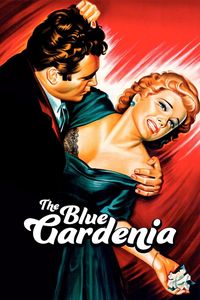
    The Blue Gardenia (1953)

    (On Cable TV, June 2021) One of the reasons for the continued popularity of film noir decades after its heyday is how it enabled female characters to be empowered. The femme fatale was deadly, but she was an active participant in her fate — and such strong female characters weren’t always found in other genres. The Blue Gardenia may not be the ideal film to illustrate this thesis, but it does something that few other films did at the time — play with the idea of violent retribution for sexual assault while on a date. The conclusion zig-zags a bit as to the identity of the killer, but the core idea does remain the same. In many ways, the execution of The Blue Gardenia is strictly professional — director Fritz Lang knew what he was doing, and this film marked the first of three journalism-focused movies. The film’s hurried production schedule didn’t allow for much refinement, but the spirit of noir remains intact and enjoyable here through the touches of romance, investigation and drama. Raymond Burr shows up as the unrepentant womanizer who earns a fatal fire poker to the head, while Anne Baxter plays the conflicted lead who may or may not have been at the other end of that fire poker. Still, the details may be what makes The Blue Gardenia so much fun — a clear-eyed depiction of dating for young single urban women at the beginning of the 1950s that fills in what other movies wouldn’t touch. By wallowing in darkness, noir could be more reflective of the times in which it was set, and you can see the impact of this frankness in the way The Blue Gardenia is still relevant and enjoyable well into the twenty-first century.
  • Walk a Crooked Mile (1948)

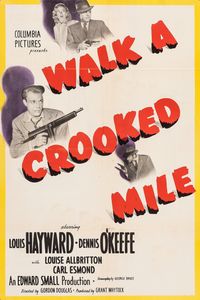
    Walk a Crooked Mile (1948)

    (On Cable TV, June 2021) It would be a stretch to call Walk a Crooked Mile a good film, but as a cauldron in which the late 1940s poured their insecurities, stylistic quirks, social prejudices, technological developments and vision of authority, it almost becomes fascinating. Often presented as noir thriller, it’s a film that’s perhaps best described as an espionage procedural with a heavy dash of two-fisted action. Mainly concerned about tracking down anti-American communist spies sniffing around the edges of the nuclear program, it’s a thriller with a heavy narrative voice to reassure viewers on what to think, clearly highlighting the new techniques that the homeland has at its disposal to identify and catch those who would threaten the nascent American hegemony. If this sounds heavy-handed… you haven’t seen the way director Gordon Douglas goes about it. The heroes (all males) fit within the very specific Anglo-Saxon ethnic mould that the FBI and Scotland Yard identified for its agents, while our villain (Raymond Burr in an early-career role) is conveniently labelled as not-like-us with a conspicuous goatee. There’s a sequence in which scientists are introduced with their career accomplishments, immediately followed by something along the lines of “and this brilliant woman, speaking five languages, is their secretary.” (While not uncommon for films of this era, this systemic marginalization of a female character is more infuriating here because it’s sandwiched in the middle of an authoritative tone that clearly tells viewers what is right and correct.) While Walk a Crooked Mile’s style is a blend of realism and noir flair, its attempts to stick to reality are not always helped by bombastic, dramatic scenes — such as the torture sequence in which the beaten-down immigrant American (a woman) spits in the faces of her torturers by telling them that she knows what dictatorship is like and she won’t help them. There is some interest in the breathless description of new gadgets that the all-virtuous never-wrong police services are starting to use. While I do have some innate fondness for that kind of nascent techno-thriller and the clean, straightforward style that the film takes on, I did have a bigger problem than usual going along with Walk a Crooked Mile’s unexamined ideological assumptions — I suspect that much of my reluctance comes from its daddy-knows-best tone, coupled with the knowledge that it supported a worldview that led to minority oppression, HUAC witch-hunting and rampant abuse of power. Classic Hollywood was a white man’s power fantasy, and Walk a Crooked Mile clearly fits the mould. Fascinating, but not necessarily good, nor a good thing.

  • Godzilla, King of the Monsters! (1956)

    Godzilla, King of the Monsters! (1956)

    (Second viewing, On Cable TV, July 2019) Blame my failing memory, but I assumed that Godzilla, King of the Monsters! was a sequel to the original Gojira, and nearly put off its viewing to another day after watching the original. But I didn’t, and was pleasantly surprised to find out that in its cinephile goodness, TCM had played both the Japanese original and its Americanization back-to-back. Godzilla, King of the Monsters! takes Gojira and reshapes its footage around new sequences featuring Raymond Burr as an American journalist who gets to experience the events of the film as part of his reporting. Extra sequences with Japanese actors talking with Burr are inserted in the previous film’s footage, providing a snappier rhythm (the film begins with catastrophic devastation, then flashes back in time to explain how we got there) and an accessible way for 1950s audiences to appreciate an unapologetically Japanese movie. Tall-and-wide Burr towers awkwardly over Asian extras as he describes the events unfolding, and even sort-of-interacts with some of the original characters through tricky editing. Despite the repetitiousness, it’s a far better movie if you’ve just seen the original as I did, as you can really appreciate the efforts that the American filmmakers went through in order to adapt the material to their target audiences. (History, hilariously enough, shows that this Americanization was more popular than the original in many markets, and even found its way back to Japan a few years later where it made a substantial amount of money.)  Some of Gojira’s most explicitly political (read; anti-nuclear) material did not survive the recut, but some of the best lines of dialogue remain. For today’s far more cosmopolitan audience, the idea of re-cutting a foreign movie with American content is tantamount to heresy, and it’s easy to laugh at the clumsiness of the attempts. But that’s missing the historical context: Without Godzilla, King of the Monsters!, there wouldn’t be much of a Godzilla cultural imprint in American society, and perhaps even less of an inroad from other Japanese filmmakers (including Kurosawa) in 1960s American film culture. It did the job at the time, and it does feel reasonably respectful even today: Burr interacts humbly with his Japanese hosts, and even if the spotlight is on him, he does not diminish the heroism of the Asian characters. The result is fascinating, especially if you can pair it with the original.