Raymond Massey

  • Possessed (1947)

    Possessed (1947)

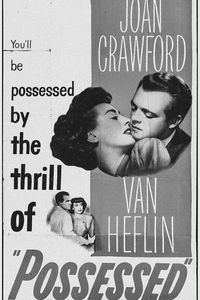
    (On Cable TV, June 2021) I’m not a big Joan Crawford fan (I’ve made my choice in the Davis-versus-Crawford feud), but it’s hard not to be impressed by the performance she gives in classic film noir Possessed, and by the overwhelming bleakness of the film surrounding her. The framing device has a woman (Crawford) telling a doctor about the events that have landed her in a psychiatric help facility, the film going through a multi-year dramatic story. There’s a very noirish sense of fatalism to the events, as Crawford’s character goes to the end of her murderous crush on a man. The story is told with admirable fuzziness, blurring the lines between subjective recollection of a troubled mind and the descriptive realism that was Hollywood’s mainstream style at the time. No less than Van Heflin and Raymond Massey play the two men with polar relationships with the protagonist — one of them she loves and who doesn’t in return, the other she doesn’t love even though he does. While conceived as a psychological drama rather than a crime film, the dark ending and sombre cinematography mean that Possessed has been included with some fanfare in the film noir corpus. It’s not a bad pick — and much of that credit goes back to Crawford herself.
  • 49th Parallel (1941)

    49th Parallel (1941)

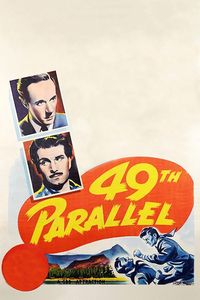
    (Criterion Streaming, January 2021) I usually scrutinize foreign films about Canada with a sharp eye, but 49th Parallel is a very satisfying mixture of semi-clichés, adventure, anti-Nazi propaganda and decent location shooting. Coming from the British film industry in the middle of WW2, it’s obviously conceived by filmmaking duo Powell/Pressburger as a kick in the pants for the then-neutral United States, and the best way to do this is by having Nazi saboteurs land in Canada and try to make their way to the States. As an adventure tale, it does have a nice forward rhythm, going from one episode to another as the Nazi infiltrators make their way across the country in a truly roundabout way and encounter various kinds of Canadians, with their numbers dwindling along the way. It starts off strongly with none other than a young Laurence Olivier playing a French-Canadian trapper (with decently accented French!) telling Nazis to shove off when they try to drive a wedge between French and Anglo-Canadians. Next up is a colony of Hutterite German immigrants, once again telling the Nazis to go away when they start playing on their common ancestry. After a detour through Winnipeg and the Rockies (where a British writer makes a strong stand for “soft” democracies), the action inexplicably gets back to Ontario in time for one last episode, where a less-than-perfect soldier (played by Raymond Massey, brother of future governor general Vincent Massey, who narrates the opening segment!) gets the finishing move near Niagara Falls. 49th Parallel would probably be fifteen minutes shorter without the speeches and propagandist material, but at a time of resurgent neo-Nazism, it’s still satisfying to see a portrayal of Canadians fighting back against the Third Reich. Aside from the ludicrous cross-country-and-back nature of the episodes, there’s plenty to like about the way Canada is showcased here. Some location shooting gorgeously feature its forests, prairies and mountains, while the characters have nicely done speeches making the country sound like amazing antagonists for the Nazis. Even the First Nations have some authentic representation, which is quite a lot more than we can say about many subsequent films. All told, 49th Parallel is quite a lot of fun to watch, and it’s an intriguing glimpse at the way Britain thought of Canada at the time.