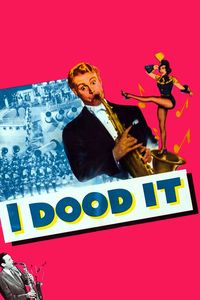
I Dood It (1943)
(On Cable TV, July 2020) One box-office formula is as old as time: funny man plus attractive woman. In I Dood It, it’s then-popular comedian Red Skelton playing a humble pants presser, paired with the supremely gifted Eleanor Powell as a Broadway star. Through various shenanigans and misunderstandings, the two end up married, leading to further confusion and set-pieces. An entertaining blend of comedy, dancing and singing, I Dood It is not exactly a film with a strong plot: What is in place is just enough to get us from one sequence to another, and while the dancing and singing are fine, the comedy bits tend to be stretched just a bit too long—if you’re dubious about Skelton’s brand of comedy, some passages based on his verbal humour are borderline unbearable. Meanwhile, the physical comedy bits (including a sequence featuring a passed-out Powell manhandled by Skelton) are a bit better—Skelton had some help from gagman Buster Keaton in conceiving the physical comedy, as the film is a partial remake of Spite Marriage. Powell does quite well in her role, with two impressive original dance numbers (a Western-themed one at the beginning of the film, then a Polynesian one near the two-third mark) with a final reprise from Born to Dance that’s telegraphed by having the protagonist describe his ideal dance sequence in suspiciously familiar terms for Powell fans. While some moments drag on too long, I can’t fault I Dood It for those—one of the highlights of the film has the story stop cold in order to have the great Hazel Scott deliver a dazzling piano number, immediately followed by Lena Horne headlining a rather amusing “Fall of Jericho” number. Who can complain about that? Wartime topical content includes a saboteur subplot that provides just enough drama to prop up the last act, and a rather amusing precision that a French poodle is a “Free French Poodle” (as opposed to a “Vichy French Poodle.”) It’s not particularly well directed by Vincente Minelli (although there is a flourish during the piano and dance sequence), who would go on to better things. While I Dood It starts slowly and doesn’t amount to much more than a collection of scenes, it’s worth it for the Powell, Scott and Horne trio.
