Richard Roundtree

  • Maniac Cop (1988)

    Maniac Cop (1988)

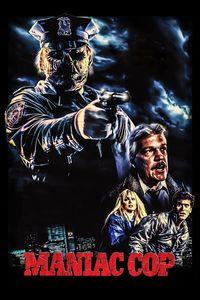
    (In French, On Cable TV, April 2020) So there’s this maniac and he’s a cop and this is a slasher horror film set in New York City and I can probably stop the review right here because you know all you really need to know about Maniac Cop. It’s directed by William Lustig (who also directed 1980’s execrable Maniac) but written by Larry Cohen, so there’s something that can’t easily be dismissed in the script and the result is, much to my dismay, an above-average slasher—maybe even a dark supernatural thriller. One of the interesting tricks that Cohen plays is changing protagonists every so often, eventually landing on none other than Bruce Campbell (albeit in a histrionic-free turn) as the protagonist. Richard Roundtree also shows up! There are a few surprisingly good stunts at the end of the film, and the entire thing is very much a New York City movie—and proudly made as a B-movie. While I can’t bring myself to call Maniac Cop a good film, I liked it better than I thought, and feel that with police brutality being under an unprecedented scope, the film should find a specific audience in the ACAB crowd. Maybe we’ll end up with a remake one of these days.

  • Shaft (2019)

    Shaft (2019)

    (On Cable TV, February 2020) Having seen the original 1970s Shaft not too long ago and the 2000 sequel/remake in theatres, my expectations for this newest instalment were calibrated just right. As much as it may irk some, the best thing about the original movie remains the title song—nearly everything else has been handled much better in other blaxploitation films. The 2000 film was an uninteresting follow up, so how much worse could another reboot be? As it turns out, this latest instalment feels like the most entertaining film of the trilogy. By explicitly setting itself up as a third film in an ongoing once-a-generation series and having both Richard Roundtree and Samuel L. Jackson play older versions of their own characters, this Shaft opens itself up to a new audience while paying a more respectful homage to the previous generations. The film clearly draws upon 2010s scripting techniques by blending comedy with action, adopting a fast pace thanks to director Tim Story and relying a bit too much on established stereotypes even as it decries doing so. Much of the story has to do with the newest, youngest Shaft (played by Jessie T. Usher), son and grandson of previous ones. He’s a data analyst with the FBI, who dislikes guns (while still being pretty good at them, as shown in one of the film’s best scenes) but is forced to team up with his elders in order to resolve the murder of a friend. The story isn’t as important as seeing a twenty-first century Shaft argue about approaches and techniques with his rougher elders, each coming from a slightly different era of blaxploitation. Jackson is particularly funny as a man out of time, but everyone has their chance to shine along the way. Alexandra Shipp makes for a rather lovely companion to the younger Shaft, while Regina Hall also makes an impression as an ex-flame of Jackson’s Shaft. Some of the humour is predictably directed at younger generation clichés, but it all reaches a polished climax high atop a villain’s lair. I liked Shaft quite a bit more than I expected, even though I suspect that it may not age particularly well… but then again neither has its predecessors. Not as much as you’d like to think.

  • Shaft (1971)

    Shaft (1971)

    (On Cable TV, December 2018) My expectations may have been a bit too high for the original Shaft. The film, in the popular imagination, has become a bit of a Blaxploitation landmark, buoyed by its famous title song and Richard Roundtree’s untouchable status as an icon. Shaft remains one of the best-known Blaxploitation film, which acted as a precursor to modern black-driven American cinema. That’s a lot of weight to put on what is, after all, simply a crime thriller. The reality on the ground, or rather on a scene-by-scene viewing basis, is not quite as glamorous: While Shaft benefits greatly from Roundtree’s performance, its Oscar-nominated title tune (naïve, but still potent) and first-mover advantage in defining blaxploitation, it does feel tepid and dated—there’s definitely some coolness to it, but it doesn’t measure up as favourably as it once did as an urban thriller. Of course, what we see now after decades of imitators is not the same thing as the 1971 audiences saw, some for the first time: a black hero stylishly navigating a complex urban landscape between cops and organized crime. While I enjoyed it, I was clearly expecting more, probably conditioned by endless flashy imitators refining the lessons learned by the original Shaft.