Richard Widmark

  • O. Henry’s Full House (1952)

    O. Henry’s Full House (1952)

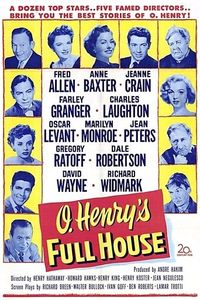
    (On Cable TV, December 2021) Although far less famous now, O. Henry (a pseudonym of William Sydney Porte) was a steady fixture of English textbooks throughout the twentieth century, his deeply ironic short stories being the kinds of things teachers could use as examples of literary devices that students would enjoy reading. (“The Gift of the Magi,” in particular, still has some power.) The flip-side of that popularity is that some of his stories have now fallen into easy cliché, so a film adaptation of five of his best-known tales does often seem far more conventional than intended. O. Henry’s Full House does have a few other things running for it, though: It features none other than John Steinbeck as host, telling us about Henry and introducing each of the five segments. There’s also the matter of casting, with such notables as Marilyn Monroe, Charles Laughton, Oscar Levant… and Richard Widmark reprising his character from Kiss of Death. There are also some surprisingly good credentials behind the camera as well, with Howard Hugues directing one segment co-written by Ben Hecht. Still, the overall impact of the stories is good without being great: Since Henry’s narratives are often built around an ironic surprise ending, it doesn’t take long to learn to accurately guess where the segments are going. (And that’s not counting the cases where we already know how the stories will end.)  Still, the execution is not bad, and everything can be watched rather easily. For English literature fans, O. Henry’s Full House is an intriguing film not just for the Henry adaptations, but also for Steinbeck’s only movie appearance.
  • The Cobweb (1955)

    The Cobweb (1955)

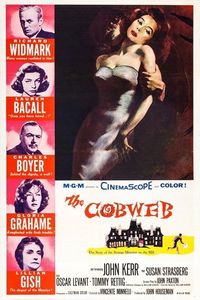
    (On Cable TV, September 2021) Unlike many other psychiatric institution movies, The Cobweb isn’t solely concerned about the therapy of its residents. Oh no — this film is about nearly everyone involved with the institution — patients, doctors, administrators and their spouses, as a question of drapes manages to ignite a near-vicious power struggle for the well-being of the institution. (The film is bookended by two title cards: “The trouble began” and “The trouble was over.”)  Richard Widmark stars as a workaholic doctor who gets involved in the trouble, and has to juggle patients, faculty infighting and marital troubles. The supporting cast is probably more interesting than you’d expect, what with the ever-beautiful Lauren Bacall and Gloria Grahame, a matronly Lilian Gish as well as an Oscar Levant as a patient. (Legend has it that Levant was incredibly difficult to work with, which feels entirely unsurprising.)  The Cobweb isn’t exactly a high-octane film — for all of the strife that it works toward, it all feels mild-mannered, even academic. Levant is underused in a role unusually close to his persona, while Bacall doesn’t have all that much to do either. Still, the film does offer a glimpse into mid-century mental health attitudes without quite delving into the usual clichés of the genre. It’s not that good but not that unbearable either, although careful viewing is required to remain invested in the ongoing story before it heats up to serious drama.

  • Kiss of Death (1947)

    (On Cable TV, July 2021) Often hailed as one of the classic film noirs, you can see in Kiss of Death something that did not often exist in prior movies: Richard Widmark’s psychopathic performance (in his film debut!) as a two-bit hoodlum, with a wide-eyed smirk and sadistic laughter right before sending an old lady tumbling down a staircase. It’s a performance that does wonders with an underwritten part, and film historians tell us that this marked a turning point in the history of movie villains. (Widmark got an Academy Award nomination for the performance, and you can find echoes of it all the way to Heath Ledger’s Joker.)  Surprisingly enough, it still works well even after decades of psycho killers in films far worse than this one — and much of the effectiveness goes in establishing the protagonist as someone with a lot to lose, with two daughters and a new wife to protect against the evil antagonist. But it’s hard not to be impressed by most aspects of the film’s production — from a screenplay by classic Hollywood legend Ben Hecht to a credible use of location shooting to a result filled with procedural details and cynical dialogue, Kiss of Death is already a superior noir from the moment the actors step on set. Victor Mature does a good job in the lead role, a protagonist dealing with the suicide of his first wife while he’s in prison and turning informant in order to protect his two daughters sent to an orphanage. Colleen Gray provides the narration and some further dramatic heft to the film as a babysitter turned wife. It all wraps up in a good package, with a happier ending than is the norm in noir.

  • No Way Out (1950)

    No Way Out (1950)

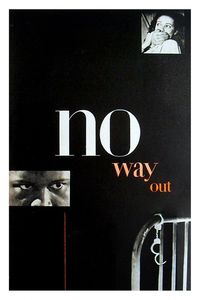
    (On Cable TV, June 2021) It’s almost amazing to realize that No Way Out was Sidney Poitier’s feature film debut, because it already shows the characteristics and the persona that would transform him into a movie star during the following decade. Here, he plays a black doctor confronted with a deeply racist criminal as a patient (Richard Widmark, fully playing up his cad persona) that he nonetheless has to treat. A mysterious death ends up causing no end of troubles for the young doctor, and the film keeps exploring racism in a way that still resonates today. Written and directed by the legendary Joseph L. Mankiewicz, No Way Out is well-written and well-structured — a joy to watch despite the tough subject matter. Poitier is already exceptional and the script’s naked racism still rankles today.

  • Two Rode Together (1961)

    Two Rode Together (1961)

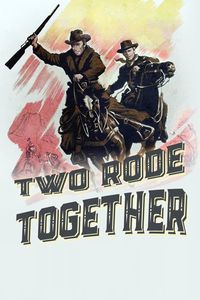
    (On Cable TV, February 2021) Considering my lack of affection for westerns and my Canadian citizenship, it’s probably no accident if I don’t have much fascination for director John Ford, nor his seemingly endless list of westerns. But I do like James Stewart, and his starring role in Two Rode Together was worth a look. The story is immediately reminiscent of the much superior The Searchers, as the protagonist goes looking for settlers “kidnapped” by Native Americans. Of course, there’s little heroism here, as the revisionist westerns take hold over a new decade (after Hollywood’s severe overdose of westerns in the 1950s) and Stewart seems only too happy to keep going in the same misanthropic streak he enjoyed in the films he shot with Anthony Mann. His mercenary lawman isn’t admirable, although he does get the girl (against all odds) and the happy-ish ending. I didn’t like much of Two Rode Together: the script is an ambitious mess going in far too many directions than strictly necessary, and the film (despite being shot in colour) is a somewhat downbeat carnival of dashed expectations and overturned presumptions. Whatever humour remains seems curiously glum or immediately dashed by far more sombre material. Even the relatively complex treatment of its Native American character seems hampered by the director’s old-fashioned shooting techniques. While Two Rode Together is worth a look if you’re interested in Stewart’s western oeuvre, or Ford’s touch on material he didn’t believe in (he famously directed the film for money and a personal favour, believing that the material strayed too close to The Searchers). The best scene, amazingly enough, is just Stewart and Richard Widmark chatting away about various things while the camera remains locked on them — it does suggest a far more avant-garde western made entirely of casual conversations and static camera shots à la early Kevin Smith. But not really. Two Rode Together ends up being an unwieldy collection of elements that don’t necessarily fit together, indifferently directed albeit with capable actors and the saving grace of a half-optimistic ending. That’s not much, though… even for Stewart fans.

  • The Tunnel of Love (1958)

    The Tunnel of Love (1958)

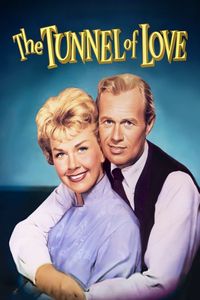
    (On Cable TV, September 2020) The late 1950s were a turning point for legendary singer-dancer-actor Gene Kelly: getting older, he turned his MGM fame into an opportunity to start directing movies. The best known of them probably remains Hello Dolly!, but the first would be the comparatively little-known The Tunnel of Love, a romantic comedy that pushes some disquieting buttons, such as marital infidelity. (Heck—much of the film’s later half is built on the suggestion of infidelity leading to a pregnancy leading to a baby being adopted by the man and his increasingly furious wife.) With such touchy material, it’s no wonder if the film flopped and the critics were not kind—with a number of contemporary reviews being particularly uncomfortable about the boundaries that the film was pushing in terms of sexual frankness. The Tunnel of Love feels tame today, but there’s still some material in here that seems cruel to the female lead: a combination of patriarchal aloofness and contrived avoidance of essential discussions that makes the film less than pleasant to watch even today. (This is one of those films where the plot falls apart if the two main characters had good ongoing communication.) Filmed in black-and-white, it also carries a connotation of seriousness that other colour comedies of the time didn’t have. Richard Widmark is not entirely suited to a role that crucially carries the film—Doris Day, meanwhile, is more pitiable than comic as his long-suffering wife. The direction itself is somewhat unremarkable, perhaps more noteworthy for the topic matter than the actual craftsmanship that it demonstrates. Kelly would later do much better as a director: even in the same infidelity-comedy ballpark, A Guide for the Married Man, ten years later, would be funnier and more interesting to watch, probably buoyed by changing mores and acceptance of a saucy topic matter.

  • Night and the City (1950)

    Night and the City (1950)

    (On Cable TV, October 2019) Film noir is often about desperate people in bad circumstances, and in this light Night and the City certainly qualifies as such. Unusually taking place in London rather than in a large American city, it nonetheless plays up the grimness of low-class hustling, with a protagonist perpetually convinced that he’s only one lucky break, one spin of the wheel away from success. Grim and tawdry, it takes place in the city’s underworld, rubbing shoulders with wrestlers and killers. Richard Widmark is not bad as the protagonist, but I suspect that most viewers will better appreciate Gene Tierney as his long-suffering girlfriend. The unrelenting grimness of the result isn’t only in the atmosphere, but in the lack of sympathy for any character and the unsparing ending of director Jules Dassin’s preferred version (a British version reportedly softens up the ending—it’s not the one I saw). Night and the City is not a film for every audience or every mood, but it does stand as a prototypical noir even despite not taking place within American borders. You even get a (repeated) didactic mention of “Montréal, in Canada” just for the fun of it.

    (Second Viewing, On Cable TV, November 2020) There have been many films noir in the 1950s, and they do get to blur if you’re watching too many of them in rapid succession. What director Jules Dassin’s Night and the City has over others is its somewhat unusual location: For as American a genre as noir, it feels refreshing to see the film take place in London. The historical circumstances surrounding this are strange—Dassin was on the blacklist at the time, and MGM was looking to take advantage of some financial incentives to produce films in England. (It also set in motion the very improbable series of events that would make Jules Dassin the father of an iconic French singer, but that’s going way beyond the scope of this review.)  Taking place in the very noirish demimonde of boxing promotion, Night and the City piles on the noir trademarks; desperate characters squeezed into illegality by bad luck and circumstance, moody black-and-white cinematography; plenty of scenes in which characters run in deserted alleyways; a femme fatale, this time played by the legendary Greer Garson. Plus, the London backdrop is quite intriguing as a change of pace. It doesn’t make Night and the City all that good, but it does help it distinguish itself from so many close contemporaries.