Robert Altman

  • California Split (1974)

    (On Cable TV, September 2021) I don’t gamble and I’m not often a Robert Altman fan, so my expectations going into California Split ran low. This is, after all, a very Altmanesque film (complete with overlapping dialogue made possible by the then-innovative technique of using eight-track mixing) about two gamblers meeting each other and going through the highs and lows of the lifestyle. Surprisingly, though, I quite liked the result. From a clever opening sequence mixing an instructional tape with ironic counterexamples, the script has a sure-footed take on the toll and exhilaration of full-time gambling, taking us to casinos and pawn shops along the way. It helps to have two capable actors anchoring the cast: George Segal as the gambling apprentice, but especially Elliott Gould as the inveterate devotee to a life spent chasing the next sure thing. The atmosphere of mid-1970s Los Angeles and Reno is nicely portrayed, and the typically Altmanesque cacophony is used to good effect when it comes time to represent the confusion of a gambler on a multi-hour binge. Interestingly enough, California Split resists the temptation to offer a moral lesson— while one of the protagonists may have had a moment of clarity, the other clearly intends to keep on doing what he’s been doing not-that-successfully. It all comes together for a film that’s still quite entertaining, with a filmmaking technique that feels appropriately modern at times.

  • Brewster McCloud (1970)

    Brewster McCloud (1970)

    (On Cable TV, June 2020) Writer-director Robert Altman’s sense of humour is an unusual one, as shown by the odd Brewster McCloud. It’s a bizarre mixture of Houston setting, ornithologic information, oddball characters and uncomfortable gags that get more quizzical chuckles than outright laughs. Most amusing bits are a few refinements away from outright humour: there’s clearly something here that’s meant to be funny, but it doesn’t click naturally—although viewers are free to revel in the weird counterculture nature of it all. The atmosphere of 1970s Houston is well rendered, though, with a focus on the Astrodome as the scene of many of the film’s big moments. In other ways, Brewster McCloud is random stuff thrown together for unclear purposes: As a taste, let’s mention the professor (played by René Auberjonois) whose lecture on bird characteristics keeps underscoring the character action, even as he gradually transforms into a bird throughout the film. Said references inevitably lead to an Icarus-like climax. Other bits and pieces include some weird take on the Bullitt-grade supercop archetype, an amusing car chase, and an angel intervening in the proceedings whenever she can—plus Shelly Winters looking much cuter than expected in her screen debut, despite unfortunate eye makeup choices. Add to that Altman’s motifs of gritty filmmaking and naturalistic dialogues and Brewster McCloud certifiably becomes a weird movie—but not necessarily a successful on. Although that final video credit sequence… has to be seen to be believed. Which stands for much of the film, really—you’ve never seen anything quite like this before or after.

  • McCabe & Mrs. Miller (1971)

    McCabe & Mrs. Miller (1971)

    (On Cable TV, February 2020) In retrospect, it makes sense that the western genre—for years the stereotypical Hollywood exemplar, would have been one of the most deconstructed genres by the 1970s. New Hollywood was eager to show how different it was from the old one, and in that context it’s not surprising to see Robert Altman squarely taking on the genre in McCabe & Mrs. Miller. Though technically a western, it’s almost at the opposite end of the usual Western iconography. It’s set deep in a forest in snowy cold northwestern American, with flawed characters unable to resist the corrupt business interests against them. Visually, nearly every optical trick in the cinematographic art is used to give a distressed look to the film: Washed-out colour, rainbow highlights, hazy soft focus and so on. It’s all gritty and dirty and colour-muted like many 1970s films, which viewers are liable to love or hate. To be fair, the period recreation is a lavish representation of a western work camp—it’s just the way it’s captured that’s liable to make some viewers crazy. Warren Beatty is quite good as McCabe (it’s a kind of role he’d often play in his career, all the way to the tragic conclusion), while Julie Christie is also remarkable as the other half of the lead sort-of-couple. Even with nearly fifty years of subsequent Western deconstruction, there is still something in McCabe & Mrs. Miller that feels unique—perhaps because no one else since has dared to be so resolutely indifferent to audience expectations. The early 1970s were another time entirely in Hollywood history, for better or for worse.

  • Countdown (1967)

    Countdown (1967)

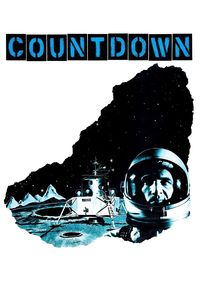
    (On Cable TV, July 2019) No matter how much you know (or think you know) about movies, there’s always another one you don’t know, and today’s discovery for me is 1967’s Countdown, a pre-moon landing techno-thriller about a desperate backup plan to land a single American on the moon before the Soviets do. What was speculative fiction back in 1967 is now a fascinating bit of alternate history, especially considering the care taken in ensuring that the film is grounded in reality—NASA collaborated with the film, and the filmmakers went to painstaking detail to ensure that the film felt plausible. Perhaps the biggest surprise in discovering Countdown (which doesn’t even rank among IMDB’s 100 top seen movies of 1967) is finding out that not only it was director Robert Altman’s first film, but that it starred none other than a very young James Caan and Robert Duvall as astronauts competing to be the first humans on the moon. Altman’s touch can be seen most clearly in his typical (but rarely seen at the time) overlapping dialogue—otherwise, this straightforward tightly-plotted thriller is as far removed from his other movies as it’s possible to be. Caan and Duvall are nearly unrecognizable as younger men, but give quite a bit of gravitas to their ongoing squabble through the film. Compared to other films of the period and later renditions of the space program, Countdown scores highly when it comes to verisimilitude—the spirit, sets, perceived danger and technical details all ring true. Special-effects-wise, the biggest issues come toward the end, as the sequences set on the surface of the Moon don’t have the characteristic harshness that real-life footage has shown us. But for a film released 18 months before the Apollo 11 moon landing, it’s a pretty good effort. Story-wise, I do feel as if the film (or the novel on which it’s based) is missing an entire third act—we leave the protagonist at the earliest possible moment, whereas I feel there was a much stronger and longer story to tell about his return back home. Still, I quite liked Countdown: its techno-thriller aesthetics and narrative drive fall squarely in one of my favourite kinds of fiction, and I think that it’s a splendid period piece to illustrate the suspense of the moon program back in the mid-1960s, before we saw it all culminate with a successful moon landing. I have a feeling I’ll be singing the praises of this less-known film for years to come.

  • Popeye (1980)

    Popeye (1980)

    (Popcornflix streaming, September 2018) I grew up on Popeye cartoons (in French, mind you), but somehow hadn’t seen the live-action adaptation until now. I can’t say I missed much, because for all of director Robert Altman’s skill in recreating a cartoon-inspired seashore village, much of Popeye simply falls flat with simplistic character motivations, too-long musical numbers and an overall impression of … dullness. It’s not all bad: Robin Williams is good as Popeye, but Shelley Duvall is terrific as Olive Oyl and Paul L. Smith is remarkable as Bluto. The sets are splendid (almost too good, in fact—we don’t really want to spend any more time there) and there is some occasional good staging for the physical comedy. But otherwise, Popeye remains surprisingly boring: The film feel self-satisfied, prone to excessive sentimentalism and unwilling to make its narrative advance. Williams’ constant mumbling of malapropisms as Popeye in in-character, but that doesn’t mean it’s any less annoying. In some ways, Popeye also seems made for those who already know Popeye—I’m among those, but we’re literally a dying breed and I wonder what audiences new to the character would make of the film. I certainly had to pause and think a bit about those Saturday morning cartoons to be reminded of why the film followed a certain path, who those annoying people were and why it was so stylized. Overall, I’m disappointed at the result.

  • MASH (1970)

    MASH (1970)

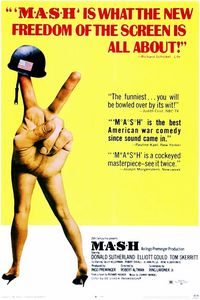
    (On TV, June 2018) Some films are so successful that they sabotage their own legacy, and if MASH doesn’t feel quite as fresh or new or daring as it must have felt in 1970, it’s largely because it was followed by a massively successful TV series and embodied a new cynical way of thinking that would come to dominate (North-) American culture in the following decades. Obviously commenting on the Vietnam War by using the Korean War, MASH shows us disaffected doctors treating the war, and the entire military institution, with obvious contempt. They’ve been drafted, they belong elsewhere and their attitude encapsulates what many Americans had come to think about the military by 1970. Such things are, to put it bluntly, not exactly new these days—and you could easily build a mini-filmography of films in which military heroes behave badly. MASH also suffers from an episodic, largely disconnected plot—there’s a new episode every ten minutes, and it doesn’t build upon those adventures as much as it decides to end at some arbitrary point. Director Robert Altman’s shooting style is also far more similar to newer films than those of 1970—inadvertently scoring another point against itself. It’s not quite as interesting as it was, not as innovative as it was, not as shocking as it was. As a result, it does feel more inert than it should. It’s still worth a watch largely as a historical piece, but also as a showcase for an impressive number of actors—starting with Donald Sutherland, alongside Elliott Gould and a smaller role for Robert Duvall. The metafictional ending works well, but it still leaves things unfinished.

  • The Player (1992)

    The Player (1992)

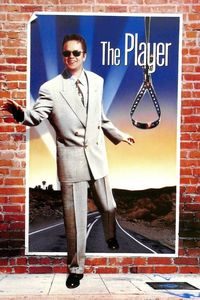
    (Second viewing, On Cable TV, March 2018) I first saw The Player sometime in the mid-nineties and fondly remembered it as a good satire of the Hollywood system. Seeing today, now that I’m venomously better-informed about moviemaking, is almost better than a first viewing. Tim Robbins stars as a studio executive who, harassed by an unknown person, comes to accidentally kill a screenwriter. The rest of the film is about avoiding detection even in the face of persistent investigators. Writer/director Robert Altman has rarely been funnier as he (somewhat gently) skewers the Hollywood machine, portraying nearly everyone as self-absorbed jerks capable of the worst. Back in 1992, much was made of The Player’s nonstop parade of cameos—twenty-five years later, it’s turned into a game to spot people whose fame has considerably waned a quarter of a century later, or non-actors Hollywood royalty whose face were never that well-known in the first place. The film does begin on a very high note with a complex seven-minute shot that neatly introduces a bunch of narrative threads and characters. It spends a remarkable portion of its first half-hour lining up joke after joke even as it gradually builds up its premise. The rest of the film isn’t as constantly funny—The Player does take its plot seriously after a while, and the detective subplot isn’t particularly high on satire. The last few minutes, however, do go back to the satire, with an amusing movie-in-a-movie and a killer last few lines in which, well, “forget it Jake, it’s Chinatown.”  While I don’t think I’m quite as bullish about the movie as when I first saw it, I still like it quite a bit.

  • Dr. T & the Women (2000)

    Dr. T & the Women (2000)

    (In theaters, December 2000) This might be a rather impressive misfire, but at least Dr. T & the Women can boast one of the most descriptive title of the year. There’s the plot in a nutshell, how a gynaecologist (Richard Gere, in a fairly good role) deals with the woman in both his professional and personal lives. I’m not sure if the screenwriter actually lives on this planet (Woman looking forward to their visit to the gynecologist? I’m no expert on the subject, but that’s news to me.) but it’s clear that s/he’s got no skill writing comedy: Despite the potential of the film’s elements, it falls singularly short of exploiting its own quirkiness. (At one point, I kept hoping for Dr. T. to say “My wife’s a nut, my sister-in-law’s an alcoholic, my lesbian daughter is getting married to a guy, my secretary’s hitting on me and the most normal member of my family is a conspiracy theorist!”) lot of missed opportunities, slow pacing, implausible situations (even for a Robert Altman film) and a truly awful ending which doesn’t resolve anything. But don’t think that I didn’t enjoy the film, flaws and all. The star-studded cast is impressive in itself, there’s some welcome female nudity and if you don’t know the ending you can kid yourself in being interested in how worse the plot threads can get for the intrepid Dr. T. Kudos to my sister for uncovering a subtle interpretation of the film, as she maintains that it’s Dr. T. himself who’s responsible for the nuttiness of the women around him. All in all, a film that’s worthwhile almost despite itself.