Robert. B. Parker

  • Spenser Confidential (2020)

    Spenser Confidential (2020)

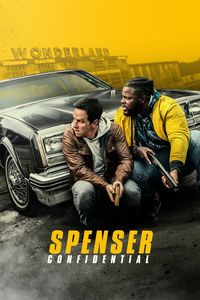
    (Netflix Streaming, March 2021) I wasn’t in the most forgiving mood during the first thirty minutes of Spenser Confidential. As someone who has read over twenty of Robert B. Parker’s “Spenser” novels back in the 2000s, my expectations were simple: I wanted a screen adaptation of Spenser, Private Investigator of little words and considerable attitude. In my mind, Spenser looks a lot like Parker himself — a bit squat and portly, with a magnificent moustache and flashes of devious inspiration. In other words, nothing like Mark Walhberg. But as the film advanced and made it clear that it only kept the Boston-area setting and character names of Spenser, wingman Hawk and dog Pearl, a quick look at Wikiepdia confirmed that I’d missed out on quite a bit in the past decade — most notably that following Parker’s death in 2010, writer Ace Atkins rebooted the Spenser series to (sigh) a younger, sexier version, and it’s that Spenser who was adapted to the screen. (I shouldn’t be too annoyed — after all, the original Spenser was previously adapted to the screen though a three-season TV show and two separate series of TV movies.)  But enough of that neepery — Considered on its own terms, how is Spenser Confidential? Well, it’s clearly designed as a launching pad for a series of Wahlberg vehicles— here we have Spenser as an ex-police officer who went to prison for hitting a (corrupt) officer whose savagely beaten body is found the day following Spenser’s release. Taking an interest in the widow and child of another slain officer in a connected affair, Spenser adjusts to civilian life, makes friends with the imposing Hawk, navigates a tumultuous romance with his ex-girlfriend, and investigates his own origin story. It takes place in Boston but stays in the working areas of the city, with director Peter Berg showcasing his easy rapport with Wahlberg in their fifth collaboration to date. Still, there’s no denying that the film almost runs on autopilot, with few surprises along the way and a strictly utilitarian approach to its material. There are a few scenes here that could be cut with no sense of loss — most notably a dogfighting sequence that serves no perceptible purpose other than making the film longer. Spenser Confidential is agreeable enough—the kind of film you leave playing but don’t have to watch all that closely—but it’s nothing special. Which, to think of it, does feel a lot like the overall goal of the original Spenser novel — expect that Parker’s formula was more interesting at its core than this adaptation.
  • Stone Cold (2005)

    Stone Cold (2005)

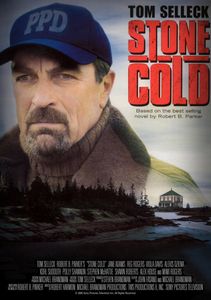
    (In French, On TV, June 2020) As a fan of Robert B. Parker’s crime thriller novels, it was inevitable that I’d eventually make my way to the movie adaptations of his work sooner or later, and Stone Cold has the distinction of featuring a protagonist other than Parker’s Spenser. (Technically, this is the first of nine films in the series but it’s adapted from the fourth novel—don’t worry too much about it.) Paced more slowly than many other police thrillers, it’s focused on Jesse Stone, a grizzled police chief in a small Massachusetts town where nothing usually happens, and who suddenly had to contend with serial killing and the rape of a teenager. For a made-for-TV movie, this one has a rather good pedigree, what with Tom Selleck credibly playing Stone, supported by such well-cast notables as a pre-stardom Viola Davis (as a police officer), Jane Adams (not much of a stretch playing a psycho killer) and Mimi Rogers (with a handful of great scenes as a lawyer who goes after what she wants). Stone Cold is not much of a crime mystery—we already know early on who did it, so it’s best approached as a character study in following a disillusioned, possibly depressive man at the end of his rope. The atmosphere of a small seaside town is amiably portrayed, and the film becomes a somewhat comfortable experience, more remarkable for the ride than the destination.

  • All Our Yesterdays, Robert. B. Parker

    Dell, 1994, 466 pages, C$8.99 mmpb, ISBN 0-440-22146-3

    It’s become something of a cliché to represent every best-selling author as someone with deep literary aspirations who resort to simple, exciting, shallow novels to support himself while s/he’s writing the Great American Novel. (Even Olivia Goldsmith’s The Bestseller does this…)

    For instance, everyone knows that Stephen King can write shlocko horror novels at the rate of two or three a year, but his fans also know that meanwhile, King is also writing deeply serious, profound works of literature with his Dark Tower series (among other things, including his short stories.)

    In this case, Robert B. Parker is best known as the best-selling author of the detective series “Spencer”. In these novels, a witty Boston private investigator fends off the Mob and other assorted thugs while solving crimes and engaging in witty banter with his psychologist girlfriend and a gallery of sharply-drawn characters.

    I more or less became hooked to Robert B. Parker in early 1997, when one friend gave me a box of crime novels which contained two “Spencer” thrillers. I don’t usually read much crime fiction (perhaps ten-fifteen books a year in good years) but somehow became a “Spencer” fan.

    And now this, a non-Spencer Parker novel.

    All our Yesterdays traces the affairs between two families over three generations, beginning in 1912 and ending in 1994. The legacy of an affair between an Irish revolutionary and an American nurse will ultimately end up in Boston (considering Parker—where else?) being played-out in a city-wide gang war. Three generations of cops, trying to deal with crime and love.

    This book is a much more ambitious novel than any of the “Spencer” novels. It’s also nastier, as if Parker realized he was writing for a more jaded audience than his usual crowd. His characters are darker; his prose style is harsher. People swear, have sex and beat up others even more. (They don’t seem to kill off each other in greater quantities, though.) Even given the not-always-fluffy tone of the Spencer novels, this is something. Unfortunately, a lot of the humor is also left behind. This isn’t necessarily a bad thing, since Parker retains his grip on how to write crackling dialogue.

    The characters of the novel are deliciously complex, and often end up acting in ways you’re not supposed to expect. The relationships between the characters is more dynamic than in the average novel, and it’s one of the pleasures of the novel to see everything being played out. It may be argued that the small scale of the novel is unsatisfying, but Parker makes simple dialogue more exciting than explosions, so everything evens out. The style is unusually readable, this 450+ pages novel being easily readable over a single day.

    All our Yesterdays, despite its bigger aspirations, isn’t that much of a step over the Spencer series. (A testament of the overall quality of Spencer novels more than anything else) As such, fans of Spencer will certainly enjoy this novel as much as the other ones. Others might see this as a good one-time introduction to Parker’s fiction.