Robert Bresson

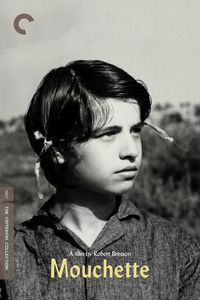
  • Mouchette (1967)

    Mouchette (1967)

    (On Cable TV, February 2021) As much as there are directors out there with whom I seem to share a considerable amount of affection even for their most ordinary movies, the converse is true and I suspect that Robert Bresson is one of those. With Mouchette, I’m one-for-three for his movies, except that the lone film I like from him (Un Condamné à mort s’est échappé) I liked despite Bresson’s usual minimalist style and because it wasn’t as intensely depressing as his other two. Mouchette combines my profound opposition to Bresson’s style with a just as exceptional distaste for stories of continuous suffering. Here, Nadine Nortier plays the title role, a young girl whose entire lot in life seems to be suffering at the hands of others: overworked and underappreciated at home, bullied at school, dismissed by fellow villagers, raped by an alcoholic and orphaned, her life just keeps getting worse and worse every single minute of the film, and the ending is no exception. Bresson being Bresson, this horrid tale takes place in minimalist black-and-white cinematography, with emotionally muted performances by non-actors and low-end production values. Mouchette isn’t any fun to watch by any stretch of the imagination, and quickly grows exasperating if you care too much about it. Alas, it looks as if Bresson is well regarded and directed a number of titles on the various must-see lists I’m using as a guide to cinema I don’t like. I’m not looking forward to his next films.

  • Un condamné à mort s’est échappé ou Le vent souffle où il veut (1956)

    Un condamné à mort s’est échappé ou Le vent souffle où il veut (1956)

    (Criterion Streaming, November 2020) I have said some very dismissive things about writer-director Robert Bresson in past reviews, but Un condamné à mort s’est échappé makes me want to walk back some of that commentary. Bresson’s typically sparse and detached style ends up being a near-ideal match for this topic matter here, as he intensely studies every twitch and action standing between a French Resistance leader and his escape from a Nazi prison during WW2. Bresson, working from a real-life memoir, himself knew what he was talking about, having himself been imprisoned by Nazi authorities during WW2. His quiet, drawn-out approach works well here, maintaining the suspense of the ongoing escape, and relying on a meta-tapestry of thrills (that is: the threat of being shot, the evil of the Nazis, the patriotic meaning of La Resistance) outside of what he is showing on-screen. It’s a clever film, stripped of the histrionics of not-dissimilar movies such as The Great Escape but effective in its own way. The film’s world is the prison—it ends as soon as the lead character is no longer in it. Sometimes a director’s idiosyncratic approach proves to be irritating until it’s applied to the right context, and that’s how I feel about Bresson here—I can’t stand much of his filmography, but it happens to be the exact right fit for the topic matter here, and the result is without a doubt not only my favourite film of his, but an essential French film of the 1950s.

  • Pickpocket (1959)

    Pickpocket (1959)

    (On Cable TV, June 2020) “Ugh, Bresson” is slowly becoming “Eh, Bresson,” and while that doesn’t sound like much, it’s actually quite a bit of progress: I can now start watching his films without feeling as if it’s going to be as terrible as That Donkey Movie. Not that writer-director Robert Bresson steps away all that far from his usual techniques in Pickpocket: it’s still sparsely scored, delivered in low-key, almost affect-less style, employing non-professional actors, and joyfully dispenses with notions of genre conventions. Despite revolving around an active criminal pursued by the police, Pickpocket is far more of a character study than a genre crime film—it zigs and zags and seldom settles for the simplest plot development. Adding philosophical musings to a crime story, it almost defies categorization. I actually… ahem… liked it, which is more than I can say about other Bresson films.

  • Au hasard Balthazar [Balthazar, at random] (1966)

    Au hasard Balthazar [Balthazar, at random] (1966)

    (Kanopy Streaming, October 2018) I have a parody version of French New Wave movies in my mind that has been fed by other parodies, by early unpleasant encounters with the genre and by various readings about the Cahiers du Cinéma/Rive Gauche crew. My theoretical parody is a wholly unfair funhouse version of a valid artistic movement, and I’m astonished to find a movie that surpasses its absurdity. That would be Au hazard Balthazar, a movie about a donkey. A real donkey as a protagonist. A donkey whose life, from birth to death, is followed by the film as an illustration of humanity as it gets new owners—some nice and others not-so-nice. But wait: the absurdity doesn’t stop there, as a donkey protagonist means that we’re stuck in rural France for the duration of the film. But wait! There’s more! Under writer/director Robert Bresson’s instructions, the actors do not emote even in the fiercest of conversations, giving an intense feeling of detached alienation to the proceedings, something that the mostly static camera and stripped-down surroundings definitely heighten. I’ll be the first to admit that this kind of cinema isn’t for me. Really; an emotionally-dampened movie about a donkey?! But then again I’m only beginning to dip seriously into the pool of sixties French cinema. Maybe I’ll revisit Au hasard Balthazar in a few years. In the meantime, I’m afraid I won’t be afraid to use the movie as an example of how absurd Nouvelle Vague cinema can be. A movie about a donkey and emotionless humans. Really.