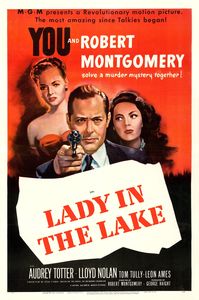
(On Cable TV, January 2020) Film history is filled with curios, some of them of lasting importance and others forgotten until we revive them as earlier examples of what we thought was new. Putting aside the entire found-footage genre (in which a camera is presumed to be the viewer rather than the cameraman), there have been few subjective perspective (or Point of View—PoV) movies in the genre’s history: Hardcore Henry (2015) is probably the modern canonical example, although it’s inspired by videogames more than anything else. Farther away in time, the opening act of Dark Passage (1947) carefully avoided showing the protagonist’s face for plotting reasons, alternating between subjective takes and faceless framing. But Lady in the Lake is the real thing: a feature-length noir film in which everything is seen from the perspective of the detective investigating the case, navigating his way between femme fatale, corrupt cops, criminals and rich businessmen. As the film’s production history goes, Hollywood star Robert Montgomery wanted to make a splashy directorial debut by putting us inside a first-person noir narrative. As protagonist Philip Marlowe takes on a difficult case, the camera sees what he sees, experiences conversations from his perspective (Montgomery had the camera setup modified so he could sit under it as director), sees the clues as he does and gets knocked unconscious along with him. If that sounds like a challenge even today (Hardcore Henry has a generous amount of CGI to help things along), then you can understand why Lady in the Lake was not a big success upon release. The staging is awkward, the actors clearly don’t know what to do with a camera as an interlocutor, and the film often breaks its own PoV rules for reasons both practical (in order to show what’s happening) and commercial (with two breaks in which Montgomery appears on camera in-character, because studios wanted to feature his face as a commercial draw). Reviewers weren’t kind, but even if they were right in calling it a gimmick, the fact is that the gimmick remains fascinating even today. There’s a good chunk of “how are they going to do that?” interest in watching the film and even if it’s not completely successful, it remains interesting from beginning to end. The Christmas setting adds a bit of atmosphere, as are the typical noir archetypes used by a film more concerned about style than plot. Lady in the Lake is clunky, sure, but it’s also incredibly cool. I guarantee that you won’t get tired of watching what it tries to do.