Robert Ryan

  • Clash by Night (1952)

    Clash by Night (1952)

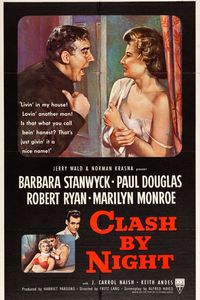
    (On Cable TV, February 2021) On paper, Clash by Night feels like a must-see film: An intense small-town drama directed by Fritz Lang, featuring a late-career performance from Barbara Stanwyck and one of the first featured turns from Marilyn Monroe? Who can resist that? Alas, the film itself is not quite as gripping. While the drama’s bubbling into melodrama can be momentarily intense, the film feels poorly paced, with numerous lulls, overdone moments and an unsatisfying conclusion. The relatively small stakes (in a small coastal town setting) don’t add much more, and you can almost feel Lang itching to take the film firmly into noir crime thriller territory, while being held back by the material stemming from a realistic Broadway play. In other words, Clash by Night feels far from being even the sum of its parts — not a particular highlight for its time, and a minor entry in everyone’s filmography.

    (Second viewing, On Cable TV, August 2021) It’s not so easy to assess films that competently do something that you just happen to not like very much. So it is that Clash by Night does have a clear intention in mind, as it follows a woman coming back to a small town after years living in the big city. The film is clearly split in two acts, and the melodrama inherent in the premise means that no one will be all that happy with the ending. It’s a story about picking between a dangerous but exciting man and a safe but dull one, set against a small fishing community. As the lead, Barbara Stanwyck here clearly demonstrates why she’s widely considered one of the best actresses of Classical Hollywood, and then there’s a younger Marilyn Monroe doing well in a supporting role. Robert Ryan and Paul Douglas play the poles of masculinity that the lead gravitates to. The small-town atmosphere is effective and clearly weaved into the plotting. Fritz Lang’s direction is straightforward, and perhaps less beholden to the film noir style he was using in other movies at the time. That drama is strong (fittingly for a film adapted from a play) even if it frequently dips into what twenty-first century viewers will see as melodrama with a woman making poor choices and creating all sorts of problems for herself. Of course, that’s the point of the film: the lack of temporal unity is deliberate, as are the theatrical anguish, overdone antagonist and manipulative elements of the conclusion. All of which may explain why I end up appreciative but generally cool to the results – Clash by Night is a fine melodrama with good performances, but I’m having a hard time mustering any enthusiasm about it.

  • On Dangerous Ground (1951)

    On Dangerous Ground (1951)

    (On Cable TV, December 2020) Film nor takes a trip to the country for crime and romance in director Nicholas Ray’s On Dangerous Ground. Robert Ryan stars as a burnt out suspect-punching New York City cop who, in the film’s opening segment, gets reprimanded by being sent upstate to cool off and help an ongoing murder investigation. The second portion of the film is a contrast in more ways than one, as the rainy nighttime visuals are replaced by the serene beauty of snowy farmlands and our policeman anti-hero gets to interact with people who aren’t necessarily the scum of the Earth. This is where he meets a beautiful blind woman (the ever-striking Ida Lupino), for whom he falls despite her brother being his prime suspect. It all escalates into a climax that’s both predictable and satisfying within the confines of the film’s sense of right and wrong – romance gradually creeping up on the criminal arc and acting as the true resolution of the film. It’s quite an unusual blend despite its familiarity – noir in the snow and eventually replaced by romantic redemption. But that’s the magic of Ray as a director – make us believe in dubious material, and somehow wrapping it up in a coherent package.

  • Executive Action (1973)

    Executive Action (1973)

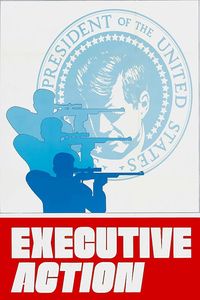
    (On Cable TV, November 2020) As far as JFK assassination conspiracy fantasies go, nearly everyone remembers Oliver Stone’s bravura 1991 masterpiece JFK, but 1973’s Executive Action has faded from memory. I’m not necessarily saddened by that—As I’m editing this review in early 2021, the United States is experiencing an alarming tribal epistemology crisis, with truth taking a distant second place to political affiliations. (And lest you think that I’m making a “both sides” argument, let me set you straight: The right wing’s acceptance of nonsensical conspiracy theories has little equivalency on the other side of the aisle.) The result is thousands of excess mortalities in a national pandemic, an attempted political coup (incompetent because fantasy-based, but a coup nonetheless), a disturbing dismissal of norms and significant damage to American institutions. So, you may excuse me if my tolerance is nonexistent for such intentional blurring between fact and fantasy for political gains. At another time, I probably would have enjoyed screenwriter Dalton Trumbo’s skillful blend of fact and fiction, describing a shadowy cabal planning the assassination of JFK and subsequent coverup: the film is a masterclass in dramatization of a wild conspiracy theory, playing on universal fears and prejudice to tell all about men in control rather than a lone nut sending everything in chaos. From the opening narrative scroll to the final error-filled one, Executive Action is about sowing doubt, blocking objections and suspending disbelief. It can rely on strong actors such as Burt Lancaster and Robert Ryan, a sober execution and a surprisingly modern kaleidoscopic approach to its subject. In other words, it’s quite intriguing from a technical perspective and in its execution. But I simply cannot, right now, bring myself to feel any sympathy for its goals. I’ve had it up to there with conspiracy fiction now that I see it blend in the real world with people unable to make the difference between truth and politically motivated manipulation. Maybe I would have been more sympathetic five years ago. Hopefully, I will be able to be in five years.

  • The Racket (1951)

    The Racket (1951)

    (On Cable TV, November 2020) Probably the best thing about The Racket is seeing bad-boy Robert Mitchum take on the role of a two-fisted police captain hellbent on taking down a major organized crime leader played by Robert Ryan. The film, a remake of one of the first movies ever nominated for the first Oscars, is essentially a grand strategy game between the two, as they vie for the affection of a cabaret singer (Lizbeth Scott), try to manipulate politicians in doing their bidding, and have proxy battles through surrogates. There’s some awareness here of the tricky intersection between justice, politics, the media and the personal emotions of the characters themselves. Mitchum may not be ideally cast as a square-jawed icon of law and order (his celebrated arrest and conviction for drug offences were still fresh in the public’s mind at the time), but I found that his screen persona actually worked in his favour here, as the character didn’t seem above a few horrible actions in order to fight his criminal counterpart. Having seen and rather enjoyed the 1928 original, I wasn’t bowled over by the remake—while Mitchum is remarkable, Scott is good and Ryan isn’t bad (switching roles may have been a better casting decision, but then again no one would have cheered for the police in that case), the rest of the film is merely solid, whereas the original had a few moments of innovative brilliance. (Although the remake keeps the spectacle factor: woo-hoo, a big car crash!) But it may be more fascinating for its behind-the scenes drama, as producer Howard Hugues kept tinkering with the film (as was often his habit) and brought in no less than five directors to complete it. The result can occasionally feel disconnected with too many subplots and plot turns underdeveloped. I still enjoyed The Racket—it’s compelling viewing as a film noir (which the first one wasn’t really, instead heralding the gangster movies of the 1930s) and it clicks in the same ways a competent crime story does.

  • Captain Nemo and the Underwater City (1969)

    Captain Nemo and the Underwater City (1969)

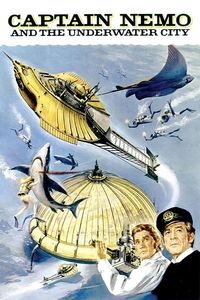
    (On Cable TV, April 2020) Huh—I really did not have “proto-steampunk underwater adventure” on my to-watch list today, but that’s what I got in Captain Nemo and the Underwater City. Loosely based on Jules Verne’s classic novel, it’s more a branded excuse to show off Victorian underwater wonders than to let it suggest any kind of a plot. Unfortunately, whatever plot it does feature is a misguided story of escape, featuring a protagonist that comes off as a dangerous idiot less worth cheering for than worth drowning for everyone’s safety. It’s not quite the only dodgy plot elements, especially considering what feels like a kid’s film: a comic-relief character is killed off late in the film through sheer greed, and everyone seems to take with impassivity that’s meant as lifelong imprisonment. (Well, except for the dangerous protagonist, who should not be celebrated as a hero.) At least Nanette Newman looks good, and Robert Ryan shows appropriate gravitas a Captain Nemo. The film’s production history suggests that it was heavily influenced by the late-1960s Jacques Cousteau underwater craze, and that’s best reflected in how much of the film is a wide-eyed wonder at submarine cities and possibilities. Even discounting the film’s less-than-stellar narrative, there’s some rather incredible visual stuff for a film that’s largely forgotten today—novel visuals in a Victorian underwater steampunk atmosphere. There’s probably a good remake to be made from Captain Nemo and the Underwater City, but only if anyone still remembered it.