Robert Taylor

  • Johnny Eager (1941)

    (On Cable TV, August 2021) Not quite film noir yet but more than gangster films of the 1930s, Johnny Eager does begin on a strong note, with a charming ex-con managing to keep the authorities convinced that he’s back on the straight path, even as he’s back to controlling a good chunk of the metropolitan underground—and being utterly ruthless in doing so. Things get far more twisted when he gets an occasion to seduce the daughter of an influential district attorney. The plotting gets to be a lot of fun after that, with romance, crime and thrills thrown into the mix. Still, the highlight here is Van Heflin in an Oscar-winning performance as an alcoholic intellectual with florid dialogue, the only person able to talk back to the protagonist and get away with it. Robert Taylor is also quite good as Johnny Eager himself, both charming and homicidal. Meanwhile, Lana Turner does her best at, well, being Lana Turner. As a criminal melodrama, Johnny Eager isn’t particularly respectable, but it moves quickly, features a few good performances, and wraps everything up in some well-crafted irony.

  • Waterloo Bridge (1940)

    Waterloo Bridge (1940)

    (On Cable TV, September 2020) I can’t say that I was all that impressed by Waterloo Bridge—playing from grand riffs on old-school themes such as a tragic wartime romance, it’s clearly meant to move audiences, give the filmmakers some space to stretch their “serious movie” muscles and (incidentally) court after the same audience that went flocking to the earlier 1931 film. By a stroke of good luck, the project attracted talent such as director Mervyn LeRoy, Viven Leigh and Robert Taylor, and the darkening news from the United Kingdom in the early days of the war added heft to the result. For modern audience, Waterloo Bridge plays as an old-fashioned weeper, perhaps a bit more daring than most considering that prostitution is a plot element of the heroine’s downfall and that the ending is a downer of significant proportions.

  • Undercurrent (1946)

    Undercurrent (1946)

    (On Cable TV, June 2020) Wait, wait! There’s a film in which Vincente Minelli directs both Katharine Hepburn and Robert Mitchum? Why did no one tell me? Well, it’s probably because they’ve seen it, considering how all three are playing outside their wheelhouse in Undercurrent. A domestic thriller the likes of which were popular at the end of WW2, it features a demure spinster who marries a mysterious rich man but ends up having a closer affinity with his brother. There’s a bit of gothic romance to the story as hints of mental instability creep in and the action moves to murder: it doesn’t escalate to noir, but there’s still a creepy drama underscoring the entire film. The threat may come from inside the house, but Undercurrent’s biggest twist is that Hepburn plays a meek character, Mitchum plays a sensitive guy (for barely three scenes), Robert Taylor plays the creepy villain, and Minnelli tries his hand at suspense, all of which is completely at odds with their strengths. One of Hepburn’s last role as a debutante (she was 39!), the film isn’t particularly good nor terrible: it’s interesting for the eyebrow-raising use of familiar names in unfamiliar roles, but if you’re looking for a good domestic thriller of the era, you might as well have another look at Gaslight.

    (Second Viewing, On Cable TV, July 2021) The only thing better than a film that brings familiar names together is a film that uses those familiar names against type. Of course, saying that about Undercurrent is misleading, as it takes place early in the career of two of its three marquee names. So here we have MGM musical director Vince Minelli going for a quasi-gothic thriller, steely Katharine Hepburn settling for a soft and weak character, and noir icon Robert Mitchum playing a refined and good-hearted character. (Plus, leading man Robert Taylor going for moustache-twirling psychopathy.)  It’s quite a ride if you’re coming to it with different expectations, and it’s probably that which distinguishes my second better-informed viewing for the first – in between the two, I developed my own appreciation for those three names, and Undercurrent clearly plays against them. Otherwise, well, there’s not much more to say: from a detached narrative perspective, the film does go hard for gothic mysteries, as the new wife of a mysterious man gets to gradually unveil the secrets surrounding his brother. The film is designed to be overly melodramatic, and feels long at something like 115 minutes. It’s not a bad watch but not a particularly fine example of a form perfected by Rebecca or Gaslight – but it’s worth a look if you’re too comfortable in what to expect from any of the marquee names.

  • Party Girl (1958)

    Party Girl (1958)

    (On Cable TV, March 2020) There’s a truly fascinating mix of ingredients in Party Girl: Cyd Charisse with a meaty dramatic role (her last contract role for MGM—indeed, one of the last contract roles in the entire studio system), director Nicholas Ray bringing his usual set of skills to a rather conventional story; Lee J. Cobb as another mobster; and Robert Taylor in a noticeably more dramatic role than usual. Some musical numbers, a few Prohibition-era plot points inspired by real life, expensive colour cinematography, expansive sets, and a plotline that gleefully mixes organized crime, barely-repressed prostitution, crooked lawyers and nightclub showbiz. By all rights, this should be quite a movie—alas, Party Girl merely settles for being just fine. It’s certainly watchable, and Charisse gets one of her last big-budget roles here—but most of the time, it fails to meet expectations as more than a standard mob-nightclub riff. Ray’s direction is competent, but fans of his deeper films may find something missing here. Maybe there’s too much going on; maybe it’s just not made of strong-enough writing. Maybe the actors were just a bit past their prime—no matter why, Party Girl is entertaining without being as memorable as it should be.

    (On Cable TV, June 2021) Frankly, I expected more of a gangster musical comedy featuring Cyd Charisse, director Nicholas Ray and a plot that brings together a fusion of chorus girls dance sequence and mobster drama. But Party Girl does not feel quite like a musical (too few musical sequences), nor quite a noir (there’s a happy ending), not quite a romance (not showing much heat between lead Robert Taylor and the notoriously restrained Charisse) and not quite a comedy (viz the criminal element not played for laughs). It is occasionally well directed and photographed in impressive colour, but somehow the elements don’t quite mix well. There’s probably an issue in Party Girl coming from the late-1950s, at a time of creative exhaustion by the studios (as per the film’s rote musical sequence, aware that the musical was fading away but not quite knowing what to do instead) but also an increasingly unworkable production code that couldn’t allow filmmakers to go where the story needed to go creatively. It’s certainly watchable, but also disappointing in the way it doesn’t fully use the material at its disposal. In many ways, Party Girl is more interesting as a last gasp of the MGM studio system (this was Charisse’s last film under contract and the next-to-last film for Taylor’s contract – they were the last two stars in the MGM firmament) than by itself.

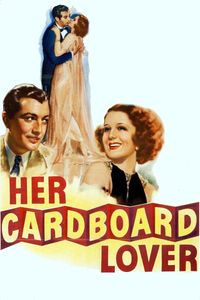
  • Her Cardboard Lover (1942)

    Her Cardboard Lover (1942)

    (On Cable TV, January 2020) Once you’re deep into classic Hollywood movies, you start picking movies for their stars and directors rather than their plot or historical importance. That’s how I ended up watching Her Cardboard Lover, a somewhat forgotten George Cukor film that nonetheless features the ever-cute Norma Shearer playing off George Sanders (in a typically antagonistic role) to the rather likable Robert Taylor. The plot of the film isn’t much to talk about—it’s the old-fashioned formula of one woman using a man to make another jealous. But it’s handled with enough whimsy to make it fun despite the familiarity. Some surprisingly enjoyable dialogue and repartee, especially between Shearer and Taylor, do keep things entertaining during the entire film. The two male leads even get into a very funny fight scene, which is somewhat atypical for the reserved Sanders. We can quibble about the lead female character’s flightiness and her overall romantic suitability when she’s happy to pit two men against each other, but Her Cardboard Special remains a romantic comedy that wraps up nicely—nothing special, but highly enjoyable.

  • Ivanhoe (1952)

    Ivanhoe (1952)

    (On Cable TV, November 2019) Technicolor-era historical Hollywood adventures don’t get any more exemplary than Ivanhoe, what with a 19th-century novel being loosely adapted into a Technicolor swashbuckler. It has more than its share of issues, especially from a contemporary perspective, but it also has quite a bit of charm. Robert Taylor and Joan Fontaine may star as the lead couple, but modern viewers may be forgiven for only having eyes for Elizabeth Taylor in an early yet striking supporting role. George Sanders is also up to his usual standards playing a villain. Otherwise, the rest of the film is a succession of sex appeal, sword fights, medieval jousts, and arena combat as a climactic bow. Ivanhoe is not to be trusted as a historical document, but it’s not a bad way to spend nearly two hours—the film is easy to take in, the hero is interesting (even a bit devious in his combat style), Taylor is luminous and it all builds to an effective action sequence in a film that has a few of them. As a competent Hollywood rendition of medieval adventure, Ivanhoe was nominated for three Academy Awards back then (including Best Picture) and you can see why it was both a commercial and critical success. This less-usual take on the Robin Hood legend is quite intentional, and it prefigures other films in that vein.

  • Quo Vadis (1951)

    Quo Vadis (1951)

    (On Cable TV, April 2018) I have dim memories of watching Quo Vadis as a kid (especially the last shot of the film) but watching it now is more an exercise in historical Hollywood than an enjoyable viewing in itself. Historically, Quo Vadis was the first big success of an era in film history where Hollywood headed to Rome in order to film epic movies on a smaller budget. You can see the result on-screen with a lavish production with countless costumes, credible historical re-creations and an ambitious Bible-related subject matter palatable to international audiences. Quo Vadis is a deep dive in Roman history in the decades when Rome fought the newly popular Christianity. It’s not particularly historically accurate, but it does revel in the imaginary imagery of the era, combining swords and sandals and political/religious conflict alongside a big dash of family melodrama. It’s tedious and impressive at once, especially when you try to keep up with the very large cast and equally long running time. It does help that the film features actors such as Robert Taylor and Peter Ustinov, alongside captivating actresses such as Deborah Kerr and Marina Berti. A long list of notables had small roles among the cast and crew, but the film’s biggest impact was financial, both in terms of revenues (it reportedly saved MGM from bankruptcy) and legacy (it paved the way for very similar epics). It’s not quite as good as many of the films it would spawn, though: the highlights are few and far between, while the film’s connection to the bible is tenuous at best. It does make for an impatient viewing experience—well-known but not particularly enjoyable, Quo Vadis is a bit of an imposed viewing … unless you like that kind of thing, of course.