Robert Wise

  • Born to Kill (1947)

    (On Cable TV, July 2021) As Eddie Muller pointed out in his TCM Noir Alley introduction to Born to Kill, there’s a fantastic gender-flip at the heart of the film—Lawrence Tierney playing a cold-blooded killer corrupting two good (?) women on his way to more power, and mercilessly eliminating the obstacles in his way. Even by the standards of film noir, Born to Kill plays rough — the body count accumulates, no one gets what they wanted and there’s a clear air of moral decrepitude over the entire thing. (Contemporary accounts of the film reveal negative aghast reviews, successful efforts to ban the film from further distribution, and the film being used in the defence of a young man accused of murder —further evidence that nothing is new under the sun.)  While Tierney gets the lead role and Claire Trevor does her best to follow him into crime, my favourite character is probably the Private Investigator played by Walter Slezak as a jovial but amoral force of chaos with an impact on nearly everyone. Director Robert Wise ended up with a chameleonic career following his debut here — but I don’t think any of his later films were as gleefully dark as this one. For jaded twenty-first century viewers, Born to Kill amounts to a nice period piece that narratively goes from Reno to San Francisco, but thematically delves deeper and deeper into darkness with the stylish flair of classic noir.
  • The Body Snatcher (1945)

    The Body Snatcher (1945)

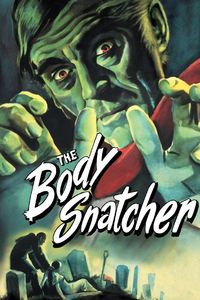
    (On Cable TV, May 2021) For classic horror fans, The Body Snatcher features a mixture of familiar names— infamous murderers/graverobbers Burke and Hare, for one (their infamy extending well into twenty-first-century takes), producer Val Lewton for another, and also chameleonic director Robert Wise in one of his earliest directing credits (and perhaps his first true end-to-end project). But what will get most people’s attention is Boris Karloff and Bela Lugosi in the same film, neither of them playing the monster archetypes they’re best known for. This certainly isn’t their only collaboration, and Lugosi’s role is minor at best — but Karloff is quite good, and more importantly he’s good in a somewhat respectable context: The Body Snatcher is heavy on atmosphere and historical references, helmed by a director who clearly wanted to impress. Even the premise, having to do with murderous graverobbers, is far from lurid monster features. The result is very decent no matter the age of the film: it’s a signpost in the filmography of many familiar names, but it’s also a film that holds up decently as long as you don’t walk in expecting cheap thrills or camp monsters.

  • Run Silent Run Deep (1958)

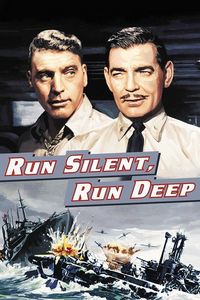
    Run Silent Run Deep (1958)

    (On Cable TV, March 2021) There were a lot of submarine movies made during the 1940s and 1950s, and it’s perfectly understandable if they tend to blur together. But that’s not the case with Run Silent Run Deep, a superior example of the form that never forgets that the point of submarine movies is people under pressure. The casting already makes the film distinctive: With none other than Clark Gable and Burt Lancaster in the lead roles, the film already feels more substantial. It gets better as both men play to their strengths, Gable as the revenge-obsessed commander fending off Lancaster as the ambitious second-in-command. Infighting is good for drama until everyone turns their guns (or rather torpedoes) to the true enemy in time for a thrilling third act. Rather good special effects help sell the illusion: the explosions are particularly satisfying. Thanks to director Robert Wise, the immersion of WW2 submarine life is convincing, and the film eventually has a tragic heft that helps further separate it from other similar WW2 dramas. There’s a straight line from Run Silent Run Deep to later examples like Crimson Tide, but the point is that it’s a film that just works — it’s engrossing and it doesn’t let up until the end.

  • Odds Against Tomorrow (1959)

    Odds Against Tomorrow (1959)

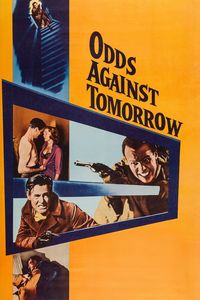
    (On Cable TV, March 2021) Coming from the end of the classic film noir era, Odds Against Tomorrow does have one interesting wrinkle for an urban subgenre that remained surprisingly Caucasian-tinted throughout its first iteration: A black main character. While much of the story will feel very familiar and bridges the gap between classic noir and bank robbery thrillers, the race of the main character does bring something different and interesting to the results. Of course, much of this has to do with Harry Belafonte (who also co-produced the film)— always a charismatic performer, and fascinating to watch in a film focused on harder-edged crime suspense. Racism becomes a further source of tension between the men plotting the bank robbery and as things predictably blow up toward the end of the film, it does add an extra dimension of social commentary to a film not completely focused on genre mechanics. (The coda is not subtle about the essential meaninglessness of race in those circumstances, but it’s far better than avoiding the issue.)  Director Robert Wise was never an accomplished stylist, but he here manages to create an effective sense of tension, at least when the action gets started in the second half. Odds Against Tomorrow does falter when compared to other bank heist films of the 1950s, but the racial element alone distinguishes it from a lot of similar films, and justifies by itself a look at the result — if it’s not already on your viewing list if only for Belafonte’s presence.

  • Executive Suite (1954)

    Executive Suite (1954)

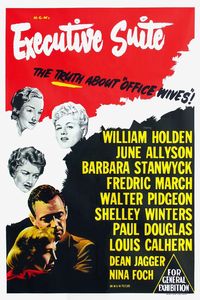
    (On Cable TV, October 2020) I am fascinated by tales of boardroom intrigue, a fascination that comes from my background as a white-collar office drone, constantly aware and at the mercy of senior management shenanigans. I also suspect that such high-level executive machinations are perhaps the closest modern equivalent to palace intrigue, what with the king having to deal with his scheming courtiers in modern attire. No matter the reason, I found myself very quickly drawn into Executive Suite’s steely-eyed depiction of the feeding frenzy that follows the death of a furniture magnate, as two visions of the company battle it out in a succession drama played in voting shares and personal grudges. The film’s opening moments are remarkable, as a first-person point of view of someone sending a telegram and going out to take a taxi turns tragic when the person dies and his wallet is stolen. It turns out that we’ve just seen the death of a company president, and the wallet theft means that no one (except for one executive using this knowledge for insider trading) will realize what happened for another day. The film settles down a bit after this fantastic opening sequence, but the sides are steadily described, what with a quality-conscious designer going up against a penny-pinching financial officer for control of the company. There are many similarities here with 1956’s Patterns, but Executive Suite is a solid drama of moves and counter-moves (with a seriousness underscored by, well, the lack of a score), with a likable hero played by William Holden and decent supporting roles for Barbara Stanwyck, Fredrick March and Shelley Winters. Director Robert Wise’s approach to the material is decidedly close to the ground, but there’s a decent understated flourish to the script, as it quickly sketches characters, and sometimes catches them in compromising positions. I don’t expect everyone to be as enthralled by Executive Suite as I was, but there’s something carefully balanced about its dramatic plotting and its almost realistic approach to the material.

  • The Setup (1949)

    The Setup (1949)

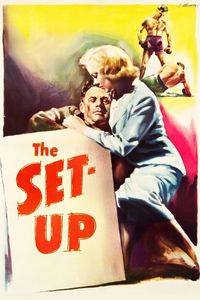
    (On Cable TV, July 2020) Somehow, boxing and film noir often go hand in hand, or maybe fist-to-fist: The subgenre is filled with sweaty gymnasiums, high-stakes bouts, boxers attempting to go straight and shady promoters eager to fix matches. What works really well in boxing thriller The Setup is its attempt to tell, in real time, a story of sports manipulation and personal redemption, as a boxer trying to retire ends up fighting against the orders of his manager to lose. There’s a strong sense of verisimilitude and intensity coming from the work of director Robert Wise here—not only the cranked-up tension of a real time 70 minutes, but the atmosphere of a boxing ring, the struggles of the boxer and the way the camera moves through the environment. It’s quite admirable even for those who don’t really have an interest for boxing. The simple plot is not a disadvantage, as it allows the filmmakers to focus on the way to tell the story. The Setup is quite admirable, but it also anticipates a slew of other later boxing films (notably Raging Bull) that would move away from realistic aesthetics in telling ringside stories.

  • The Haunting (1963)

    The Haunting (1963)

    (On Cable TV, February 2019) If there’s a single path to longevity for horror movies, I have a sneaking suspicion that it’s atmosphere. The Haunting may be one of the best examples of this: As strangers travel to an isolated mansion to investigate its paranormal nature, the plot is far less important than the sheer oozing oppression of its setting. Taking place in a grand gothic manor, The Haunting never misses an occasion to crank up the eeriness of its location. Director Robert Wise uses a succession of askew angles in order to reinforce the foreboding production design. The Haunting is remarkable for its black-and-white cinematography in that it almost always imposes incredibly dense images, with immensely detailed walls, cluttered decoration and intricate architectural flourishes. By the time the house walls seem to breathe, well, The Haunting has earned its place in the horror pantheon. Richard Johnson is quite good in a familiar kind of role, while Julie Harris has perhaps the most skillful performance as a haunted person. There’s a dash of humour and self-awareness to the proceedings, but The Haunting still feels respectable and highly efficient—taking chances that still feel daring such as giving extensive internal voiceover monologues to the characters. Even the strong hints that the entire thing may be in the character’s heads isn’t quite enough to lessen the supernatural experience. This is one horror film that can still hold its own against more recent entries—in fact, it has now clearly outlasted even its own remake as a still-worthwhile film.

  • West Side Story (1961)

    West Side Story (1961)

    (On TV, June 2018) I thought I knew West Side Story before watching it: A Romeo-and-Juliet adaptation taking place in the Latino communities of Manhattan, what more could it be? But as it turns out, the film is almost irresistibly engaging, with enough musical numbers to showcase the skills of the filmmakers and the cast. I put one the movie while doing other things, thinking that I wouldn’t want to watch it closely … and ended up sitting down to watch big chunks of the film. While Nathalie Wood gets top billing, Rita Moreno steals the show with “America”, a number that crystallizes the film’s respectable intention to tackle the immigrant experience in a relatively upbeat fashion. The diversity of numbers means that there’s something for everyone—you can have your “Maria” if you want, I’ll take “America” and “Gee, Officer Krupke” on repeat. The romanced portrait of early-sixties urban life is fascinating, and Robert Wise’s direction is often amazing in the way it choreographs the dancing and singing with cinematic qualities. But what fascinates me more about the film, and what provides its substance beyond its musical qualities, is its admirable willingness to engage with issues of immigration, integration and acceptance. There’s gang violence set to music as an engaging counterpoint, and the film feels intensely alive as it mixes violence with music and dance. While it may seem quaint today, it has aged far better than other more restrained movies of the time. The downer ending comes with the literary inspiration, but the best moments of West Side Story are exhilarating.