Robin Williams

  • Hook (1991)

    Hook (1991)

    (Second viewing, On TV, December 2016) I remember two or three jokes from my first viewing of Hook more than twenty years ago, but not a whole lot more. I have noted a certain polarization of opinion about the film—a lot of regular people like it, while critics don’t. I watched the film in regular-person mode, and wasn’t displeased from the experience: Despite claims of this being a sequel to the original Pan, Hook is very much a retelling … so closely so that it gives rise to some vexing issues (as in: “why bother?”) There is a very late-eighties quality to the way the action is staged in Neverland, prisoner of limited soundstage sets and the special effects technology of the time. As a take on the Peter Pan mythos, it’s decent without being exceptional or revolutionary—it’s still miles better than the 2016 Pan, although not quite as successful as 2003’s Peter Pan. Julia Roberts isn’t bad as Tinkerbell, although her unrequited romance is good for a few raised eyebrows. Robin Williams is OK as Peter, but it’s hard to avoid thinking that another actor may have been better-suited for the role. Meanwhile, Dustin Hoffman seems as if he’s having a lot of fun in the titular role. While Steven Spielberg directs, there is little here to reflect his legendary touch. It does strike me that Hook fits almost perfectly with the latest Disney craze of remaking its classic animated movies as live action. Perhaps contemporary opinion about the film will be more forgiving than the critical roasting it got at the time. Until that reconsecration, the result is perfectly watchable and squarely in the middle of the various takes on Peter Pan.
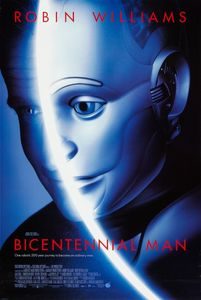
  • Bicentennial Man (1999)

    Bicentennial Man (1999)

    (On DVD, September 2016) Before telling you what I really think about Bicentennial Man, I’ll just take a moment to appreciate what I do like about the film, even if it boils down to intentions. I like the idea of a classic Isaac Asimov story being adapted on the big screen. I certainly appreciate how the film tries to cover a two-century period in two short hours, and I can recognize the attempt at conveying some of that future history through background details. It’s the kind of thing that makes written science fiction so interesting, and it’s rare to see it even attempted on the big screen. This being said, none of those good intentions are enough to rescue Bicentennial Man from some condemnation. The ham-fisted script never misses an occasion to be dumb, sappy, obvious or nonsensical. The vision of the future is all about changing surface and simplistic attitudes, never taking an opportunity to tackle social change in a meaningful way, or escaping funny-clothes laziness. Robin Williams is here in full-blown nice-guy persona, wasting comic energy in a role seemingly built to be as dull as possible. While the film has aged badly in seventeen years (now that we have direct experience with the introduction of technology, the way Bicentennial Man deals with its robots feels worse than off), let’s not kid ourselves: it was pretty bad even in 1999. Laced with cheap sentimentality, flatly directed by Chris Columbus and hobbled by dumb story choices manifested by even dumber character decisions, this (in many ways) showcases how badly Hollywood mishandles Science-Fiction as a genre.

  • Jumanji (1995)

    Jumanji (1995)

    (Second viewing, On Cable TV, June 2016) I recall seeing Jumanji on TV in the mid-nineties, but another visit twenty years later only highlights the film’s issues. It’s not simply that the film’s special effects haven’t aged well (and they haven’t—the CGI material looks noticeably disconnected from the live action), it’s the film’s structure, its casual disregard for causality, its refusal to engage in the consequences of its more audacious ideas. Robin Williams is fine in the lead role (although one sense that he’s being restrained with the requirements of the special-effect production) and the script does show some intriguing ideas along the way, but they’re not explored in any details beyond the surface appeal of compelling visuals (monkeys jumping around the kitchen, wild beasts stampeding on the city square). Meanwhile, these are a few horrific ideas dealing with lengthy exiles, the game-as-monster and parallel timelines that are barely and lazily addressed. Of course, exploring those issues further would take Jumanji far away from the romp-for-children that it aims to be… Still, there are missed opportunities in making weighty themes stand too close to an adventure film for kids: I can imagine younger audiences cheering and clapping along while their parents stand there with a queasy grin informed by far too many reasonable fears. If you can let go of this weighty baggage of implications, the film itself works intermittently: Director Joe Johnston can certainly handle special effects set pieces (it’s not his fault if the technology wasn’t quite there yet at the time). For once, the announcement of an impending remake doesn’t bother me too much: Jumanji has a lot of potential, but a lot of it was mishandled by this version. Here’s hoping the 2017 remake does better.

  • Mrs. Doubtfire (1993)

    Mrs. Doubtfire (1993)

    (On Cable TV, June 2016) I’m sure that the filmmakers wanted me to like Mrs. Doubtfire more than I did. Featuring Robin Williams as an immature dad cross-dressing as a way to stay in touch with his kids following a messy separation, Mrs. Doubtfire navigates a tricky line between Williams’ high-intensity comedy and the somewhat more sobering implications of a disintegrating marriage. There’s a layer of duplicity and impossible logistics to the film that makes it harder to enjoy the moment you look closer at it. (Do you know how much close-up face prosthetics cost and how long they take to apply?) For a while, it doesn’t matter very much, especially when Williams is on-screen making funny voices and working without a leash. But anyone expecting a tidy conclusion will have to contend with a romantic rival who’s not despicable, a conclusion that doesn’t patch everything together and an ending where things go on uncomfortably. I’d normally appreciate such a nuanced conclusion, but it merely reinforces a feeling that for a comedy, Mrs. Doubtfire is a sad film, with good people driven to lies and unhealthy behaviour. Much of the same can be said of the film itself: sometimes, we’re torn between opposite impulses, and they end up making a mess of good intentions. Here, the drama undermines the comedy and the comedy undermines the drama, leaving no-one truly happy.

  • Night at the Museum: Secret of the Tomb (2014)

    Night at the Museum: Secret of the Tomb (2014)

    (On Cable TV, December 2015) The Night at the Museum series has its own unlikely formula perfected by this third installment: Magically-reanimated members of the New York museum exhibits get to travel to another museum on some irrelevant pretext, meet the local magically-reanimated characters, have special-effects-heavy adventures and go home.  Director Shawn Levy is well-used to the formula by now and it shows in the strengths and weaknesses of the film.  Ben Stiller mugs for the camera, everyone else hams it up, cheap jokes abound, there’s some Egyptian woo-woo to hold the jokes together and the movie ends before anyone gets exasperated.  It’s familiar to the point that this third installment doesn’t get to try very hard to be witty or clever: Despite taking place at the hallowed British Museum, Secret of the Tomb seems rote and lifeless, coasting on familiar shtick (including a last vigorous Teddy Roosevelt performance by the late Robin Williams) but not pushing the envelope with any of its new characters — except, fitfully, Rebel Wilson’s security guard.  The Hugh Jackman cameo is amusing and so is the M.C. Escher-inspired sequence, meaning that the film isn’t entirely on auto-pilot.  But it does feel like a re-heated attempt to extend a concept past its prime, and this feeling that it’s about time that the show ends means that the final moments of the film aren’t as poignant as anyone would have liked.  There are, thanks to the generous budget and the high-concept, a few things to see.  But those aren’t quite enough to make Secret of the Tomb feel worthwhile as more than another attempt to rely on what worked in the previous films of the series.  There may or may not be another installment –who cares at this point?

  • Night at the Museum: Battle of the Smithsonian (2009)

    Night at the Museum: Battle of the Smithsonian (2009)

    (On TV, May 2015)  The weirdest franchises can emerge from Hollywood’s idea factory, and so what we have here is some kind of “museum comes to life, allowing historical characters to interact” CGI-fest, along with actors having up playing grander-than-life personas.  This second Night at the Museum is a bit weirdly structured, with Ben Stiller’s protagonist somehow selling a company in order to keep prolonging the franchise.  Oh well; it’s not as if we’re really watching the film for its finer plot points as much as Robin Williams once again having fun as Teddy Roosevelt, or Amy Adams really playing it up as Amelia Earheart, complete with snappy period dialogue.  The rest of the film is almost entirely based on sight-gags, a copious use of CGI and plot mechanics aimed at kids.  It sort-of-works, even though nothing really stick in mind except for Adams’ performance.  There should be more to say about the film, but somehow there isn’t.