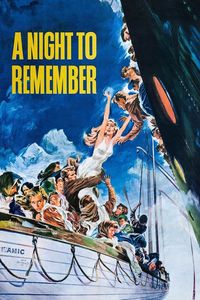
A Night to Remember (1958)
(On Cable TV, March 2020) It’s completely unfair to compare a film with another one made forty years later, but such is the luck of the draw for A Night to Remember, which has been and will continue to be compared to 1997’s Titanic. The comparison is fairer than most, though, given that the intent behind both movies is more or less the same: Illustrate the tragedy of the Titanic’s sinking by recreating as accurately as possible the event given the time’s technology, and dramatizing its biggest human conflicts through a mixture of real characters and ones meant to stand in for the ship’s inherent class issues. Titanic’s writer-director James Cameron explicitly acknowledged the influence of A Night to Remember, and even the most contrarian curmudgeon will acknowledge that the 1997 film was simply better in terms of technical polish, special effects, accuracy to what we now know about the disaster, and simple story structure. One can quibble forever about Cameron’s dialogue and sentimentalism, but then again compare it with A Night to Remember and the difference doesn’t seem so stark. But even acknowledging that A Night of Remember was outclassed by its spiritual remake is not necessarily diminishing director Roy Ward Baker’s considerable achievements at the time. While we now know more about the ship’s sinking than they did at the time, the rest of the film stands up reasonably well to real-life events, and the dramatic tension of the film keeps increasing throughout the period after the iceberg crash—relatively speaking, the film doesn’t take a long time to get there. Sure, the whole thing is imbued with 1950s melodrama, but up to a certain point that adds to the period charm of the film. Still, you have to have a special interest in vintage films in order to get the most out of A Night to Remember—anyone else looking for a suitable take on the topic matter would be best served by the later film, and anyone who has seen the 1997 film will find their viewing of the 1958 one constantly tested by comparisons.