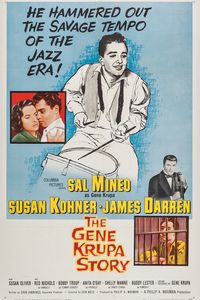
Sal Mineo

  • The Gene Krupa Story (1959)

    The Gene Krupa Story (1959)

    (On Cable TV, January 2021) It’s often fascinating to realize how we come to know some things. In explaining why I deliberately set out to watch The Gene Krupa Story, for instance, I would have to explain how I was introduced to the American drummer through the music of electronica band Apollo 440 and some swing-house tracks, then add how Krupa often popped up in classic Hollywood movies such as Ball of Fire, The Glenn Miller Story and The Benny Goodman Story. Even today, nearly everyone has heard Krupa at one time or another—his drum work on Benny Goodman’s “Sing, Sing, Sing” is regularly sampled as shorthand for “old-time swing music” in contexts as various as The Simpsons or Woody Allen movies. Alas, always be wary of discovering more about half-familiar names: As documented here in a biographical film already sympathetic to its subject, the real Gene Krupa was a brilliant drummer that came bundled with a difficult human being. Drug abuse, unstable relationships, adultery and ostentatious lifestyle come with his success, and while this is all predictable to modern audiences raised on generations of musical biographies, The Gene Krupa Story did it in 1959. The film is perhaps most noteworthy for Sal Mineo’s energetic performance as Krupa—while Krupa himself provides the film’s music, it takes some talent to mimic his live-wire act, and despite other flaws, the film can at least claim to have a solid lead performance. Where the film doesn’t do as well is in flattening its historical component—coming from 1959 (and unfortunately shot in black-and-white). The Gene Krupa Story doesn’t portray much of a difference between the decades of its narrative: Everything feels like the 1950s, even when it heads to the heydays of 1930s Manhattan jazz. A wasted opportunity—but the drum work makes the film worth a look even when other aspects of the production falter. Listen to the film even if you don’t watch it—but have a glance at Mineo’s high-energy act from time to time.

  • The Longest Day (1962)

    The Longest Day (1962)

    (On Blu Ray, September 2018) I often complain about excessively long movies, but even at nearly three hours, I found The Longest Day riveting throughout. A meticulously detailed overview of the Allied landing in Normandy during World War II, this film takes a maximalist approach to the event: It features dozens of speaking roles in three languages, as it tries to explain what happened from the American, British, French and German perspective. Character development gets short thrift, but that doesn’t matter as much as you’d think if you consider the event as world-sweeping history featuring four nations. An all-star ensemble cast helps propel the story forward with some sympathy, as the personas of John Wayne, Richard Burton, Robert Mitchum, Sean Connery (in a very funny pre-Bond role), Sal Mineo and may others guide us through the war. The black-and-white cinematography is gorgeous, and hits anthology levels with a sweeping minutes-long uninterrupted shot of urban warfare. (There’s also a great camera movement early in the film that shows the beach landing and many of the 23,000 soldiers used during filming.) While Saving Private Ryan has eclipsed The Longest Day as the definitive portrayal of D-Day, this 1962 production remains important as a historical document in itself: Many cast and crew had been in Normandy twenty years later, to the point where some actors were portraying people close to them when it happened. (Richard Todd was offered his own role and ended up taking that of his then-superior officer, and ends up speaking “to himself” during the movie.) Visually, the movie remains spectacular even fifty-five years later, and it gets better the more early-1960s stars you can spot. (This also works for historical figures—Omar Bradley is instantly recognizable in a one-shot role.) It’s an exceptional tribute to the events of June 6, 1944, a thrilling adventure story and its relatively bloodless nature doesn’t undercut its portrayal of war as being hell where anyone can die at any time. It’s quite a rewarding film, and it’s even better when you can understand more than one of the three spoken languages.