Sally Fields

  • Places in the Heart (1984)

    Places in the Heart (1984)

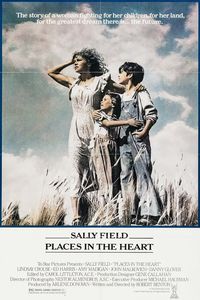
    (On Cable TV, April 2020) It’s not that Places in the Heart is a bad film; it’s just that I can probably dissuade you from seeing it simply by listing facts. 1930s rural Texas. Cinematography in shades of brown and yellow. A widow with two children. Classic Hollywood melodrama. A farm at jeopardy of being repossessed. Episodic structure. A blind boarder. A black handyman and the KKK. A final sequence that’s pure fantasy. Oscar-winning screenplay and best actress for Sally Fields. If that sounds like your kind of movie, then go ahead. If anyone else needs coaxing, know that despite the above elements, Places in the Heart comes together nicely. It’s old-time rural drama and very low-key, but it does go off running in several directions, some of them more interesting than others. The blind boarder is an intelligent man played by John Markovich. Ed Harris shows up. There’s a tornado special-effects sequence. It all amounts to something that’s more than the sum of its parts, good or bad. I liked it, slightly, and that’s more than I could have said running down the list of ingredients that make Places in the Heart.

  • Soapdish (1991)

    Soapdish (1991)

    (In French, On Cable TV, February 2020) I wasn’t expecting much of Soapdish, a comedy revolving around the world of daytime soap operas. But much to my surprise, the film proved far more interesting than I expected, and got a few good laughs out of me. Sally Fields does well as an aging actress obsessed by her age, and convinced that the staff of the show is working against her. As it turns out, she’s not wrong—everyone around her despises her diva behaviour, and the showrunner sets a plan in motion to get her to quit. This goes through an old ex-flame of hers, a washed-up actor (Kevin Kline, hilarious) rescued from the tragedy of overacting in dinner theatre. Robert Downey Jr. is not exactly the best choice as the showrunner (at least not compared to his later persona) but he does get a few of the movie’s best lines, often delivered halfway to the camera at the end of his scenes. Whoopi Goldberg also gets a few choice lines (although, checking the quotes of the film, I realize that Soapdish is far funnier in English than the French dub). For someone my age, seeing Leeza Gibbons show up as herself is a welcome sight, almost outdone by Teri Hatcher as a self-aware sexpot. Hollywood does love to talk about itself, and using soaps as a satirical playground does offer it some plausible deniability. The script does occasionally teeter between comedy and drama, but much of the drama eventually reveals itself to be a mere setup for further comedy. The big third-act twist is a lot of fun, and it speaks to the success of the film that I didn’t bother anticipating it despite ample evidence pointing to its nature. The score is very catchy, with Latin influence and a main melody fit for humming. The one thing that hasn’t aged all that well is one late-movie transphobic joke—to be clear, having a character revealed as a transsexual (or transvestite—the film isn’t too clear about that and that’s an issue in itself) is not necessarily a problem: but having characters react as if it’s the worst thing in the world is what feels so terrible. Still, the rest of the film is far funnier than I would have expected, and Soapdish will score high on the rewatch desirability index.