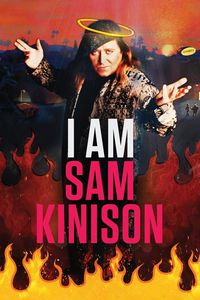
I Am Sam Kinison (2017)
(On Cable TV, April 2021) I can certainly see why Sam Kinison would be a good subject for Network Entertainment’s “I Am” series of documentary biopics: He was a grander-than-life entertainment figure, he died young at 38, and he had many well-known friends willing to sit down and talk fondly about him. But unlike the subjects of other films in the series, Kinison’s legacy hasn’t necessarily aged as well — most of his career as a shock stand-up comedian lasted from 1985 to 1992, leaving little trace in permanent medium. His two movie credits include a little-known action film and a small (but memorable) turn in Back to School. His style of aggressive, misogynistic comedy may have been a revelation at the time, but it’s been overtaken and then marginalized by the zeitgeist since then. As the documentary clarifies, Kinison’s public persona was unfortunately close to his private one. Born in a preacher’s family, Kinison did get some experience as an ordained minister before turning to comedy — but an appetite for drugs and two bitter divorces didn’t leave him the most well-adjusted person. The documentary is perhaps at its most interesting in delving into the Los Angeles stand-up comedy scene of the early 1980s, as Kinison lived hard and put together his reputation as a comedian’s comedian. His rockstar-lifestyle (not an exaggeration in his case, as he dabbled in rock music and consumed unbelievable amounts of drugs and alcohol) does lead to enjoyable moments of utter debauchery in the vein of well-known life-fast-die-young narratives. The affection of his friends (Bob Saget, Jay Leno, Joe Rogan, Tommy Chong and Charlie Sheen among them!) is still obvious even decades later — leading up to one of the film’s most vexing characteristics, albeit one shared across the entire “I Am” series: Perilously close to hagiography, it’s a documentary that seeks to minimize the issues surrounding a controversial figure. Kinison’s well-documented misogyny and homophobia are repeatedly given a pass, and the paradoxical consequence of this is that we’re not given a lot in order to appreciate what made Kinison so well-known: For modern-day viewers, much of his shtick is just weird and not funny. The film provides the building blocks to describe how he failed to achieve his potential — in particular, his lackadaisical work ethic and penchant for confrontation that got an entire Hollywood film project shut down barely into shooting. But I Am Sam Kinison is far more concerned about interviewing friends and excusing his behaviour with a now-irritating series of “boys will be boys,” winks. Interestingly, this minimizes the central irony of how the film presents Kinison’s death—that after hard-partying years, he cleaned up, met a woman, was on his way up to a second act—and then died in a freak car crash, not at all like everyone expected him to die even a few years earlier. It’s certainly an interesting film, and one that does much to create interest in a figure that has passed into obscurity. But I am Sam Kinison is far from being the most accurate documentary possible on Sam Kinison.