Sanaa Lathan

  • The Family That Preys (2008)

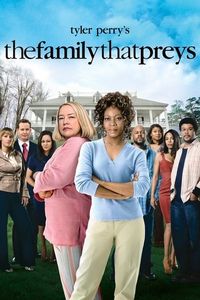
    The Family That Preys (2008)

    (On Cable TV, October 2021) Anyone wondering about Tyler Perry’s early-film-career strengths and weaknesses (not that there’s been much of a change since then) can always have a look at The Family that Preys, a middle-of-the-road effort that does feature the usual highs and lows of his film work. On the good side, we have a heartfelt look at black characters, with an emphasis on female characters. There are effective sequences supporting a strong sense of humanist morality, religion and family. There’s often (but not always) a clear-cut distinction between good people and bad ones, with the virtuous getting their rewards at the end. He manages to attract very interesting acting talent, and his flair for populist entertainment is far better than most other filmmakers, especially in playing to his specific audience. His penchant for melodramatic plotting (in the neutral sense of the expression) makes for easy, sometimes even engaging viewing—it’s easy to sit down and be swept in the story, even as blatantly plotted as it can be. On the other hand, his excesses are also here—a lack of a clear theme that leads to an unwieldy, sprawling structure that barely sits down to work out its own ideas. The writing is not very elegant (that “memory card” bit is, wow) and the points it makes are not subtle at all. Even the film’s striking moments (such as a man slapping his adulterous wife, portrayed as justified, or a homeless person being revealed as very important) seem very calculated. The caricatural nature of the antagonists is often too broad to be credible (the adulterous son even booking the same hotel room as his adulterous father!) and you know within moments who you’re dealing with—a woman putting down her man’s dreams is obviously up to no good, right? And yet, The Family that Preys rather works if you’re willing to be forgiving. The cast certainly helps—Kathy Bates effortlessly dominates the film as a matriarch, and her rapport with a splendid Alfre Woddard is one of the film’s highlights even if their subplot seems contrived and out-of-place. Sanaa Lathan is wonderfully detestable as the female villain, while pre-stardom Taraji P. Henson plays her good sister, Robin Givens has a striking smaller role and Perry himself has a small role as a construction worker. The ending is a lot of righteous fun to watch, as people get what they deserve from an old-school moralistic standpoint. Blunt but crowd-pleasing, Perry’s films are far more interesting than their critical reputation (largely forged by movie critics outside his intended audience) would suggest. I’m having a surprising amount of fun going through his filmography, even when the films are less than wonderful.

  • Brown Sugar (2002)

    Brown Sugar (2002)

    (On TV, January 2021) I’m fond of saying that an interesting setting can make even a formula romantic comedy seem far more interesting, and this is exactly what happens in Brown Sugar… at least when it remembers what its setting actually is. Set in Manhattan at the turn of the century, Brown Sugar begins with a succession of cameos from hip-hop stars telling us about the moment they fell in love with the genre. A flurry of genre references firmly establishes the film as being about hip-hop, seen through our lead character’s own love for music. The very likable Sanaa Lathan plays a music magazine editor who ends up falling for her long-time best friend (the equally likable Taye Diggs) at the very moment when he’s getting married and she’s getting into a serious relationship. Blending music with romance, Brown Sugar is at its best when writer-director Rick Famuyiwa focuses on the music—which is admittedly less and less so as the film progresses. Lathan and Diggs are great leads for a romantic comedy, but hip-hop fans may be more impressed by supporting turns from Mos Def and Queen Latifah alongside the dozen artists seen in the opening segment. In terms of story, Brown Sugar doesn’t offer much that’s new, although its willingness to portray its central romantic relationship as adultery (albeit on a partner intent on cheating) does remain unusual. It’s not a bad time, though, even if the deviations from reality get more and more noticeable as it goes on—find me a radio station that operates the way “Hot 97” does and I’ll be very surprised. Still, like the characters themselves say, the music is the most important thing—even more than romance, in Brown Sugar’s case.

  • Love and Basketball (2000)

    Love and Basketball (2000)

    (On TV, February 2019) We should never underestimate the impact of a great movie poster, because the one for Love and Basketball stuck with me long enough to get me to record and watch the movie nineteen years later. Fortunately, it’s not a movie solely defined by its poster: As the title aptly summarizes, this is a romantic comedy focusing on a basketball-playing couple, each with professional ambitions that run against their obvious attraction to each other. Romantic comedies are often best distinguished by their setting, and the focus on basketball works equally well at creating kinetic excitement as it does as a literalized metaphor. Playing with a four-quarter structure, Love and Basketball follows our protagonists over a seventeen-year period, as they go from backyard hoops to professional play, always threatening to come together until the very end. It’s quite enjoyable purely on its own merits, but as the film ages it also becomes a pretty good time capsule for some great turn-of-the-century actors: After all, where else can you watch Sanaa Lathan, Omar Epps, Alfre Woodard, Dennis Haysbert, Gabrielle Union, Regina Hall and a quick glimpse at Tyra Banks? Love and Basketball is a clever movie from writer/director Gina Prince-Bythewood: It’s not meant to be particularly surprising or challenging (it climaxes right where it should—on the basketball court), but it has quite a bit of heart, and an interesting frame over familiar, relatable material.

  • Approaching the Unknown (2016)

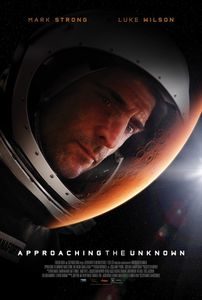
    Approaching the Unknown (2016)

    (Video on Demand, July 2016) At first glance, Approaching the Unknown has a kernel of potential. The trailer promises a somewhat introspective look at space exploration, alongside an astronaut travelling alone to Mars. There’s been a recent mini-boom in space-exploration films, and while no-one expected this low-budget production to match Interstellar, it could have found a place alongside Europa Report. But even after a few minutes, it becomes horribly clear that Approaching the Unknown is a big heap of nonsense choked in pseudo-profound meandering and then smothered in interminable pacing. I don’t often fall asleep during boring movies, but Approaching the Unknown got me, and it got me good: I actually had to go back and re-watch the second half, which made it even worse given how the film disintegrates even further in its second half. It’s a multifaceted failure, from nonsense science (I could give you a list of ten things from the movie that are actually dumber than the Transformers series) to meaningless musings to a direction job that kills any interest the film may have held. It’s just a terrible movie-watching experience that I wouldn’t wish on anyone else. It even made me think less of Mark Strong for choosing the role, as well as Sanaa Lathan and Luke Wilson for showing up in supporting roles. I get that the film is meant as a meditative character piece about sanity, exploration and self-discovery, but as the old SF truism goes, if the literal level doesn’t work, the metaphorical level can’t either. I don’t particularly like to dismiss low-budget passion projects, but Approaching the Unknown is a damning debut for writer/director Mark Elijah Rosenberg and I hope he’ll be able to do better the next time around. (I’ll at least acknowledge that the film may be best suited to people who liked Under the Skin.)