Sandra Dee

  • Gidget (1959)

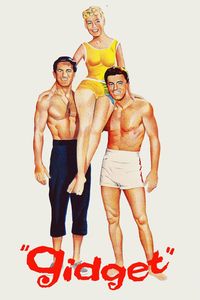
    Gidget (1959)

    (On Cable TV, January 2021) The 1950s can arguably be called the decade during which the teenager was solidified as an explicit life stage between childhood and adulthood. Hollywood, to no one’s surprise, was instrumental in charting and even creating the social construct: By 1959, after all, the oldest baby boomers were hitting 14 and aspiring to be older, the Southern Californian lifestyle was sweeping the nation’s collective imagination and the studios were desperately trying to keep young audiences in theatres given the threat from television. So here comes Gidget, one of the first movies to document the SoCal surf lifestyle. Featuring Sandra Dee as the titular “Girl Midget—Gidget” (despite not being that short compared to the other characters), the film still reads as a timeless example of a “What are these young ones doing?” bout of mild paranoia. Cliff Robertson shows up as a much older beach bum trying to hide away from Korea war PTSD, and becomes the object of the teenage protagonist’s affection—leading to one of the film’s least pleasant subplots, although to its credit the film does have the good sense of avoiding the teenager hooking up with the thirtysomething guy. Still, compared to many of its inheritors, Gidget is somewhat more serious-minded in its portrait of the American teenager—there’s some authentic coming-of-age here, and the film is not quite as mindless as the subsequent Beach Party series of movies. While Gidget is best experienced as a blast from the early years of American adolescence, it’s still likable on its own terms, early surfboards, 1950s hairstyles and all.

  • Take Her, She’s Mine (1963)

    Take Her, She’s Mine (1963)

    (On Cable TV, October 2020) By the early 1960s, James Stewart was long past his young premier roles of the 1930s, his everyday men of the 1940s or his attempt to redefine himself in a darker, more rugged persona in the 1950s—he was now fit to portray a stereotypically likable dad dealing with sending his daughter to college. Adapted from a Broadway comedy that was, amazingly enough, based on the experiences of eventually famous writer-director Norah Ephron as a younger girl, Take Her, She’s Mine has Stewart as the kind of dad that everyone would like to have—bumbling and overprotective, but also intensely likable and able to support his daughter (played by iconic teenybopper Sandra Dee) whenever she needs help. The framing device has Stewart’s character explaining an increasingly ludicrous series of embarrassing newspaper articles before we go back in time and see how each one of them came to be. It all plays against a California-based couple sending their daughter to an east-coast college where she is swept up in the burgeoning social protest movements. As a look in the turmoil that was developing within 1960s America, Take Her, She’s Mine is a fun romp—at least in its first two thirds, because the film loses quite a bit of comic steam in the later third as the action moves to Paris and stops being as relatable. Still, Stewart can’t be topped as the well-intentioned, stammering dad who ends up participating in a sit-in against obscenity laws on behalf of his daughter, or tries to muddle through a deficient knowledge of French while tracking down his daughter in quasi-bohemian Paris. (Some of the French is quite good, some of it almost unintelligible.) It’s all good fun, and even the exhausted third act (reportedly a product of studio interference) can’t quite erase the superb period piece humour of the rest of the film as handled by director Henry Koster. Then, of course, you’ve got Stewart in a minor but highly enjoyable role—and sometimes, that’s really all you need.

  • Imitation of Life (1959)

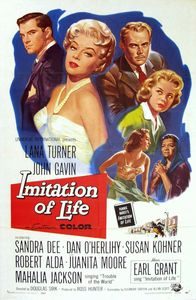
    Imitation of Life (1959)

    (On TV, July 2013) Dipping into Hollywood’s back-catalogue can be a strange experience, as films developed for an earlier generation can become interesting for things they didn’t intend.  So it is that Douglas Sirk’s Imitation of Life becomes fascinating as much for its period background detail than for its subject matter.  From a contemporary perspective, it’s certainly not a tightly-plotted feature film: The story jumps forward abruptly, doesn’t quite know what story it’s trying to tell and ends abruptly, leaving a bunch of threads up in the air.  Still, the point isn’t the story as much as the emotional problems that the characters have: The film’s most compelling plot strand has to do with a mixed-race teenager rejecting her racial heritage, and while the film’s dialogue may feel a bit melodramatic by today’s standards, there’s no denying the impact of lines such as “How do you tell a child that she was born to be hurt?” The film’s other plot, about a suddenly-successful actress ignoring her daughter and leading on a suitor, is almost insufferably dull… except for studying bits and pieces of the decor and imagining being back in the 1950s.  Lana Turner is nice-but-boring in the lead role (much the same can also being said about Sandra Dee as her daughter) but the film’s most compelling performances easily belong to Juanita Moore and Susna Kohner as the estranged mother/daughter pair.  Imitation of Life has held up better than many films of its era not for the melodrama, but for the substance underneath.