Satyajit Ray

  • Mahanagar [The Big City] (1963)

    Mahanagar [The Big City] (1963)

    (On Cable TV, December 2021) As someone who bounces off writer-director Satyajit Ray’s films with unbecoming ease, I thought I had it all figured out when I deliberately selected The Big City to lull myself to sleep during a bout of insomnia: After complaining that his films were snooze-inducing, why not use that to my own benefit? Surprisingly, it did not work:  I really got into the film, as it follows the adventures of a middle-class wife who gets a job and upsets the power balance of her family. A terrific performance from Madhabi Mukherjee (playing off a frequently-irritating turn from Anil Chatterjee) anchors the entire film, but Ray’s script is interesting on a moment-to-moment basis even as we can see the big plotting threads evolve throughout. The portrait of early-1960s Calcutta is fascinating, in-between the clashing cultures left in the wake of the British occupation, and the lively everyday mixture of languages. My attempts to go to sleep went nowhere — I just wanted to see where things were going next. The ending is slightly too open-ended for my taste, but The Big City itself is a surprisingly accessible piece of neorealism whose effectiveness went past my usual objections.

  • Apur Sansar [The World of Apu] (1959)

    Apur Sansar [The World of Apu] (1959)

    (On Cable TV, May 2021) Considering Satyajit Ray’s reputation as a foremost figure of Indian cinema and the very high esteem enjoyed by his Apu Trilogy as a whole, being less-than-impressed by The World of Apu is tantamount to heresy. So, I’ll be a heretic—but a self-professed one: I have a hard time getting into classic Indian cinema. The only Ray film I half-enjoyed was The Big City, and I still can’t explain why it interested me. This being said, The World of Apu is more interesting than most of his films — featuring a young man going through incredible hardship, it has effective dramatic hooks and a likable protagonist. You can easily watch it without having had much of an interest in the previous two instalments of The Apu Trilogy — The World of Apu works well as a standalone film, and builds to an effective climax. I’m sure that this half-hearted recommendation will be a disappointment to many, but at this point of my exploration of Ray’s filmography, that’s a lot better than I was expecting.

  • Aparajito (1956)

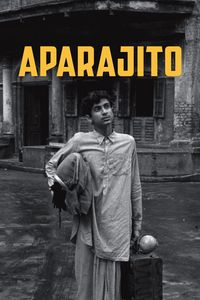
    Aparajito (1956)

    (On Cable TV, May 2021) It’s essential for any self-respecting film fan to explore the world of cinema as thoroughly as possible. Old, new, local, international, lauded and reviled — part of the point of those “1000 Essential Movies” lists is to expose viewers to a wide sample of cinema as a proof of what the medium can achieve, but also help them find out their favourite genres and periods. At the same time, I don’t expect everyone to like everything. Once you’ve gone through your list of essentials, as limited or expansive as it can be, it’s perfectly acceptable to declare a sub-genre of film not to your liking. As I have trekked through world cinema, I have reliably found that, no matter the country or the era, the one thing I can’t stand is neorealism. (The only borderline exceptions are when neorealism is culturally close to me. I’ll tolerate French-Canadian neorealism and give a passing grade to Francophone or Anglophone neorealism, but anything farther than that is usually asking too much.)  As a result, well, I did not have a good time with Satyajit Ray’s Aparajito, which returns to 1920s India to continue the story launched by Pather Panchali (another film I didn’t particularly like). The drama gets more intense by the third act of the film, as the lead character loses an important relative and his reaction is not necessarily one we expect. None of my tepid reaction of the film should be misconstrued as a dismissal of Aparajito (and its associated trilogy) as a piece of world cinema — I can appreciate the incredible documentary aspect of chronicling Indian life even from the mid-1950s and how Ray helped Indian cinema become more than the razzle-dazzle of its dominant masala tone. But every critic eventually learns the distinction between importance, quality, art and, on the other side, a personal appreciation of the result. I may respect Aparajito, but I don’t have to like it.

  • The River (1951)

    The River (1951)

    (On Cable TV, November 2019) If you’re looking for the hidden link between French and Indian cinema, look no further than The River, a film for which Jean Renoir went to India and ended up hiring no less than Satyajit Ray as an assistant. The rest, as they say, is history as Ray (who previously worked in advertising) became one of India’s most acclaimed directors. The irony here is that if you stripped off every name from The River, showed it to cinephiles and asked them which of Renoir or Ray made this, many would pick Ray. The River has, for better or for worse, the characteristics of a certain kind of slow meandering classic Indian cinema—starting from the subject matter, which describes a coming-of-age story during the British Raj era. While skillfully made, I’ll admit to my limitations in trying to appreciate the results—this isn’t my kind of cinema, and while I find the Renoir/Ray historical connection fascinating, it doesn’t make the film more interesting to me. That’s fine—considering the number of best-ever-movies lists on which The River figures, it doesn’t need my approval.

    (Second viewing, On Cable TV, May 2023) I’m surprisingly happy to report that The River is a lot more interesting a second time around — perhaps thanks to a batter understanding of what the film tries to be about — once you focus on the theme of life, death and rebirth as linked to the meandering, unstoppable flow of a current, a lot of the film comes into much better focus. In hindsight, it’s also easier to appreciate the accessibility of the film: Sure, colour shouldn’t make any difference but compared to a lot of similar movies of the era (or decades later), The River’s terrific colour cinematography makes it a great document of the era. Sure, the perspective on India from a foreigner living there and exploiting local labour may be not be our idea of ideal, but it is a smooth way inside the atmosphere of the time and place, and it is a perspective that you can’t really get any more. The somewhat mean plotting of the film’s last third becomes much more meaningful when you look at it thematically than narratively, and the rather surprising charm of its teenage narration becomes more apparent. I’m glad I ended up revisiting The River — I don’t exactly love it, but I like and respect it well enough this time around.

  • Pather Panchali (1955)

    Pather Panchali (1955)

    (On Cable TV, October 2019) I understand why Pather Panchali is an important film: Breaking from the dominant tradition of song-and-dance Indian cinema, it chooses to focus on a representation of desperate rural poverty in, helping to launch the parallel cinema movement. Writer-director Satyajit Ray is considered a legend today, and his work in India echoed what was also going on in Europe as cinema tried to propose an alternative to the glossy Hollywood film aesthetics. His work in Pather Panchali is as dramatically effective as any other director, with a gut-punch of an ending that certainly won’t have you thinking about a happy ending. Then there’s the fact that the film presents Indian culture from the inside, without the distancing effect of many western productions (especially at the time) that imposed a filter over the depiction of the country. (See the quasi-contemporary The River, from Jean Renoir, that was closely linked to the production of Pather Panchali.) That’s all fine and good, and I suppose that I can check off one more film from the must-see lists of world cinema. But here’s the thing: I really don’t like neorealism, no matter the country. I like the glossy entertainment that cinema has to offer, and the thought of being stuck for more than two very long hours in desperately poor rural India has me reaching for the escape door, the fast-forward button or any other form of escape. For all of my growing film education, I really don’t like Pather Panchali, don’t want to see it ever again, and am not looking forward to digging deeper in that subgenre to watch similar movies. Part of a film education isn’t only to find out what you like, but also what you don’t.