Sean Penn

  • It’s All About Love (2003)

    It’s All About Love (2003)

    (On-demand, September 2012) When writers with no understanding or affection for science-fiction turn to the genre, the result is often a mixture of pretentious philosophy, incoherent fantasy and plot-free structure labeled SF in the misguided conviction that you can use the genre label to say anything without scrutiny.  So it is that in It’s All About Love’s near-future, we get a blend of human cloning, people dropping dead in public places, Uganda experiencing country-wide weightlessness, all water periodically transforming into ice.  These elements make no sense in a literal fashion, but trying to figure out the metaphorical link in-between those events and the on-screen adventures of a divorcing couple soon turns to indifference.  Who really cares when the film fails to achieve any kind of narrative momentum?  Deadened by terrible dialogue, dark cinematography, arthritic camera moves and major actors who seem stuck in roles they didn’t want, It’s All About Love mystifies more than it enlightens.  Joaquin Phoenix mangles an Italian accent while Claire Danes looks bored and Sean Penn seems to have shot all of his plane-bound scenes in half a day.  Mark Strong makes an impression in an early minor role, but the doubt remains: how did all those actors end up in this inert and ponderous film?  It’s All About Love keeps going long after it should have concluded, and writer/director Thomas Vinterberg doesn’t seem interested in making any part of his film accessible to the audience.  With this results (and that’s not even going into the now-legendary tales of the hostile reception the film got at Sundance in 2003), little wonder that It’s All About Love sank without a trace and can now be seen only by sheer happenstance.  Some movies are best forgotten.
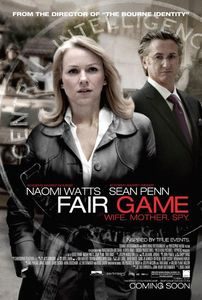
  • Fair Game (2010)

    Fair Game (2010)

    (In theaters, December 2010) One of the most unfortunate consequences of the neo-conservative fumbling in Iraq is that, for years to come, they will have to endure I-told-you-so reminders from liberals who were dead-set against the invasion in the first place.  So it is that Fair Game is a politically engaged re-telling of the events surrounding the White House’s public outing of CIA Valerie Plame in retaliation for her husband’s public dissent on whether Iraq had weapons of mass destruction.  The story will be most familiar to those who have paid attention during the Bush administration, but the film does a fair job at contextualizing the issues in a way that should be accessible to those for whom this is a new story.  Righteously angry and not shy about letting some of this anger show, Fair Game is fodder for left-wing moviegoers in much the same way that Green Zone was.  (Extra trivia point for those who remember that Fair Game director Doug Liman directed the first Jason Bourne movie, after which the series was taken over by Green Zone’s Paul Greengrass.)  Shot docufiction-style with a camera that jerks around even in conversation scenes when it doesn’t need to, Fair Game is most fascinating when it offers a deglamourized portrait of real-world intelligence and the way partisan politics bandwagons can destroy people’s lives.  As for the rest, well, the film needs to be taken with a grain of salt, given the usual Hollywood dramatizations to make it all feel more interesting.  Sean Penn continues to prove that he’s becoming a more interesting actor with time, but it’s Naomi Watts who shines as Plame, a rare multi-faceted female character balancing work and family life.  While praise for the film is likely to cut along partisan lines, Fair Game itself is a fine piece of work, suspenseful while reasonably realistic.  It’s a deft dramatization of complex events, and despite a bit of a late-film lull, it achieves what it wants to do.